Food Plot Fertilizer Calculator
Estimate nitrogen, phosphate, potash, fertilizer blend pounds, bag count, and split application rates for clover, brassica, cereal grain, corn, soybean, and mixed wildlife food plots.
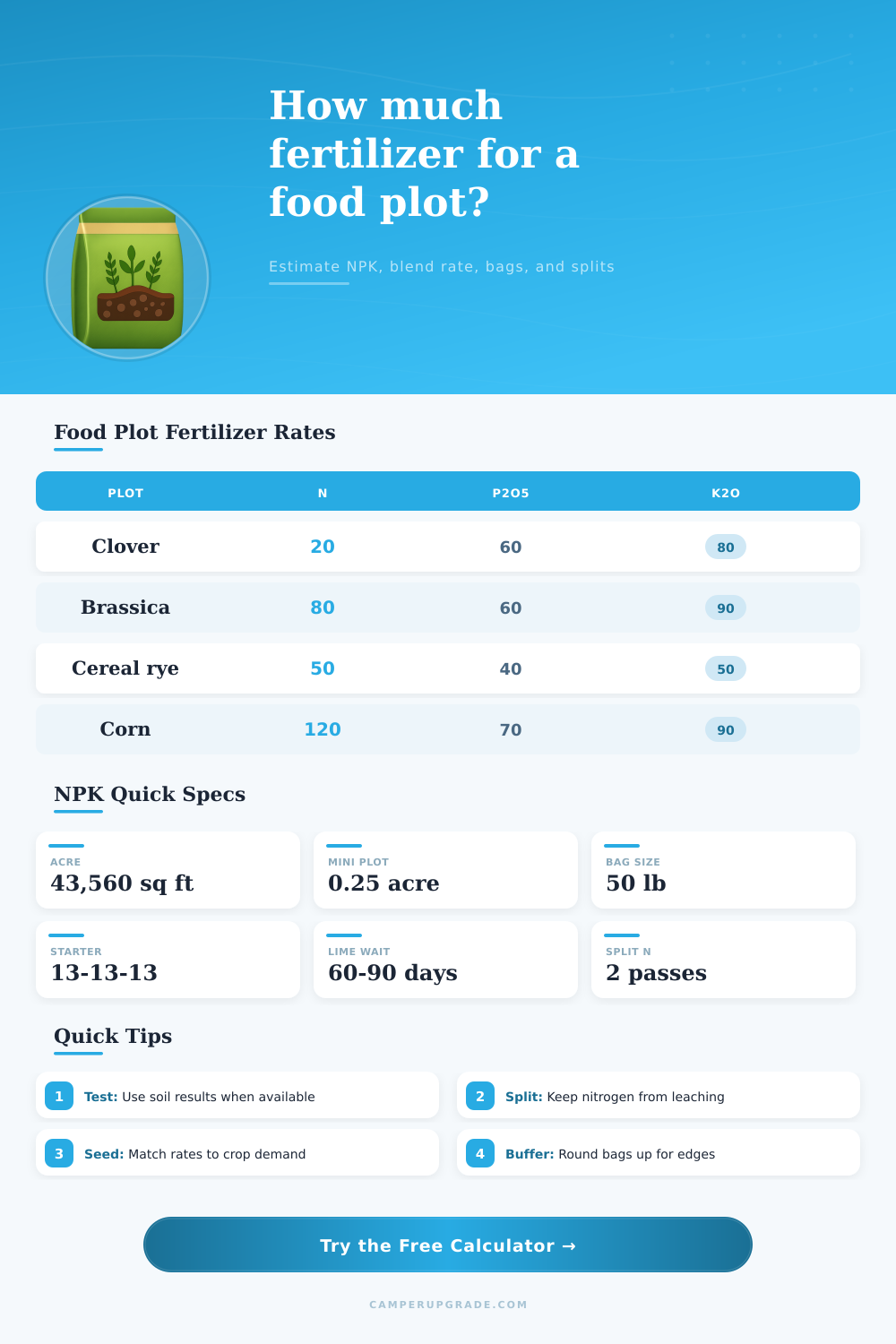
| Food plot crop | N lb/ac | P2O5 lb/ac | K2O lb/ac |
|---|---|---|---|
| Clover or alfalfa | 0-30 | 50-80 | 70-120 |
| Brassica mix | 70-100 | 50-70 | 80-110 |
| Cereal rye or wheat | 40-70 | 30-60 | 40-70 |
| Oats and peas | 40-60 | 40-60 | 50-80 |
| Corn or sorghum | 100-140 | 60-90 | 70-120 |
| Fertilizer blend | N per 100 lb | P2O5 per 100 lb | K2O per 100 lb |
|---|---|---|---|
| 10-10-10 | 10 lb | 10 lb | 10 lb |
| 13-13-13 | 13 lb | 13 lb | 13 lb |
| 19-0-19 | 19 lb | 0 lb | 19 lb |
| 34-0-0 | 34 lb | 0 lb | 0 lb |
| 18-46-0 | 18 lb | 46 lb | 0 lb |
| Plot size | Square feet | 200 lb/ac | 400 lb/ac |
|---|---|---|---|
| One-eighth acre | 5,445 | 25 lb | 50 lb |
| Quarter acre | 10,890 | 50 lb | 100 lb |
| Half acre | 21,780 | 100 lb | 200 lb |
| One acre | 43,560 | 200 lb | 400 lb |
| Two acres | 87,120 | 400 lb | 800 lb |
| Application style | Efficiency | Best fit | Rate note |
|---|---|---|---|
| Calibrated spreader | 95-100% | Open plots | Use normal rate |
| ATV broadcast | 88-95% | Half acre plus | Add small buffer |
| Hand crank | 78-88% | Remote plots | Walk crosswise |
| Rough seedbed | 75-90% | New woods plot | Expect overlap |
| Split nitrogen | 2-3 passes | Annual crops | Delay topdress |
Use local soil-test recommendations when available. This calculator converts food plot targets and fertilizer label percentages into practical field rates, but lime, pH, and nutrient credits can change the final recommendation.
To determine the amount of fertilizer that a food plot will require, a person must consider the fertilizer requirement of each type of crop. For instance, clover and other legume plants contain the ability to fix there own nitrogen, so the fertilized requirements of these plants will include an fertilizer containing phosphate and potash. Brassica crops, such as radishes and mustards, require a high amount of nitrogen in its soil to support their growth of leafy plants.
Similarly, crops like corn and sorghum require high amounts of nitrogen, but also provide requirements of steady amounts of phosphorus and potassium to support the stalk growth and grain production of these crops. Finally, cereal grains require only a moderate amount of fertilizer to support there growth. Each of these different requirements for the different types of crops determines the amount of fertilizer that will be ordered for each crop, as well as the requirements of the fertilizer blend.
How to Calculate Fertilizer for a Food Plot
Another factor in determining the amount of fertilizer for a food plot is the condition of the soil. Food plots that are cropped for many years often contain low levels of the nutrients phosphorus and potassium. In contrast, land that has been cleared from woods often contains soil that is deficient in nutrients, so those plots require extra amount of phosphorus and potassium to be added to the soil.
Finally, plots that are regularly treated with fertilizer will typically contain high levels of nutrients in the soil, so these plots will require only maintenance rates of fertilizer to be applied to those fields. Both of these factors can be adjusted in the fertilizer calculator. A third factor that a person must consider is the type of fertilizer analysis that will be used for the food plot.
One of the most common fertilizers is a “balanced” fertilizer with an analysis of 13-13-13, meaning that it contains 13% nitrogen, 13% phosphate, and 13% potash. High amounts of nitrogen, such as in a 34-0-0 fertilizer, may be used for top-dressing of established stands of plants. Finally, if soil tests reveal a deficiency of only either potash or DAP (di-ammonium phosphate), then those fertilizers may be used to address the nutritional needs of the food plot.
Each of these options is adjustable within the fertilizer calculator. The choice of fertilizer analysis is important; choosing an analysis that contains too much of one nutrient relative to the other nutrients can lead to wasteful expenditures on fertilizer. Application efficiency can also be factored into the calculation of the amount of fertilizer to order for a food plot.
Factors that may contribute to reduced efficiency include overlap of fertilizer applications, the effect of wind, and the difference between a calibrated fertilizer spreader and hand-crank spreaders. Using a lower percentage for application efficiency will lead to increasing the amount of fertilizer that is ordered to ensure that the food plot still receives the desired amount of fertilizer. Failure to account for application efficiency may lead to underapplying fertilizer to the food plot.
It is also possible to split the application of nitrogen within the fertilizer. In soils that are sandy in composition, or in fields that will be establishing fast-growing plants, nitrogen will be lost quick through leaching out of the soil. If nitrogen is placed into the soil at the time of planting, the plants may become deficient in nitrogen later in their growth period.
Applying nitrogen in two or three passes instead of one will ensure that the nitrogen remains in the soil and the established plants can utilize it. The amount of nitrogen that should be applied in each pass can be seen in the fertilizer calculator. Although lime is not part of fertilizer math, lime can still impact the amount of fertilizer that is produced by the food plot.
Most food plot crops grow best in soil that has a pH between 6.0 and 6.8. If the pH is too low (acidic soil), the fertilizer will not develop the crops that are expected from the food plot until the pH is corrected using lime. Because lime takes many months to react with the soil to even slightly change the soil pH, liming the soil prior to fertilizing it will ensure that the fertilizer produces the crops that is targeted for the food plot.
The shape of the food plot may make it difficult to calculate the area of that food plot. Many food plots contain edges that may encounter trees, or slopes in the fields that may change the way that the land drains. These factors can contribute to the actual area that is fertilized by the plots.
A measuring wheel or pacing the field to calculate the perimeter will help in determining the acreage of the food plot. The fertilizer calculator allows for length and width to be entered to calculate the area of an irregular plot. The reference tables on this fertilizer calculator contain information regarding the nutrients that are typically found in food plots with each type of crop, as well as the nutrients that are contained within each type of fertilizer blend.
These tables are not a replacement for local recommendations for fertilizer use, but they do allow individuals to determine whether the fertilizer calculator results are within normal ranges for crops. If the results are outside of the normal ranges, the settings for crop type or soil level may need to be adjusted. A successful food plot will ensure that the soil contains the nutrients that the crops need at the correct times during their growing period.
By considering each of these factors, a person can use the fertilizer calculator to determine the amount of fertilizer that will best suit their food plot establishment.