Trailer Ramp Length Calculator
Size trailer loading ramps from deck height, target ramp angle, ground slope, equipment wheelbase, underbody clearance, equipment weight, ramp count, and ramp load rating before loading a mower, ATV, side-by-side, motorcycle, compact tractor, or low car.
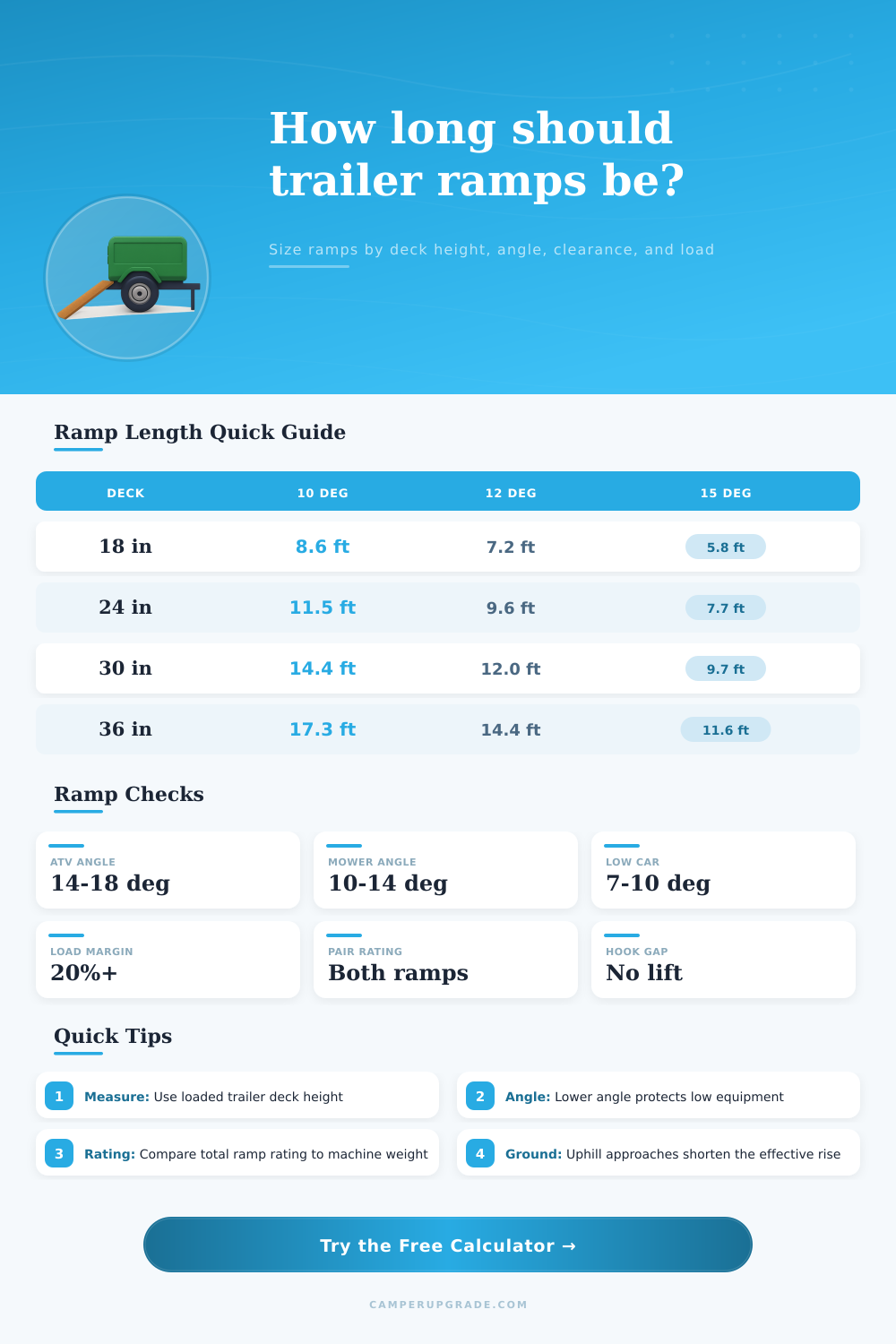
| Deck height | 10 deg ramp | 12 deg ramp | 15 deg ramp |
|---|---|---|---|
| 16 in | 7.7 ft | 6.4 ft | 5.2 ft |
| 20 in | 9.6 ft | 8.0 ft | 6.4 ft |
| 24 in | 11.5 ft | 9.6 ft | 7.7 ft |
| 30 in | 14.4 ft | 12.0 ft | 9.7 ft |
| 36 in | 17.3 ft | 14.4 ft | 11.6 ft |
| Equipment | Typical angle | Clearance concern | Ramp note |
|---|---|---|---|
| Zero-turn mower | 10-14 deg | Mower deck shell | Use long ramps or a beavertail |
| ATV | 14-18 deg | Foot boards and hitch | Check tire track spacing |
| Side-by-side | 12-16 deg | Skid plate midpoint | Use wide, high-rated ramps |
| Motorcycle | 8-12 deg | Pegs and exhaust | Add a center walk board |
| Low car | 7-10 deg | Splitter and rocker | Often needs extensions |
| Load check | Meaning | Planning action | Risk clue |
|---|---|---|---|
| 50%+ reserve | Comfortable | Verify attachment and spacing | Still avoid bouncing |
| 20-50% reserve | Usable planning zone | Load straight and slow | Off-center loading matters |
| 0-20% reserve | Tight | Choose stronger ramps | One tire can overload a ramp |
| Negative reserve | Over rating | Do not use that ramp setup | Bending or kick-out risk |
| Ground setup | Effect on ramp | When helpful | Watch point |
|---|---|---|---|
| Uphill toward trailer | Reduces effective rise | Shorter ramps may work | Trailer brakes and chocks |
| Flat pavement | Baseline calculation | Best repeatable measuring | Ramp feet must sit flat |
| Downhill away | Increases effective rise | Usually avoid if possible | Longer ramp needed |
| Soft ground | Feet may sink | Use pads under ramp feet | Angle can steepen suddenly |
Loading a mower or an ATV onto a trailers requires the consideration of a specific ramp lengths. The length of the ramp will determine the steepness of the ramp that must be utilize to load the mower or ATV. If the ramp that is utilize is too short for the height of the trailer, the ramp will be too steeply for the trailer, and the mower or ATV may scrape the trailer or become toppled while being load onto the trailer.
The height of the trailer deck is the distance between the ground and the trailer itself. The height of the trailer deck may vary depending upon the inflation pressure of the trailers tires, as well as the amount of weight that are sitting upon the trailer tongue. The ramp length calculator require three different measurements to calculate the proper length of ramp for the trailer and the machine that is to be load onto the trailer.
How to Choose the Right Ramp Length for a Mower or ATV
You need the height of the trailer deck to load the trailer, the desired ramp angle is required to determine the length of the ramp, and the ground clearance of the machine is required to ensure that the middle of the machine does not scrape the ramp when being load onto the trailer. The height of the trailer deck should be measured once the trailer is hitched to the towing vehicle, as the height of the trailer deck can change based off the hitching of the trailer to the towing vehicle. A ramp that is too steep will be a ramp that is too short to load the machine onto the trailer, as both of these objects will be difficult to store within the trailer.
However, a steep ramp will increase the likelihood of the machine scrape the trailer. Alternatively, a gentle ramp will require the ramp to be longer to store the trailer, but it will allow for the machine to remain flat and avoid any scraping of the trailer. The slope of the ground where the trailer will be loaded can impact the height of the trailer that must be crossed by the machine.
If the ground slope towards the trailer, the height difference between the trailer and the ground will be less. If the ground slopes away from the trailer, the difference between the height of the trailer and the ground will be more. It is important for the ramp length calculator to account for the slope of the ground at the location where the trailer will be loaded, to provide an accurate calculation of the length of ramp necessary for the trailer and the machine.
The weight of the machine to be load onto the trailer must not exceed the weight that is rated for the ramp. The weight rating for the ramp is typically the rating for each ramp individually, but the machine may not evenly distribute its weight to the two ramps. The ramp length calculator accounts for the weight of the machine by utilizing the worst case scenario for the distribution of the machines weight to the ramp.
This ensures that the ramps will be strong enough to handle the machine. If the weight of the machine is more than the weight that is rated for the ramp, the ramp may bend while the machine is loading onto the trailer, posing a safety risk for those utilizing the trailer and ramp. The ground clearance and wheelbase of the machine will determine the ramp’s breakover point.
The breakover point is the point at which the middle of the machine is the lowest point of the machine. As the machine is load onto the trailer, the front of the machine will begin to rise, but the rear of the machine will remain lower to the ground for some distance. A buffer for the tire squat of the machines wheel and the grounds evenness is necessary to ensure that the machine will not scrape the trailer.
Many individual will attempt to use the ramps that they already own. It is, however, more effective to utilize the ramp length calculator to determine the length of ramp that is required before purchasing new ramps. Before attempting to load the trailer and machine, enter the height of the trailer deck and the dimensions of the machine into the calculator.
According to the calculator, the length of ramp that will be required for the machine. If the length of ramp required by the calculator is greater than the length of ramps that you own, you will need to acquire ramps of that length before beginning to load the trailer. The type of machine that will be load onto the trailer will impact the length of ramp that is required.
For instance, a zero turn mower will have different dimensions than a motorcycle. A machine with a long wheelbase will require a longer ramp than a machine with a short wheelbase. Additionally, a machine with a low ground clearance will require a longer ramp than a machine with a high ground clearance.
These dimensions can be entered into the calculator to determine the length of ramp necessary for each of these different types of machines. Once the length of ramp is determined, you must secure the ramps to the trailer, as well as the trailer’s wheel should be choked to prevent the trailer from rolling away from the ramps.