Trailer Tire Pressure Calculator
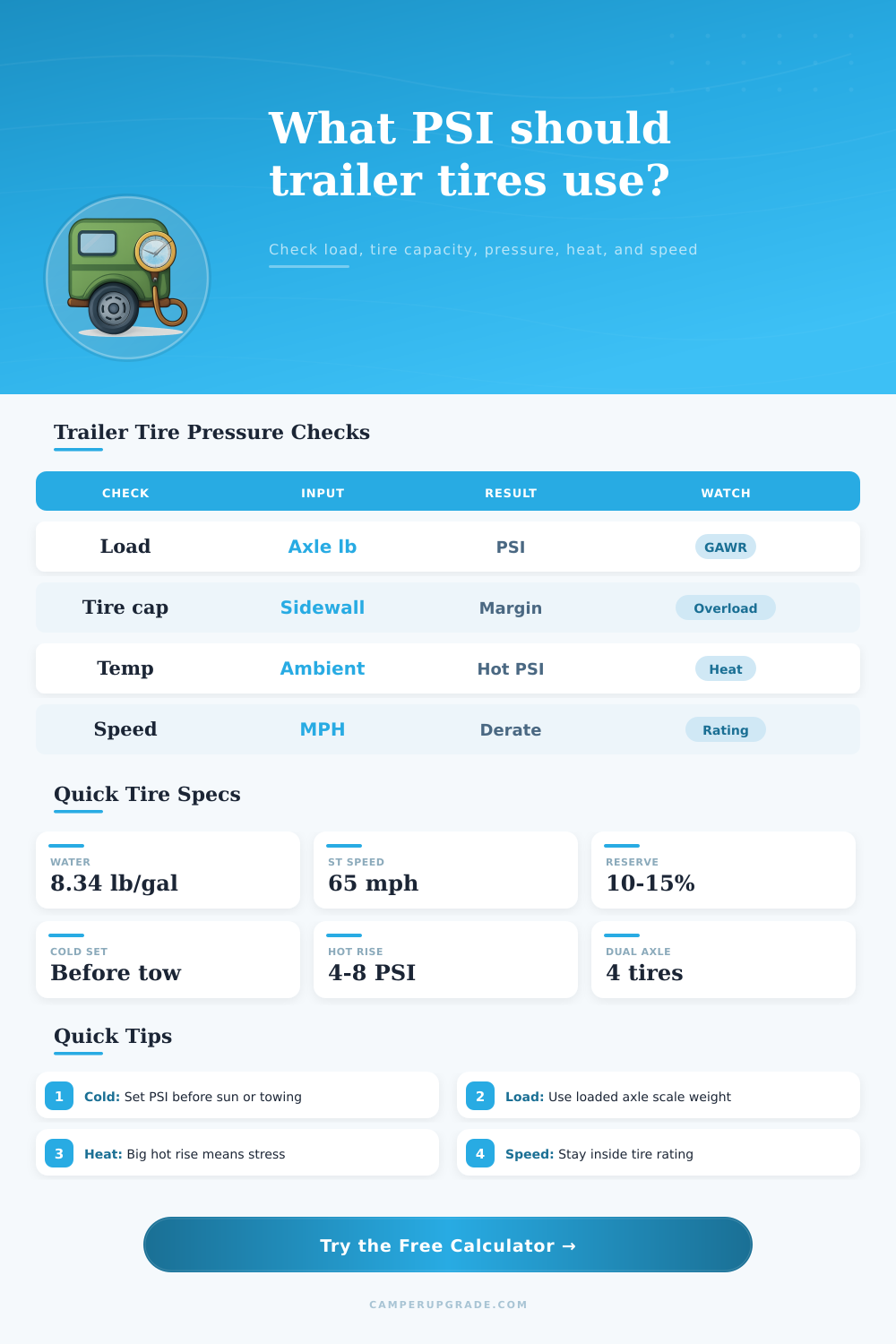
Estimate trailer cold tire pressure from loaded axle weight, tire count, rated sidewall pressure, tire load capacity, current PSI, ambient temperature, expected running temperature, speed, and reserve margin.
| Example tire | Sidewall PSI | Max load | 85% load |
|---|---|---|---|
| ST175/80R13 C | 50 PSI | 1360 lb | 1156 lb |
| ST205/75R14 C | 50 PSI | 1760 lb | 1496 lb |
| ST205/75R15 D | 65 PSI | 2150 lb | 1828 lb |
| ST225/75R15 E | 80 PSI | 2830 lb | 2406 lb |
| ST235/80R16 E | 80 PSI | 3520 lb | 2992 lb |
| Load use | What it means | Pressure action | Watch |
|---|---|---|---|
| Under 70% | Lightly loaded | Use placard or calculated PSI | Uneven wear if too hard |
| 70-85% | Normal travel load | Good margin with reserve | Check cold before trip |
| 85-95% | Working hard | Set near rated PSI | Heat and speed |
| 95-100% | Very little margin | Use rated PSI | Scale each axle |
| Over 100% | Over capacity | Reduce load or upgrade tire | Do not tow |
| Cold to hot change | Approx rise | Meaning | Use |
|---|---|---|---|
| 40°F to 90°F | About 5 PSI | Normal expansion | Do not bleed hot |
| 60°F to 120°F | About 7 PSI | Common highway rise | Compare tires side to side |
| 80°F to 150°F | About 8 PSI | Hot weather stress | Slow down if rising fast |
| Below freezing start | Lower cold PSI | Set before towing | Add air when cold |
| Speed band | Planning rule | Load effect | Check first |
|---|---|---|---|
| Up to 65 mph | Common ST baseline | No calculator derate | Cold PSI |
| 66-75 mph | Use rated tire data | Small heat penalty | Speed symbol |
| 76-81 mph | Only if tire allows | Margin shrinks | Load reserve |
| Over rating | Outside tire limit | Flagged unsafe | Reduce speed |
This tool estimates a cold pressure from load ratio. Always compare with the trailer placard, tire maker load-inflation table, wheel pressure rating, valve stem rating, and real scale weights.
Trailer tire pressures is responsible for the way that a trip can feel. Because trailer tire pressure can change, they requires regular checks of the tire pressure. Many individuals will set the trailer tire pressure once when the trailer towable is new.
However, the trailer tire pressure will change due to both the change in the load of the trailer and the change in the temperature of the trailer. Thus, the driver must check trailer tire pressure to ensure that it is set to match the load of the trailer that is being towed. The trailer tire pressure calculator require several different inputs from the trailer driver.
How to Check and Set Trailer Tire Pressure
One of the most important of these inputs is the axle weight of the trailer. This is the weight that the hitch provides by the tongue weight of the towing vehicle. Using the total weight of the trailer as the input will lead to an overestimation of the weight that the trailer tire must support.
Additionally, another feature that the calculator provides is a reserve percentage. This percentage provide a safety margin for the load of the trailer, as loads are often not even and the road isnt smoothly. The rated tire pressure of the trailer tires can determine the tire capacity of the trailer tires.
The tire capacity is used to establish the maximum load of the trailer tires. In addition to the maximum load, a speed factor is applied to the calculated tire pressure. The reason for this is that the faster the trailer is traveling, the more heat the trailer tires create.
This heat will reduce the amount of load that the trailer tire can take. The tire pressure calculator will not recommend a pressure for the trailer tires that is above the pressure that is rated for the trailer tires. The temperature of the trailer will impact the pressure of the trailer tires.
More specifically, you should set the cold tire pressure of the trailer for the trailer tires. When the trailer begins to roll, the air in the tires will expand. This will create an increase in the air pressure within the trailer tires.
However, this hot tire pressure should not be used as the tire pressure that is set for the trailer tires. If one set of trailer tires exhibits a faster rate of increasing pressure than the other trailer tires, this could indicate an issue with the alignment or balance of that trailer tire. The tire pressure calculator will estimate the hot pressure of the trailer tires to allow the trailer driver to have a reference point for the hot pressure of the trailer tires prior to beginning there trip.
Another feature that trailer drivers often overlook is the reserve percentage. A reserve percentage of 10 or 15% means that the trailer will not be running the trailer tires at the limit that they are capable of taking when the trailer is loaded. The margin provides additional ability for the trailer to manage the heat created by the trailer tires while also providing extra room in case the trailer experiences a load imbalance.
There are several mistakes that many trailer tire drivers make when adjusting the pressure of the trailer tires. For instance, many individuals will set the trailer tire pressure to the number that is on the trailer placard. However, the placard may not accurately represent the tire pressure of the trailer tires that are in use on the trailer.
Additionally, some individuals may measure the trailer tire pressure after they have loaded the trailer into the sun. As a result, the individuals will bleed the air out of the tires, leading to underinflated trailer tires when they are at its normal operating temperature. Finally, individuals may assume that each of the trailer tires on a tandem axle are the same.
However, the placement of the trailers batteries or other loads may cause one side of the trailer to have a higher load than the other. Each of the factors that impact the tire pressure of the trailer can change during the trip. For instance, if the trailer has been sitting idle for many weeks, the air will have permeated through the trailer tires.
Additionally, if the trailer tires are exposed to the sun, they will exhibit a higher pressure reading than trailer tires that are sitting in the shade. Finally, changes in elevation will change the temperature in the trailer, which will impact the trailer tire pressure. These factors will not be ignored by the trailer tire pressure calculator, but the driver should not ignored them, as well.
The reference tables that are provided with the trailer tire pressure calculator provide information regarding different load ranges and temperature impacts. These reference tables are not rules, but they do provide context for the individual trailer driver regarding their specific setup and trailer. If the calculated tire pressure is near the maximum load for the trailer tires, the reference tables will provide information regarding the impact of heat on the speed at which the trailer is traveling.
Additionally, if the calculated tire pressure for the trailer is low, the reference tables will exhibit the margin of error that the trailer driver has with the trailer tire load. In order to properly adjust the trailer tires to account for the load of the trailer, the trailer driver should take the time to measure the cold tire pressure of each trailer tire. This reading should be compared to the number that the trailer tire pressure calculator calculated.
If the trailer tire pressure is not correct according to the calculation, it should be adjusted. Additionally, this measurement should be performed after the first long trip with the trailer. The difference in trailer tire pressure between the two sides of the trailer will indicate whether there is an issue in the trailer.
The calculated trailer tire pressure should of been revisited should the individual get new trailer tires, change the load of the trailer, or change driving climates.