Trailer Axle Placement Calculator
Estimate where the axle or axle group centerline should sit from the coupler by combining trailer length, loaded center of gravity, tongue weight target, axle capacity, frame style, and cargo placement.
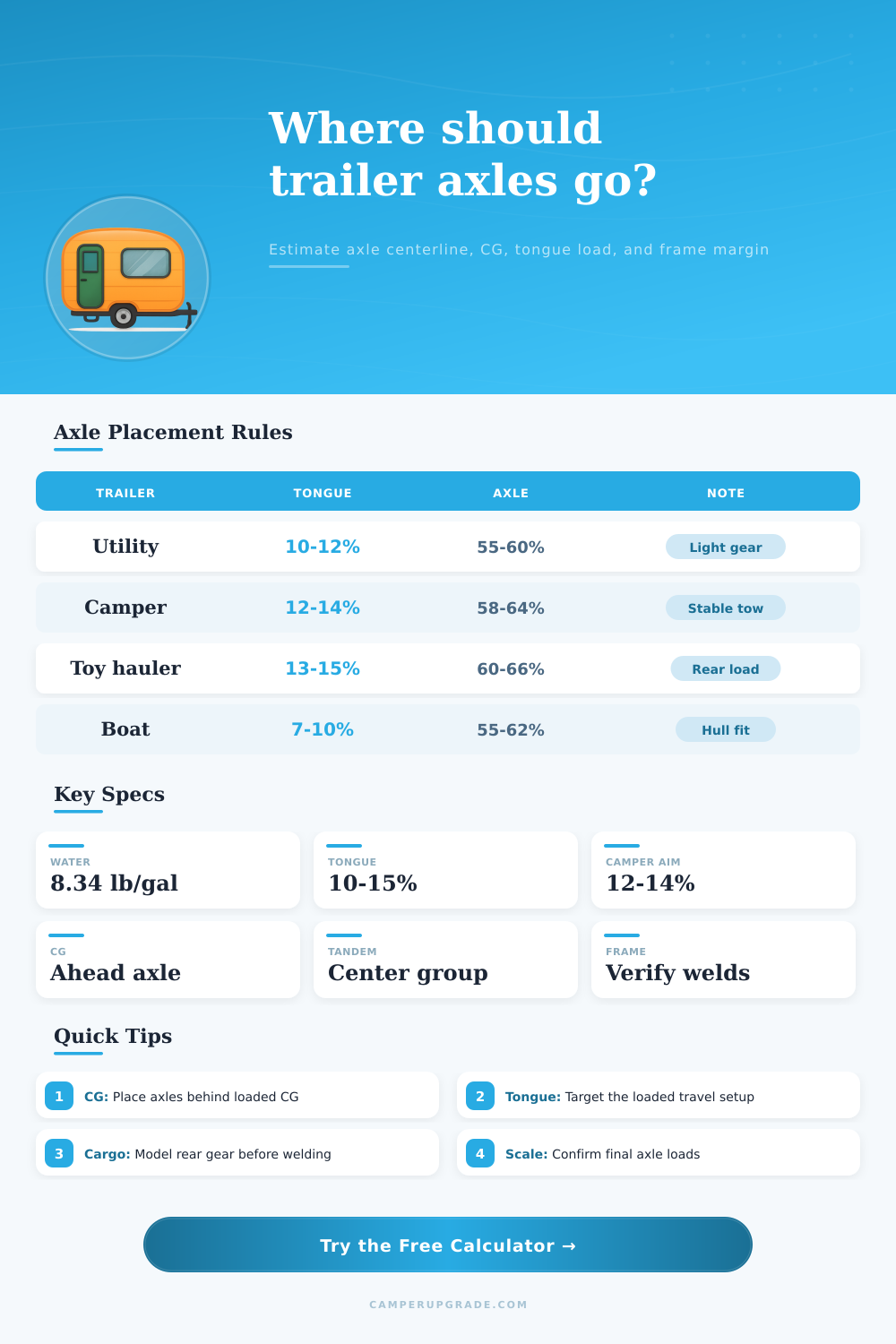
| Trailer type | Target tongue | Axle tendency | Watch point |
|---|---|---|---|
| Light utility | 10% to 12% | Moderate rearward | Cargo can vary widely |
| Travel camper | 12% to 14% | Behind loaded CG | Water tank position |
| Toy hauler | 13% to 15% | Further rearward empty | Rear toy unload shift |
| Boat trailer | 7% to 10% | Hull support first | Ramp and transom weight |
| Body length | Common axle from front wall | Use case | Check |
|---|---|---|---|
| 8 to 10 ft | 5.0 to 6.2 ft | Teardrop or small utility | Galley leverage |
| 12 to 14 ft | 7.2 to 8.8 ft | Cargo or pop-up | Front storage |
| 16 to 18 ft | 9.6 to 11.6 ft | Small camper | Tandem center |
| 20 to 24 ft | 12.5 to 15.5 ft | Bunkhouse camper | Rear bunks and tanks |
| Axle setup | Report line | Placement note | Frame item |
|---|---|---|---|
| Single | One spindle line | Place at calculated center | Hanger square and level |
| Tandem | Group midpoint | Split spacing around center | Equalizer clearance |
| Triple | Middle axle line | Middle axle on center | Suspension travel |
| Torsion pair | Group midpoint | Use maker bracket spec | Start angle and camber |
| Result | Likely cause | Adjustment | Recheck |
|---|---|---|---|
| Low tongue % | Axle too far forward | Move axle rearward or cargo forward | Sway risk |
| High tongue % | Axle too far rearward | Move axle forward or cargo rearward | Payload limit |
| GAWR tight | Loaded trailer heavy | Increase axle rating or reduce load | Tires and springs |
| Rear overhang high | Axle too far forward | Check frame bending and departure | Tail swing |
Axle placement is a critical part of the building of a trailer or the modification of an existing trailer. The placement of the axle will have a major impact upon the stability of the trailer when being towed. If the axle placement isnt correct, the trailer may tend to sway.
Swaying trailers are generally not easy to control when being towed. The placement of the trailer’s weight upon the coupler, the weight upon the trailer tires, and the tracking of the trailer behind the towing vehicle will all change with the change in the placement of the trailer axles. Consequently, many trailer builders will model the loaded center of gravity of the trailer prior to cutting or welding parts of the trailer frame.
Where to Put Trailer Axles
The calculator provided here uses a variety of variable to calculate the recommended placement of the trailer axles. The variables that must be entered into the calculator are the length of the trailer, the weight and position of the trailers cargo and tanks, the weight of the trailer while it is empty, and the desired percentage of tongue weight. Each of these parameters are necessary for calculating the balance of the trailer while it is being towed.
For instance, if a trailer owner wishes to add a larger fresh water tank to there trailer, the calculated placement of the trailer axles will change as a result of the change in the loaded center of gravity of the trailer. Not all trailer types has the same axles placement requirements. For instance, utility trailers are required to have a certain degree of placement margins established for the trailer because there cargo can be variable.
Small trailers that is used as camping trailers may have a galley in the front of the trailer, which requires a higher percentage of tongue weight to ensure that the trailer does not feel as if it has too little weight on its front end when the water and cooking tanks is filled with water and propane. Other trailers, such as toy haulers, may have a significant amount of weight on the trailer when it is transporting an ATV, but that trailer may become nose light when the ATV is removed from the trailer. Boat trailers, in contrast, may have different tongue weight targets due to the nature of boat trailers and trailer ramps.
The table included on this page includes common weights for each type of trailer. The table isnt a rulebook for trailers, but it does provide a starting point for trailer builders. More experienced trailer builders may have a preferred weight range for each type of trailer, but the table can be used to ensure that first-time trailer builders dont go outside of the range of weights that are considered normal for each trailer type.
Similar to the information regarding axle placement, the trailer builder will also require some planning for the layout of the axle groups. If a trailer has only one axle, the placement of that axle is relatively simple. However, trailers that have tandem or triple axles will require the calculated center of gravity to be placed in the center of those axle groups to even out the loading of the trailer.
Additionally, each axle group has a limited range of motion relative to the trailer. Consequently, the axles must be placed in such a way that provides for the range of motion of each axle group’s springs and torsion arms. When calculating axle placement and groups, trailer builders should ensure that the trailer is not being calculated as if it is empty of any contents.
Even though the empty trailer has a calculable center of gravity, trailers are typically towed while they are loaded with water, propane, batteries, and camping gear. Each of these items can shift the loaded center of gravity of the trailer by several feet. As such, a trailer builder can use the provided trailer calculator to model each of these loads individually to determine how the placement of the trailer axles will change with the addition of the items listed.
Another consideration for trailer builders is the need to consider the frame strength of the trailer. While the trailer axle calculator does not capture trailer frame strength, a strength margin must be established for the trailer design. The reserve load for the trailer frame must be a value that exceeds the loaded weight of the trailer.
This extra load allows for additional trailer loads, such as a spare tire. Additionally, this load allows trailer designers to account for potential extra loading of items like roof racks. If this value is negative or very small, then either the trailer axle rating must be increased for the trailer, or the load that the trailer is to carry must be reduced.
This value provides trailer designers with an estimate of whether the trailer has sufficient margin to account for any potential changes in the load. After the trailer axle placement has been calculated, it is necessary to perform some checks on the trailer to ensure that the axle placement remains correct. An actual calculation cannot account for the physical details of the trailer being built.
Consequently, trailer designers often will tow the trailer, and the trailer will be loaded with the same items that are to be transported. A trailer scale can be used to determine the actual tongue weight that is produced by the trailer, as well as the loads upon each axle. If the weights that are measured with the trailer scale are similar to those that were calculated with the trailer axle calculator, then the trailer has an appropriate axle placement.
However, if the actual loads differ significantly from the calculated loads, it is likely that the placement of some of the trailers cargo or tanks is different than that modeled in the trailer calculator. Axle placement for trailers also impacts a few other aspects of trailer design. For instance, the placement of the trailer axles will have an impact upon the placement of other trailer components.
For instance, the placement of the axles will impact the placement of fender clearances, other routing components, and the placement of steps for trailer access. Thus, prior to the trailer being fully designed, there should be a sketch of the major components of the trailer to ensure that there is enough space for the axles to be placed in their calculated position. The main goal of calculating the placement of the trailer axles is to create a trailer layout that ensures that the loaded center of gravity of the trailer is located ahead of the axle.
Additionally, the tongue weight should be within a stable range, and there should be enough margin for the loaded weight of the trailer so that it does not have to be redesigned based upon the loading of any items. Thus, the trailer axle calculator will handle the mathematics for the trailer designer to determine if the layout of the trailer design is meeting the needs of the trailer. Once the layout looks good to the trailer designer, the trailer will be tested on the road to ensure that the axle placement is indeed correct.