Trailer Brake Gain Calculator
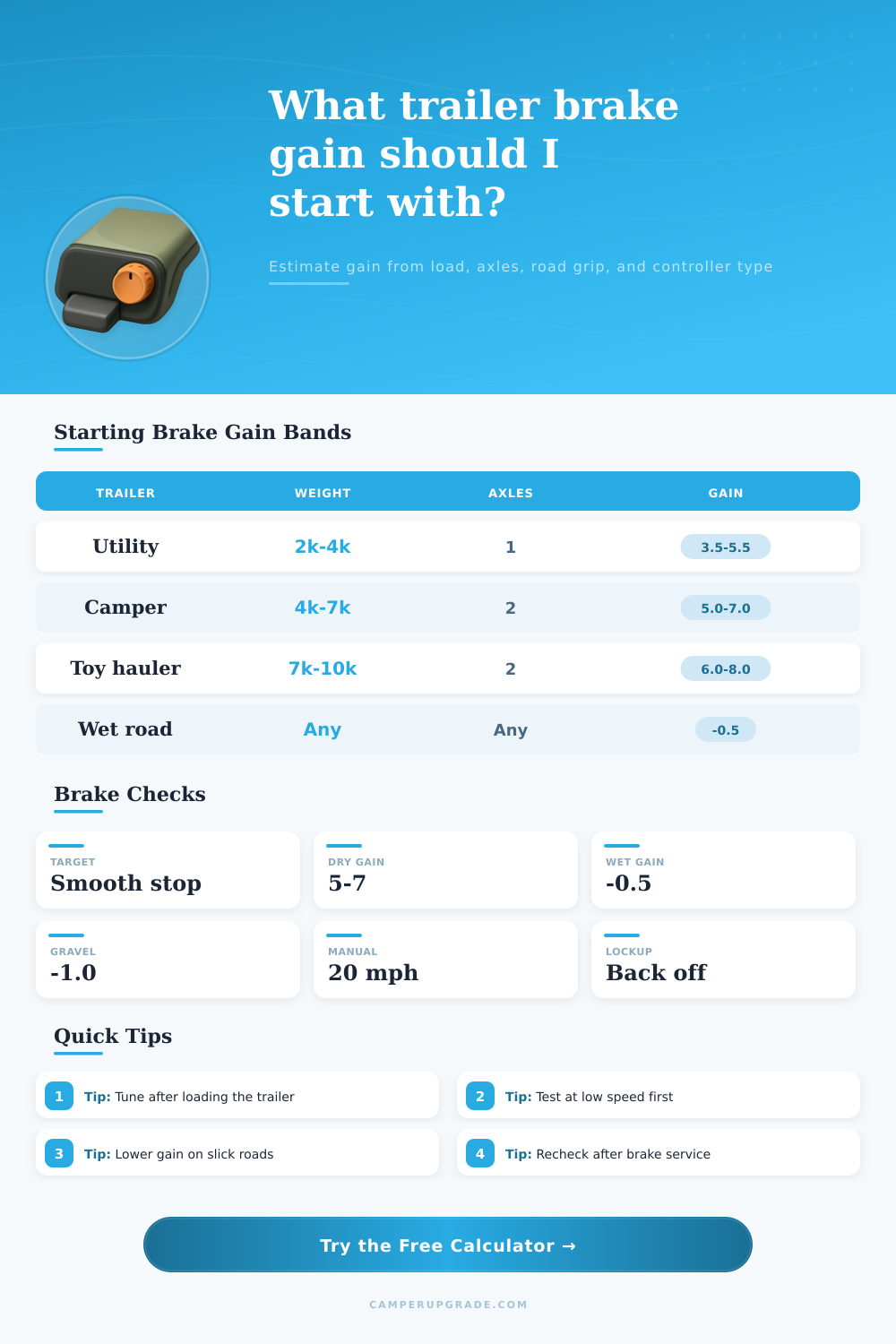
Estimate a sensible starting brake controller gain from loaded trailer weight, brake axle count, road surface, loaded ratio, controller style, trailer brake type, and tow vehicle braking preference.
| Loaded trailer | Brake axles | Starting gain | Road-test note |
|---|---|---|---|
| 1500-3000 lb utility | 1 | 3.0-4.8 | Manual lever should tug, not jerk. |
| 3000-5000 lb camper | 1 | 4.3-5.9 | Watch for early lockup on empty tires. |
| 4500-7000 lb travel trailer | 2 | 5.2-6.8 | Common balanced range for electric drums. |
| 7000-10000 lb toy hauler | 2 | 6.0-7.8 | Check rear cargo because tongue share changes. |
| 10000-14000 lb equipment trailer | 2-3 | 6.8-8.5 | Confirm axle and tire traction before raising gain. |
| Surface | Grip effect | Gain adjustment | Testing cue |
|---|---|---|---|
| Dry pavement | Normal traction | Use base estimate | Brake from 20-25 mph on level ground. |
| Wet pavement | Reduced tire grip | Subtract 0.3-0.7 | Stop should stay straight with no chatter. |
| Gravel road | Loose surface | Subtract 0.8-1.3 | Wheels should not skid during manual lever test. |
| Snow or ice | Very low grip | Subtract 1.2-2.0 | Use the lowest gain that keeps the rig settled. |
| Long downhill | Heat buildup | Add 0.2 only if stable | Use lower gear; gain cannot replace engine braking. |
| Controller or brake | Typical behavior | Start adjustment | What to verify |
|---|---|---|---|
| Proportional controller | Output follows deceleration | Base estimate | Trailer contributes smoothly as pedal pressure rises. |
| Time-delay controller | Output ramps by time | Subtract 0.2 | Avoid harsh delayed braking in slow traffic. |
| Integrated factory controller | Blends with truck systems | Subtract 0.1 | Use the truck manual for mode-specific behavior. |
| Electric drum brakes | Common RV setup | Base estimate | Adjust shoes and inspect magnets before tuning. |
| EOH disc brakes | Fast hydraulic response | Subtract 0.6 | Confirm controller compatibility with actuator. |
| Loaded ratio | Trailer condition | Brake demand | Gain note |
|---|---|---|---|
| Under 50% | Very lightly loaded | Low | Start lower and watch for wheel lockup. |
| 50-70% | Moderate camping load | Medium | Use normal estimate and test at low speed. |
| 70-85% | Typical loaded RV | Medium-high | Most rigs land near the middle of the table. |
| 85-95% | Heavy loaded trailer | High | Raise gain only if tires stay below lockup. |
| Over 95% | Near GVWR | Very high | Verify scale weight, tire rating, and brake service. |
Trailer brakes are an essential part of tow trailers. The trailer brakes must be adjusted to ensure that the trailer and tow vehicle stop at the same times. The gain setting for trailer brake controllers show the number that determine the amount of power the trailer brakes will have when the driver presses the brake pedal of the tow vehicle.
If the gain setting is too low, the tow vehicle will have to perform all of the braking for the trailer, which can overheat the tow vehicle’s brakes and cause it to take longer to stop. On the other hand, if the gain is set too high, the trailer’s wheels can lock before the tow vehicle does, which could make the trailer skid or sway. A trailer brake calculator help the trailer tow driver to determine the gain setting the trailer brakes should start at.
How to Set Trailer Brakes Correctly
This tool require the driver to input the loaded trailer’s weight, the Gross Vehicle Weight Rating (GVWR) of the trailer, the number of brake axles on the trailer, and the type of road surface the trailer will be on. The trailer’s loaded weight and the number of axles will have an impact on the required gain setting. For instance, a trailer that weigh 6,200 pounds with two axles will require a different gain setting then a trailer that weighs 9,000 pounds with two axles.
The type of cargo and it’s distribution within the trailer also impact the trailer brakes. A trailer that is loaded in a way that put its weight towards the front will behave differently from one that has its load towards the back. Furthermore, the trailer brake calculator takes into account the weight that is distribute on each brake axle.
The type of road the trailer will be on will also impact the gain setting. If the trailer’s tires has less grip on the road because the road is wet, gravelly, or snowy, the trailer’s wheels may lock more easily. For this reason, the trailer brake calculator will automatically reduce the gain setting when gravel or wet pavement is select as the trailer’s road surface.
Many trailer brake controller gain settings are set for dry road condition. Therefore, the gain setting may end up too high when the road surface becomes wet. The type of trailer brakes and the controller style can also impact the gain setting.
If the trailer features electric-over-hydraulic disc brakes, they will require a lower gain setting than trailers with standard electric drum brakes. This is because electric-over-hydraulic disc brakes reacts faster to the driver’s inputs. Furthermore, a proportional trailer brake controller will have a different gain setting than a time-delay controller.
However, the other variables mentioned in this discussion compound upon one another in terms of their impact on the trailers gain setting. For instance, the tongue weight of the trailer and the condition of the trailer brakes will impact the gain setting. While the trailer brake calculator will suggest a starting point for gain settings, this initial gain setting will not be the final gain setting.
A driver can verify the gain setting by using the manual lever test. The manual lever test can be performed at around 20 miles per hour on level pavement. The driver should pull the manual trailer brake lever firm.
If the trailer’s brakes provide sufficient power to slow the trailer, the trailer will not experience chattering or skidding of its wheels. If the trailer’s wheels begin to chatter or skid, the driver should decrease the gain setting of the trailer brake controller and perform the test again. On the other hand, if the trailer is not providing any noticeable braking power to the trailer, the gain setting should be increase and the test performed again.
The style in which the trailer is being driven can impact how the driver feels the trailers gain setting. A driver who tends to apply the tow vehicle’s brakes early and gently will have a different gain setting requirement than one who tends to brake later and with more force. Other variables that may impact the gain setting are the bias of the tow vehicle’s brakes and the type of tow vehicle that is being utilized.
However, these variables will likely have a smaller impact on the gain setting than the manual lever test. In addition to the gain setting that the trailer brake calculator calculates and verifies with the manual lever test, there are other variable that change over time. Trailers that are recently serviced will have different brake performance than trailers that have been in regular use for long periods of time.
Aged trailer brakes will provide less consistent output than fresh trailer brakes. For this reason, the trailer brake calculator will provide an option for selecting aged trailer brakes, which will require a higher gain setting. However, using a higher gain setting to try to compensate for the decreased performance of aged trailer brakes will only mask the real problem.
A trailer with aged and failing brakes should of been serviced before adjusting the gain setting with the trailer brake calculator. The tongue weight of the trailer and the position of the trailer’s cargo will also affect the manual lever test and the way the trailer responds to driving. If the trailer has a light tongue weight or if the trailer’s cargo is loaded towards the back of the trailer, the trailer may feel unstable while towing and it could begin to sway.
The trailer brake calculator will adjust for the tongue weight of the trailer, but the sensation of the trailer beginning to sway is the last indicator that either the load of the trailer must be adjusted or the trailer brakes gain setting must be adjusted. The trailer brake calculator will include table with the various types of trailers that are available and the various road surfaces. These tables will provide the starting gain setting based on the size of the trailer.
For instance, trailers that weigh 4,500 pounds with a single axle will have different starting gain setting than trailers that weigh 10,000 pounds with two axles. These tables are not precise regarding the gain setting that is required for each trailer. The trailer brake calculator will provide a starting point.
When the trailer is fully loaded as the trailer will be when on the road under normal conditions, the manual lever test can be performed to determine the final gain setting. Should any aspect of the trailer or trailer load change, the gain setting will have to be tested once more to ensure it is still set to the proper amount.