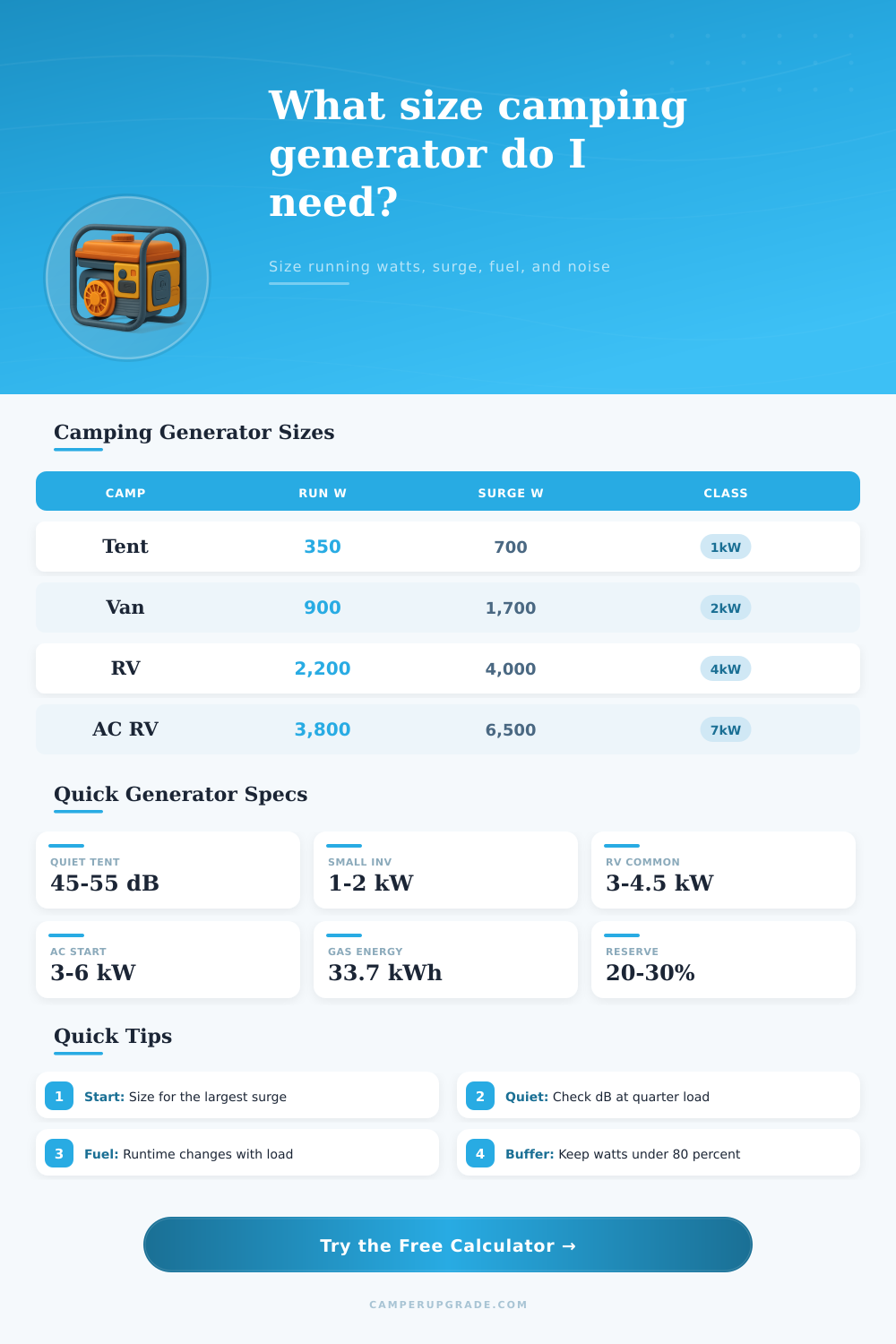
Generator Size Calculator for Camping
Estimate camping generator size from appliance running watts, starting surge, duty cycle, runtime, fuel type, altitude derating, quiet-hour noise limits, and safe headroom.
🏕Camping Power Presets
⚙Generator, Fuel, Noise, and Headroom Inputs
🔌Appliance Watts, Surge, Runtime, and Duty Cycle
| Appliance | Run W | Surge W | Use | Duty | Charger? |
|---|---|---|---|---|---|
This calculator estimates power sizing only. Follow generator manuals, campground rules, exhaust separation, grounding instructions, extension-cord ratings, and carbon monoxide safety practices.
📐Sizing Formula Cards
Running watts are the appliances that may operate at the same time before headroom is added.
Surge size adds the largest motor start gap, or overlapping gaps if selected.
Engine generators lose output at elevation, so the rated size must rise at high camps.
Fuel planning converts gallons, propane pounds, or battery kWh into usable energy.
🔋Appliance and Generator Spec Grid
📊Generator Sizing Reference Tables
| Camping setup | Running watts | Surge watts | Usual class |
|---|---|---|---|
| Tent electronics | 100-400 W | 100-700 W | Battery or 1 kW |
| CPAP tent | 120-350 W | 200-800 W | Battery or 1 kW |
| Van basics | 500-1,200 W | 900-2,000 W | 2 kW inverter |
| Small trailer | 1,200-2,200 W | 2,000-3,500 W | 3 kW inverter |
| RV with AC | 2,200-4,000 W | 4,000-6,500 W | 4.5-7 kW |
| Appliance | Run W | Surge W | Runtime note |
|---|---|---|---|
| LED campsite lights | 20-80 | 20-80 | Often continuous |
| CPAP humidifier | 60-120 | 80-150 | Overnight |
| RV converter | 400-900 | 500-1,000 | Tapers as full |
| Microwave | 1,000-1,500 | Same to 1,800 | Short bursts |
| 13.5k RV AC | 1,300-1,800 | 3,000-4,500 | Cycles on hot days |
| Generator class | Rated run | Common surge | Camping fit |
|---|---|---|---|
| 1,000 W | 800-900 W | 1,000-1,200 W | Lights, small chargers |
| 2,000 W | 1,600-1,800 W | 2,000-2,400 W | Vans, small trailers |
| 3,000 W | 2,400-2,800 W | 3,000-3,500 W | Trailer plus microwave |
| 4,500 W | 3,600-4,000 W | 4,500-5,500 W | Many RV AC loads |
| 7,000 W | 5,500-6,500 W | 7,000-8,500 W | Large RV or dual AC |
| Fuel or power | Usable energy | Best use | Noise note |
|---|---|---|---|
| 1 gal gasoline | 6-8 kWh | Short generator run | Engine noise |
| 20 lb propane | 18-25 kWh | RV dual fuel | Engine noise |
| 1 gal diesel | 8-11 kWh | Built-in genset | Lower pitch |
| 1 kWh battery | 0.85-0.95 kWh | Quiet hours | Silent |
| Solar top-off | Varies daily | Low loads | Silent |
💡Camping Generator Sizing Tips
To choose a generator for a camping trip, you must calculate the total power requirement of the appliances you plan to use. Many people does not account for the total wattage of there camping appliances. The total wattage that you will need includes the tent lights, refrigerator, phone and medical device charger.
You also will need to calculate whether the air conditioner can start without exceeding the power capacity of the generator. If the generator that you choose do not have enough power to supply your camping appliances, then it will not provide enough power for your camping trip. However, if you choose a generator that is too large for your camping trip, it will be too heavy to transport to your camping destination.
How to Choose a Camping Generator
To calculate the power needs of your camping appliances, you need to know the difference between the running watts and the starting watts of the appliances. Running watts is the wattage of the appliances while they are running. Starting watts, also known as surge watts, are the extra starting watts that appliances that have motor within them need to start up.
Air conditioner units may require a high amount of starting watts to start the compressor within the air conditioner. If the generator cannot supply enough starting watts for the appliances, it will not start the appliances or it will shut off. Because of this need for starting watts, even if a generator appears to have enough starting watts for the appliances that you plan to use, it may fail to start those appliances.
The second factor to consider when choosing a camping generator is the effect of altitude and fuel type on the generator. At high altitudes, the engines of generators lose power. If you are heading to a campground located in the mountains, the generator may lose power and not supply enough power to the appliances.
The other factor to consider is the fuel type for the generator. Gasoline, propane, and diesel fuel burn at different rate. Additionally, each fuel type creates a different level of noise with the generator and requires different types of maintenance for the generator.
An alternative to fuel-based generators are battery systems. However, if you choose battery systems, you must also consider the battery capacity and the amount of time that the batteries will take to recharge. Another constraint on the use of a generator while camping is the noise that the generator will create.
Many campgrounds has quiet hours. Additionally, the neighbors may be able to hear the generator even if the generator is located hundreds of feet from there property. Inverter generators are quieter than conventional generators when the inverter generator is running at a partial load.
Therefore, if you plan to use your generator after dark, an inverter generator may be a better choice than a conventional generator. To determine the correct size for a generator for your camping needs, create a list of all the appliances that you will use while camping. Write the running watts of each appliance, as well as the starting watts for each appliance.
After you have written the watts of all the appliances, determine which appliances you will need to run at the same time. It is not necessary for all the motor of the appliances to start at the same time. However, you must account for the starting watts requirements of the appliance that has the highest starting watt requirement.
You should also ensure that your generator is running below its maximum rated output. If you run your generator to its maximum output, you may shorten the life of your generator, and it may create more noise than when it is running at a lower capacity. The duty cycles and runtimes of the appliances will also impact the amount of power that the appliances will require.
Some appliances will run continuously, whereas other appliances will cycle on and off. For instance, your refrigerator will cycle on and off to maintain the temperature within your refrigerator. Therefore, the average power draw of your refrigerator will be less than the power draw listed on the refrigerator label.
This information will help you to determine how much fuel the generator will burn while camping, as well as if a smaller generator may be an option for your camping destination. Some of the most common mistake when choosing a camping generator is to assume that all of your camping appliances will be running at full power at the same time. Another common mistake is to ignore the starting watts requirement for appliances that have motor within them.
Find the wattage labels for all of your appliances. For instance, a coffee maker may draw 900 watts when brewing coffee. However, you must also account for the power that a refrigerator and camping light will draw.
The order in which you start your camping appliances will also impact the power requirements for those appliances. For instance, if you start your air conditioner first, you can start other appliances such as a microwave or coffee maker. Additionally, if you are using battery-powered charger, you can also start those at a later time after you have established a power source for camping.
While the camping generator calculator can help you to calculate your total wattage requirements, you will have to make the decisions regarding which appliances you will run at the same time or separately. Finally, environmental conditions while camping will also affect the power requirements for camping appliances. One environmental factor is the impact of the temperature.
The higher the outside temperature, the harder your air conditioner will work to lower the temperature of the camping trailer. Additionally, the amount of wind and how much exposure to the sun will impact the number of times that your refrigerator will cycle on and off to maintain a constant refrigerator temperature. Finally, camp rules may limit how long you may run your generator.
While these factor may not impact the wattage calculations, they do change the way in which your camping generator will function in its intended environment.