Campfire Calculator
Estimate firewood weight, log count, heat level, kindling, coal window, and reserve wood from your fire duration, group size, wood type, moisture, and weather.
🏕Campfire Presets
⚙Fire Duration, Wood, People, and Weather Inputs
Campfire Planning Results
🔥Campfire Wood and Heat Spec Grid
📋Campfire Fuel and Heat Tables
| Fire plan | People | Burn time | Dry wood range | Best use |
|---|---|---|---|---|
| Morning coffee fire | 1-3 | 0.75-1.5 hr | 6-12 lb | Boiling water, quick warmth, low smoke |
| Cooking coal fire | 2-5 | 2-3 hr | 16-30 lb | Coals for skillet, grill grate, or foil meals |
| Social evening fire | 4-6 | 3-5 hr | 25-45 lb | Visible flame without constant oversizing |
| Group camp circle | 7-12 | 4-6 hr | 55-95 lb | Large ring and wider seating distance |
| Cold weather warmth | 4-10 | 4-8 hr | 60-130 lb | Higher reload rate, stronger coal bed, reserve wood |
| Wood type | Typical dry heat | Burn behavior | Coal quality | Planning note |
|---|---|---|---|---|
| Pine, spruce, fir, cedar | 6,500-7,500 BTU/lb | Fast flame, more sparks | Light | Carry extra volume for the same burn time |
| Mixed campground bundle | 7,200-8,200 BTU/lb | Balanced flame and coals | Medium | Best default for planning a bought bundle |
| Oak, maple, ash, beech | 8,500-9,500 BTU/lb | Slower, hotter, steadier | Strong | Best for long evenings and cooking coals |
| Birch or alder splits | 7,500-8,500 BTU/lb | Easy start, steady flame | Medium | Good shoulder-season campfire wood |
| Compressed campfire blocks | 8,500-9,800 BTU/lb | Predictable, dense burn | Strong | Use only products allowed in the fire ring |
| Moisture condition | Usable heat factor | Smoke risk | Start difficulty | Wood add-on |
|---|---|---|---|---|
| Kiln-dried or very dry | 105% | Low | Easy | Usually no extra wood |
| Seasoned 15-20% | 100% | Low to moderate | Normal | Planning baseline |
| Average bundle 25% | 88% | Moderate | Normal to slow | Add about 10-15% |
| Damp 35% | 72% | High | Difficult | Add about 30-40% |
| Wet gathered wood 45% | 55% | Very high | Very difficult | Add dry starter and much more wood |
| Split size | Typical piece weight | Flame rate | Reload interval | Best role |
|---|---|---|---|---|
| Small wrist-size splits | 1-2 lb each | Fast | 10-20 min | Starting, cooking control, damp wood help |
| Medium bundle splits | 2-3.5 lb each | Moderate | 20-35 min | Most campground fires |
| Large quarter splits | 4-6 lb each | Slow | 35-55 min | Longer social fire reloads |
| Unsplit rounds | 6-10 lb each | Very slow | 45-75 min | Coal holding after a bed is established |
💡Campfire Planning Tips
🧮Calculator Method
Planning a campfire requires that you determine the amount of wood that is required to start and sustain the fire. The amount of wood that the fire requires can depend on the length that the campfire must burn and the amount of heat that is necessary for the group camping at the fire. While many individual may choose to skip the planning of a campfire if the weather is thought to be mild and comfortable for camping, skipping the planning stage for the wood that will start and fuel the campfire can result in the campfire ending prematurely due to drops in the temperatures or the increase of the wind at the campsite.
The amount of wood that the fire consumes is dependent upon several factor. Factors that influence the amount of wood that the campfire will burn include the size of the fire ring, the number of individuals that is surrounding the campfire, the density of the wood that is placed into the fire, and the moisture level of the wood. For instance, the amount of wood that is required for the cooking fires that are started for two individual is less than the amount of wood that is required to start and sustain a social campfire for eight individuals, since the social fire will require the additional wood to provide the heat that is necessary to keep the larger number of individuals warm.
How Much Wood Do You Need for a Campfire
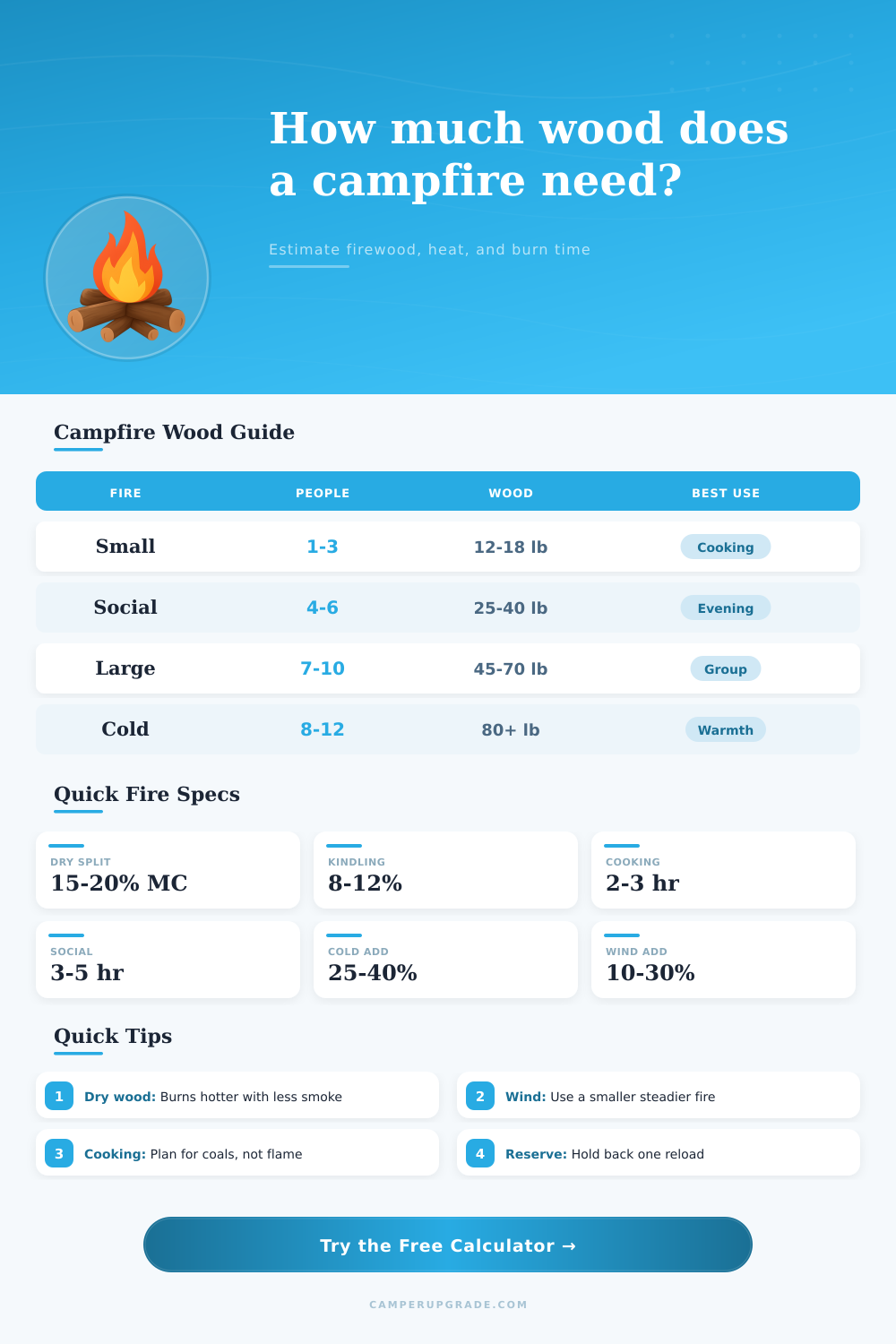
Each of these factor can be entered into the calculator to determine the amount of wood that the campfire will consume. The moisture level of the wood impacts the way that the fire burns when the wood is burning. Seasoned wood typically has a moisture level between 15 and 20 percent, and burns more efficient than wet wood.
When wet wood is used in the campfire, the wet wood will use up some of the energy of the campfire to evaporate the water from the wet wood splits, and the wet wood will also produce more smoke than seasoned wood. Because of these factors, the calculator increases the total amount of wood that is required if an increased moisture level is selected for the wood. The size of the splits of wood that are placed into the campfire will impact the amount of times that the wood must be replenished.
Small splits of wood, such as the size of an individual’s wrist, will typically light easily and burn quick. However, small splits of wood will burn quickly and dissapears from the campfire faster than larger splits. Larger splits of wood will hold the heat that the campfire produces for longer periods of time after the coal beds are formed within the splits of wood.
Consequently, many individual choose to use different sizes of splits of wood. The calculator can display the length of time between reloads of wood of the size that the individual camper chooses. The purpose for which the campfire will be used will impact the amount of wood that the campfire will consume.
For instance, cooking fires may require that the campfire maintains a bed of coals that continuously burns, while social fires may require that the fire includes visible flames that burn into the faces of the individuals that are camping at the fire. The different setting for the purpose of the fire impacts the burn time for the campfire, and can help prevent individuals from starting a cooking fire that is too large for the number of individuals in the campsite, or starting a social fire that is too small to illuminate the individuals faces. Weather conditions will impact the amount of wood that the fire consumes.
The wind will impact the burn rate of the fire, as the wind will remove heat from the campfire and push additional air through the wood splits. Additionally, cold temperature will require the campfire to use up more wood to provide heat to the camping individuals, as well as to prevent the ground at the campsite from drawing heat away from the campfire. These variables are accounted for in the final weight of wood that the calculator calculates.
In addition to considering the various factors related to the campfire and the wood that will start it, individuals must also consider the amount of tinder and kindling that will be needed to start the campfire. The tinder and kindling that is placed into the fire at the start of the campfire needs to be of sufficient amounts to start the larger splits of wood, but in amounts that dont waste dry wood. The calculator will provide an estimate to the amount of kindling that will be needed to start the campfire according to the ignition condition that the individual chooses.
Finally, some wood may be reserved for the campfire that is started. If an individual reserves one reload of wood for the campfire, the fire will last for longer, or the reserved wood can be used in case of drops in the temperatures at the campsite. The calculator accounts for this amount of reserved wood to ensure that the total amount of wood that is calculated includes this extra amount.
The tables that are provided on the calculator allow individuals to view various plans for the campfire, wood types, and the moisture levels of that wood. These tables make it easier for an individual to determine if the amount of wood that the calculator calculates is an appropriate amount for their situation. The process of planning a campfire involves determining the amount of wood that is required to enjoy the campfire, as well as ensuring that there is enough wood for the campfire to last for the desired length of time.
Too little wood will result in the campfire ending too soon, but too much wood will result in an excess amount of weight for the individual to carry when camping. Thus, the calculator can provide an individual with the starting point for their campfire planning, but individuals can use this calculator to make their own selections regarding the amount of wood that will be used to start and sustain their campfire.