Camping Wood Stove Size Calculator
Estimate stove heat output, firebox volume, flue size, and wood needed from shelter volume, temperature lift, stove material, burn time, and wood condition.
🏕Hot Tent and Shelter Presets
⚙Shelter, Temperature, Wood, and Stove Inputs
Wood Stove Sizing Results
🔥Stove and Material Spec Grid
📊Camping Wood Stove Sizing Tables
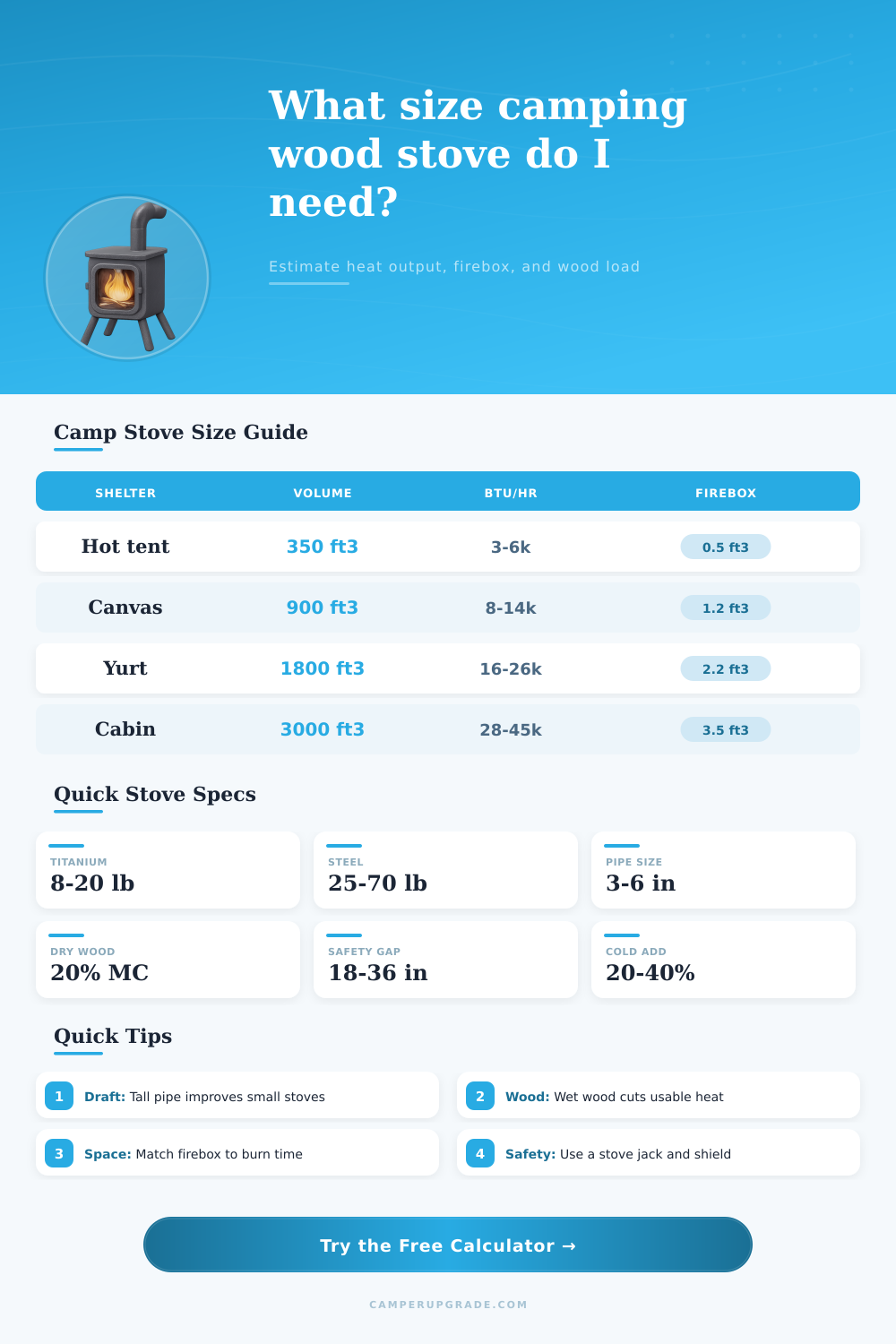
| Shelter volume | Mild 30°F lift | Cold 50°F lift | Severe 70°F lift | Typical stove class |
|---|---|---|---|---|
| 250-500 ft³ | 2,000-4,500 BTU/hr | 4,000-7,500 BTU/hr | 6,000-10,500 BTU/hr | small titanium or compact sheet steel |
| 500-1,000 ft³ | 4,500-9,000 BTU/hr | 7,500-15,000 BTU/hr | 10,500-21,000 BTU/hr | medium hot tent stove |
| 1,000-1,800 ft³ | 9,000-16,000 BTU/hr | 15,000-27,000 BTU/hr | 21,000-38,000 BTU/hr | large wall tent stove |
| 1,800-3,000 ft³ | 16,000-28,000 BTU/hr | 27,000-45,000 BTU/hr | 38,000-63,000 BTU/hr | yurt or small cabin stove |
| 3,000-4,500 ft³ | 28,000-42,000 BTU/hr | 45,000-68,000 BTU/hr | 63,000-95,000 BTU/hr | large cabin stove or two zones |
| Firebox volume | Short reload | Practical reload | Overnight chance | Best shelter match |
|---|---|---|---|---|
| 0.3-0.6 ft³ | 1-2 hr | 2 hr | very low | solo tipi or small hot tent |
| 0.7-1.1 ft³ | 2 hr | 3 hr | low | 2-4 person canvas tent |
| 1.2-1.8 ft³ | 3 hr | 4 hr | moderate | wall tent or cook tent |
| 1.9-2.8 ft³ | 4 hr | 5-6 hr | good with hardwood | large wall tent or yurt |
| 3.0-4.5 ft³ | 5 hr | 6-8 hr | best | cabin, yurt, or basecamp |
| Stove material | Heat behavior | Typical weight | Efficiency factor | Camping fit |
|---|---|---|---|---|
| Foldable titanium | fast heat, fast cool-down | 8-20 lb | 55-62% | backpacking hot tents and pulk trips |
| Sheet steel camp stove | steady camp heat | 25-70 lb | 58-66% | canvas tents and vehicle camps |
| Heavy steel box stove | more retained heat | 55-120 lb | 62-70% | outfitter wall tents and basecamps |
| Cast iron stove | slow warm-up, long radiant heat | 120-350 lb | 60-72% | cabins and fixed seasonal camps |
| Airtight cabin stove | controlled burn rate | 140-400 lb | 68-78% | cabins, yurts, and long burn setups |
| Wood condition | Usable heat | Reload behavior | Smoke risk | Field note |
|---|---|---|---|---|
| Seasoned hardwood | 8,000-9,500 BTU/lb | slowest burn | low | best for overnight heat |
| Mixed dry camp wood | 7,000-8,500 BTU/lb | normal reloads | moderate | good planning default |
| Dry softwood | 6,200-7,500 BTU/lb | faster burn | moderate sparks | carry more volume for same heat |
| Compressed blocks | 8,500-9,800 BTU/lb | predictable | low | use only stove-safe blocks |
| Damp gathered wood | 4,000-6,000 BTU/lb | uneven | high | needs extra kindling and draft |
💡Wood Stove Sizing Tips
🧮Calculator Method
When choosing a wood stove for a camping shelter, there are several specific factor that you need to consider, and there needs to be a match between the wood stove and the needs of the camping shelter. For instance, you needs to match the heat output of the wood stove to the heat loss of the shelter, and the firebox of the wood stove needs to be matched to the amount of wood that can be carried to the camping shelter. If the stove is not matched to the shelter in these ways, the stove may not provide enough heat to the shelter or it may require too much attention to maintain a fire.
The construction of the camping shelter will determine how much heat the shelter lose. For instance, single-wall nylon shelter will lose more heat than canvas shelters, and insulated ice shelters will lose less heat than single-wall nylon shelters or canvas shelters. Additionally, if the wind exposes the shelter, the wind may cause the shelter to lose heat, especially if the shelter is constructed on a ridge line.
How to Choose the Right Wood Stove for a Camping Shelter
These factors must be considered to ensure that the wood stove produce enough heat to warm the shelter. The difference between the outside temperature and the desired inside temperature of the shelter will determine the temperature lift. The higher the temperature lift, the more heat that will be required of the wood stove.
Additionally, the altitude where the camping shelter will be established will affect the way that the wood stove burns the wood within the firebox. The air is thinner at high altitudes, so the wood stove will have less draft. To account for this, it is best to use a calculator to determine the requirements of the wood stove based off the altitude of the camping site.
The material of the wood stove will affect how quickly the wood stove heats up and how quickly it loses heat. For instance, if you make the wood stove of titanium, it will heat up and cool down very quick. Sheet steel stoves will hold the temperature longer than the titanium stoves.
Additionally, cast iron stoves will retain heat better than sheet steel stoves. However, all of these stoves are much heavier than titanium stove models. The condition of the wood that is placed within the stove will affect the amount of heat that the stove outputs.
For instance, seasoned hardwood will burn better than damp wood, which will produce more smoke and be more difficultly to maintain a draft within the stove. Additionally, damp wood will output less heat than dry wood. However, the bulk density of the wood will also affect how fast the stove can be replenished with wood.
For instance, softwoods will take up more space within a firebox than hardwoods. Another consideration for wood stoves is the burn time between reloads of wood. Small wood stoves may warm the shelter very quickly but may not be able to maintain the temperature of the shelter.
However, a large firebox will allow wood stoves to burn for longer periods of time, though only if it can take the amount of wood necessary to maintain a proper draft within the stove. To calculate the size of the firebox needed by the stove, a tool is available to calculate the firebox size based on the length of time desired between reloads of wood. Another consideration is the clearance and venting requirement of the wood stove.
Every wood stove requires clearances to the shelter fabric. In addition, the flue of the wood stove must be of the correct size. If it is too small, it will restrict the draft of the stove.
However, if it is too large, the stove will lose too much heat and creosote will begin to build up within it. Additionally, the stove jack must be able to seal properly to retain the heat of the stove. Reference tables are available that describe the heat output of various models of wood stoves.
These tables can help to verify your calculations about the amount of heat that will be required of the stove. If your calculations are within the top of one of the tables, you are at the upper limit of the wood stoves capability. However, if you are within the middle of one of the rows, you have a margin for error in the moisture content of the wood or the outside temperature.
Finally, it is important to note the difference between the peak heat output of the wood stove and the steady-state output of the stove. For example, a stove that reaches high peak temperature may not be able to maintain those temperatures if the firebox is too small.