Ice Fishing Depth Finder Battery Calculator
Estimate fish finder runtime from sonar draw, battery capacity, cold temperature, screen brightness, reserve, accessories, and battery condition.
Runtime Breakdown
| Battery | 0.45 A flasher | 0.65 A flasher | 0.85 A LCD | Notes |
|---|---|---|---|---|
| 7 Ah SLA | 6.0 hr | 4.2 hr | 3.2 hr | Approximate 60% usable, mild cold |
| 9 Ah SLA | 7.7 hr | 5.3 hr | 4.1 hr | Common replacement size |
| 10 Ah LiFePO4 | 16.0 hr | 11.1 hr | 8.5 hr | Assumes 80% usable after losses |
| 12 Ah LiFePO4 | 19.2 hr | 13.3 hr | 10.2 hr | Good all-day flasher size |
Table values are planning estimates before your selected reserve. Real runtime changes with battery age, temperature, and voltage cutoff behavior.
| Battery | 1.0 A | 1.25 A | 1.5 A | Best use |
|---|---|---|---|---|
| 12 Ah LiFePO4 | 9.6 hr | 7.7 hr | 6.4 hr | Short LCD or camera trips |
| 18 Ah LiFePO4 | 14.4 hr | 11.5 hr | 9.6 hr | All-day GPS sonar |
| 20 Ah LiFePO4 | 16.0 hr | 12.8 hr | 10.7 hr | Sonar plus light accessory |
| 30 Ah LiFePO4 | 24.0 hr | 19.2 hr | 16.0 hr | Long day plus spare reserve |
If an underwater camera runs from the same battery, add its amp draw to the accessory input rather than guessing from screen size alone.
| Battery | 2.0 A | 2.5 A | 3.5 A | Best use |
|---|---|---|---|---|
| 18 Ah LiFePO4 | 7.2 hr | 5.8 hr | 4.1 hr | Short live sonar sessions |
| 24 Ah LiFePO4 | 9.6 hr | 7.7 hr | 5.5 hr | Moderate live imaging use |
| 30 Ah LiFePO4 | 12.0 hr | 9.6 hr | 6.9 hr | All-day live sonar target |
| 50 Ah LiFePO4 | 20.0 hr | 16.0 hr | 11.4 hr | Sleeper house or big display |
Live sonar systems vary widely because black boxes, displays, transducers, and network modules may each draw power.
| Battery temp | SLA / AGM factor | LiFePO4 factor | Lithium-ion factor | Planning note |
|---|---|---|---|---|
| 40 F and warmer | 0.85 | 0.98 | 0.95 | Near normal ice-house runtime |
| 20 F | 0.72 | 0.90 | 0.86 | Common open-ice day |
| 0 F | 0.55 | 0.75 | 0.68 | Keep pack insulated if possible |
| -10 F | 0.45 | 0.65 | 0.58 | Size up or carry a warm spare |
Do not charge most lithium batteries below freezing unless the battery has a low-temperature charging system or internal heater.
| Ice setup | Estimated draw | 6 hour target | 10 hour target | Comment |
|---|---|---|---|---|
| Basic flasher | 0.55 A | 7 Ah SLA or 5 Ah Li | 10-12 Ah Li | Very efficient for hole hopping |
| 5 inch LCD sonar | 0.9 A | 10-12 Ah Li | 15-18 Ah Li | Bright screen increases load |
| Sonar plus camera | 1.4 A | 15-18 Ah Li | 24-30 Ah Li | Camera draw matters quickly |
| Live sonar | 2.5 A | 24 Ah Li | 40-50 Ah Li | Plan around black-box draw |
This calculator estimates electrical runtime for planning. Follow your depth finder's voltage limits and your battery maker's charging instructions, especially for lithium batteries in freezing weather.
Ice fishing require careful planning. Small decision can have significant consequences for your ice fishing trip if the temperature drop and the wind increase. An depth finder will help you find the fish.
However, the depth finder will only work if the battery behind the depth finder have enough power to operate the depth finder. The amount of power you have will determine whether you can get back to your truck or if you have to walk a significant distance to get to your vehicle. The battery’s capacity will differ from the battery labels indicated capacity when it is in the cold.
How to Choose a Battery for Ice Fishing
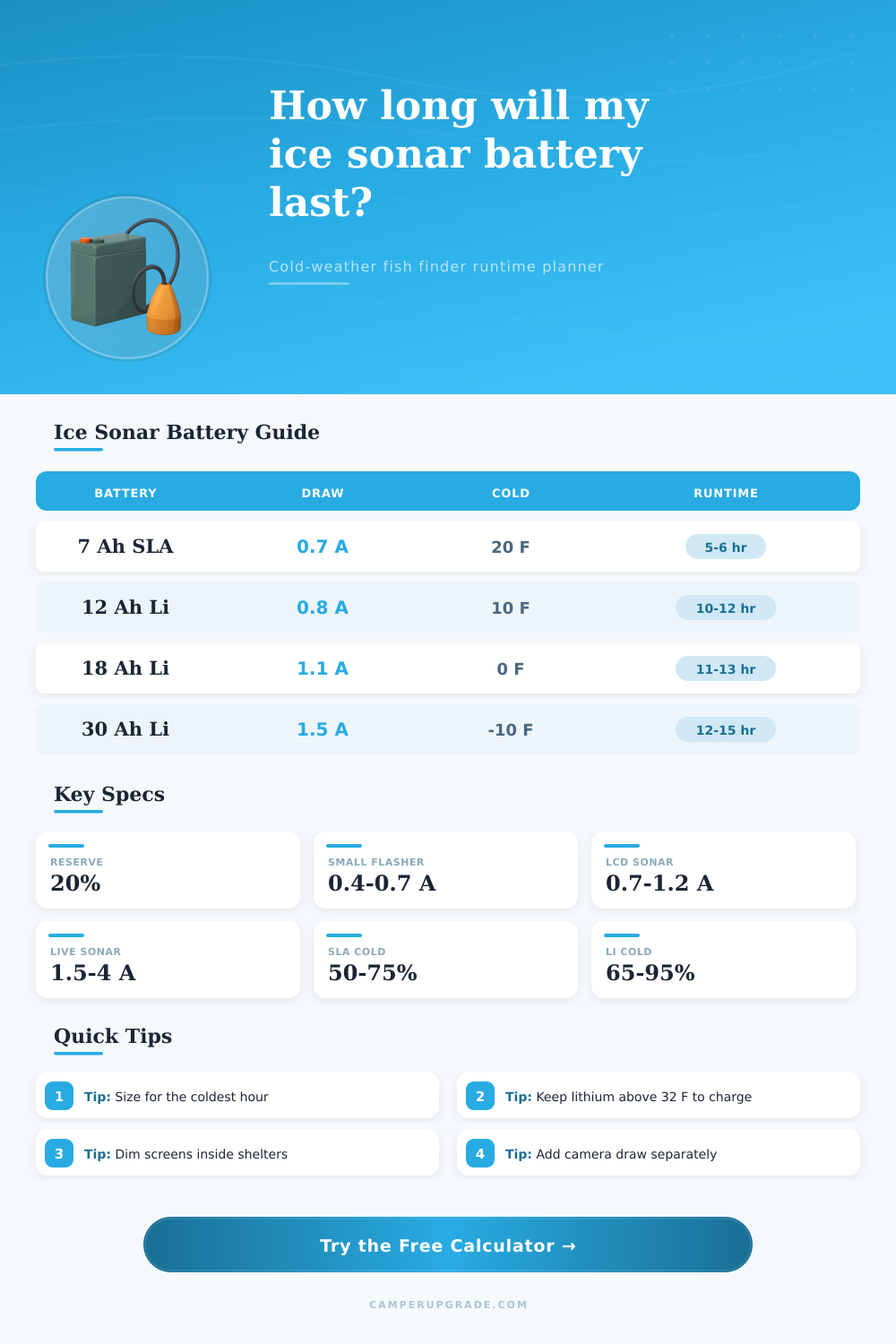
Cold air will reduce a battery’s energy. The reduction of energy from lead-acid batteries is more significant than from lithium battery. For example, a lead-acid battery at twenty degrees will only have seventy percent of the batterys capacity.
In contrast, a lithium battery at twenty degrees will have ninety percent of the batterys capacity. The calculator will show you the actual capacity of the battery based off the chemistry of the battery and the temperature of the battery. The amp draw of the battery will play a significant role in how quickly the battery lose power.
A basic flasher will draw half an amp from the battery. However, if you have a single unit that has a GPS screen, the screen may be bright, and using split screen on the GPS will draw more than one amp from the battery. Using live sonar in the water will use even more power from the battery as the black box, the screen, and the sonar transducer will all draw power from the battery.
Using an underwater camera and LED lights will draw even more power. The calculator allow you to separate the power used by the live sonar from the power drawn by any accessories you use. The depth of discharge will determine how much energy you can get from the battery.
If you use a lead-acid battery and discharge it too much, the lead-acid battery will lose voltage stability. Losing voltage stability is a problem if you still need to drill hole in the ice or find your way back to your truck. Using a lithium battery, you can discharge it deeper than a lead-acid battery.
However, to ensure the life of the battery, you should reserve at least twenty percent of the batterys capacity. The calculator will subtract this amount of the batterys capacity as it determines the depth of discharge. Wiring losses and the age of the battery will also affect how much power get to your depth finder.
The depth finder may be located on the fishing rod if the battery is in the truck. In this case, there will be losses in the wiring from the battery to the depth finder. These losses will reduce the power available to the depth finder.
Additionally, the age of the battery may show that the battery is charged, but if the battery is old, it will not provide the same number of hour of power as a new battery. The calculator allows you to account for these losses in your battery so that you can plan your trip accordingly. The tables will allow you to compare different batteries.
The first table will show you the number of hours a seven amp hour lead-acid battery will run if you have a small flashers at various temperatures. The second will show you the number of hours an eighteen or thirty amp hour lithium battery will run with a live sonar system attached. These are planning tool that can show you how large a battery you will need if you want to add an underwater camera or if you want to fish for longer periods.
Many angler will use the batteries that will fit in their equipment last season. However, this may not work for you if you have upgraded your equipment or if it is colder outside. You should calculate the power source for the depth finder based on the coldest temperature you will experience.
The temperature near the depth finder will be colder than the air temperature outside as reported on your phone. The number of times you charge the battery will also determine the life of the battery. Most lithium battery will not be charged if the battery is below freezing unless the battery has a built-in heater.
If the battery is very cold and you bring it into your truck and charge the battery, the life of the battery will be shortened. To avoid this, you can either allow the battery to warm up or bring a spare battery with you in an insulated bag. Lastly, the length of your outing will be the last variable to consider.
If your depth finder will run for seven hour, can you fish for eight hours? You will either have to use a larger battery or reduce your load on the battery. The calculator will show you the number of fishing outing within the safe runtime that your battery can last so that you can determine if your battery is large enough for the trip.
Find the correct battery for the temperature that you will experience while on the water and the way that you like to fish to ensure the depth finder stay on until you decide to stop fishing for the day.