Peak Bagging Time Calculator
Estimate total peak hiking time from round-trip distance, elevation gain, descent loss, terrain class, pack weight, rest breaks, summit time, and daylight timing.
⛰Peak Route Presets
⚙Distance, Gain, Terrain, Rest, Pack, and Timing Inputs
The estimate blends Naismith-style distance and gain timing with route terrain, pack load, rest behavior, summit stay, descent speed, and daylight margin. It is a planning estimate, not a substitute for current route and weather judgment.
🗺Route and Timing Spec Grid
Ascent Time
--Climbing estimate from distance share, vertical gain, terrain, and pack load.
Descent Time
--Return estimate adjusted for steepness, terrain, snow, and tired legs.
Turnaround
--Latest summit-or-turn time based on your selected daylight rule.
Route Flag
--Highlights daylight pressure, slow terrain, big gain, or extra complexity.
📌Peak Bagging Reference Specs
📊Hiking Time Reference Tables
| Distance | Trail Pace | Steady Time | Slow Time |
|---|---|---|---|
| 4 mi | 2.5 mph | 1 hr 36 min | 2 hr 00 min |
| 6 mi | 2.3 mph | 2 hr 36 min | 3 hr 00 min |
| 8 mi | 2.1 mph | 3 hr 48 min | 4 hr 25 min |
| 10 mi | 2.0 mph | 5 hr 00 min | 5 hr 50 min |
| 14 mi | 1.8 mph | 7 hr 45 min | 8 hr 45 min |
| Gain | Fast Add | Steady Add | Slow Add |
|---|---|---|---|
| 1000 ft | 24 min | 30 min | 38 min |
| 2000 ft | 48 min | 1 hr 00 min | 1 hr 16 min |
| 3000 ft | 1 hr 12 min | 1 hr 30 min | 1 hr 54 min |
| 4500 ft | 1 hr 48 min | 2 hr 15 min | 2 hr 51 min |
| 6000 ft | 2 hr 24 min | 3 hr 00 min | 3 hr 48 min |
| Terrain | Multiplier | Typical Route | Delay Source |
|---|---|---|---|
| Maintained | 1.00 | Trail or road | Normal grade |
| Rough trail | 1.15 | Roots or mud | Foot placement |
| Talus | 1.28 | Blocks or scree | Balance checks |
| Scramble | 1.38 | Class 3 ridge | Route finding |
| Snow | 1.32 | Spring climb | Transitions |
| Peak Day | Distance | Gain | Plan Time |
|---|---|---|---|
| Lookout peak | 5 mi | 1400 ft | 3-4 hr |
| Popular 14er | 8 mi | 3300 ft | 6-8 hr |
| Ridge scramble | 9 mi | 3600 ft | 7-9 hr |
| Volcano slog | 12 mi | 5600 ft | 9-12 hr |
| Two-peak linkup | 14 mi | 5200 ft | 10-13 hr |
💡Peak Timing Tips
Planning a hiking trip require considering many different factors. One such factor that must be consider is the length of the hike that will be undertaken. A person must plan for how long the hike will take so that they will finish the hike before the daylight dissapears.
A hiker need daylight in order to properly see the trail that they need to follow during their descent. If there is not enough daylight for the hiker to descend the mountain, the descent can become dangerously for the hiker. The calculator that is provided on this page will help a person to calculate the time that will be required for a hike based off certain input.
How to Plan Time for a Hike
The factors that a person can consider with this calculator are the terrain for the hike, the weight of the persons hiking pack, and the persons behavior while on the hike. The terrain factor will impact the time for a hike because different type of terrain can allow for faster travel than others. For instance, a person who is hiking on a maintained trail will travel at a different pace then someone who is traveling on difficult terrain.
The weight of a hiking pack can have an impact on the time it takes for a person to complete a hike. If a person is carrying a heavy pack, they will move more slow on the hike. The more a persons pack weighs, the more it will change their balance and their movement on the ground.
If the hiking pack weighs more than ten pound, it will impact the movement of the hiker. A person with a heavy pack may opt to take a more slow path over an area that may have boulders in it. A persons behavior while on the hike will impact the time for the hike.
Some people will take break throughout the hike while others will not. Most hikers will take a break to check for water, to put on layers of their clothing, or to check the route that they will take. These breaks will take time from the hike and may take an hour or more of hiking time.
People who spend alot of time taking pictures will also be spending more time on their hike. Therefore, a person must account for their hiking behavior to fully understand the time that they will be on their hiking trip. A hike will return a value of the turnaround time for the hike.
The turnaround time is the time that a person must stop hiking uphill and begin hiking downhill. This is an important time because the descent from the mountain can be more difficult than hiking uphill. People can use this time to ensure that there is enough daylight to make the descent.
Additionally, the calculator also returns a safety buffer for the hike. This safety buffer is the amount of time that a tired person will have to make the descent. People may take longer to hike downhill when they are tired then when they are energetic and ready to hike uphill.
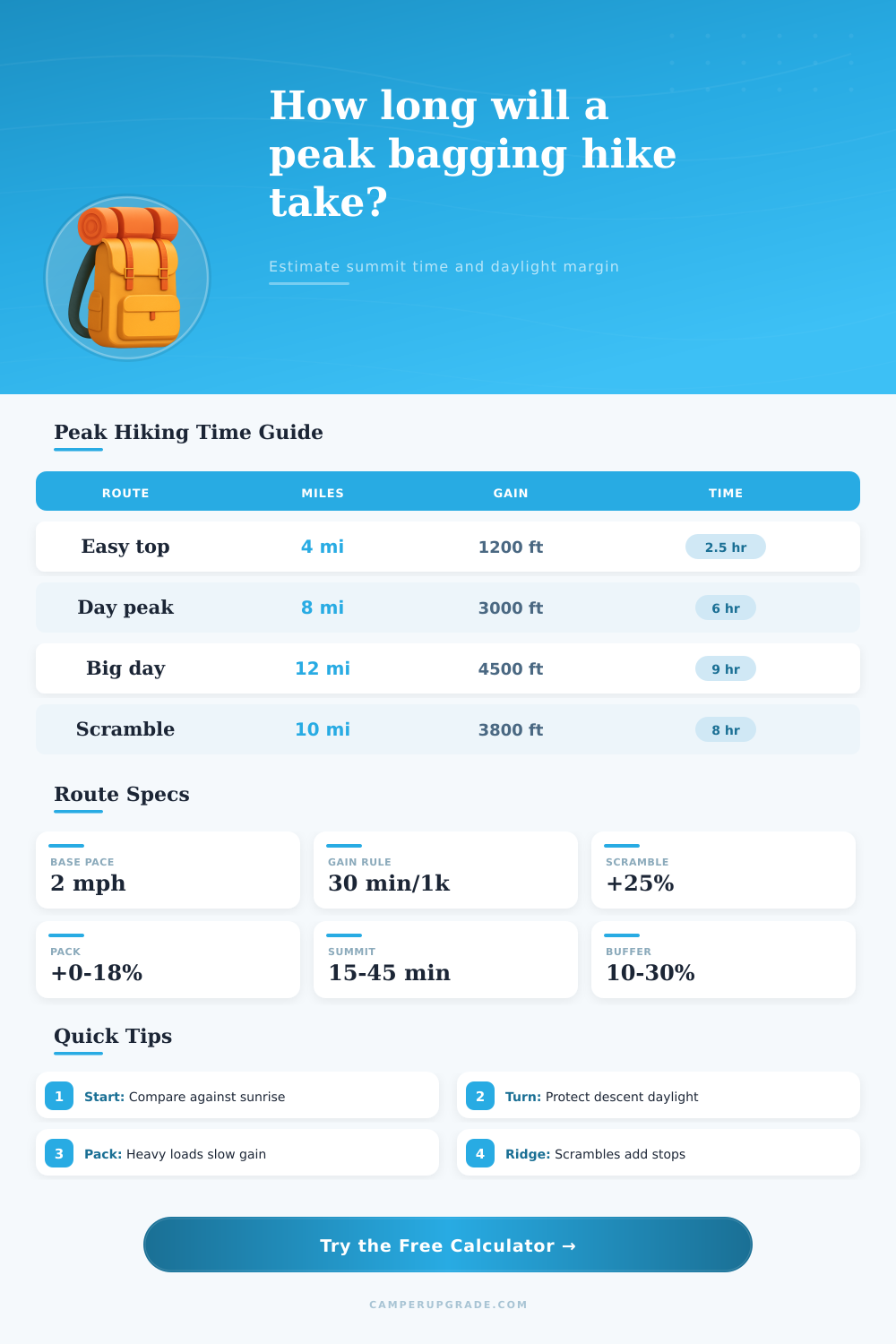
The reference tables that is present on this page can help a person to verify that the hiking plan that they created for them is accurate for their needs. The reference tables show the time that hikers can expect to spend on different distance of hiking with a certain amount of elevation gain. These tables are not rules for hikers but they can help a person understand if the hike that they plan is normal for that area or if it is a more difficult hike.
A hike that gains a lot in elevation is more difficult than a hike that gains a small amount of elevation. A difficult hike will have less time for buffer if a person should of get delayed during their hike. A person must also understand that the hike that they plan may not be the hike that they experience.
The fitness level of the hiker may not match that which was used to create the hiking plan. After the hike begins, a hiker may discover that they are not as physically fit as they thought. This information will impact the decision that the hiker makes for the hike.
For instance, if a hiker finds that they are moving more slow than they should be, they will have to use the turnaround time to make a decision about when to begin descending the mountain. They will also use the data regarding their movement while on the hike to recalculate the time for which they will be on their hike. A hiking plan is simply an estimate of the time for a hike.
Another variable that may impact the time for which a person is on their hike is the time that they will spend at the summit of the mountain. The variable of the summit time can be programmed into the calculator. The weather at the destination will impact the time spent at the summit.
For instance, if the weather is calm at the summit, a person may plan on remaining at the peak for forty-five minute. However, if the wind is strong at the summit, they may only plan on spending fifteen minutes at the peak. A person will need to take this variable into consideration to ensure that they have enough time to complete their hike during the daylight time.