Desert Hiking Water Calculator
Estimate desert hiking water by distance, temperature, body weight, climb, exposure, pace, pack load, reserve, dry stretch, and planned water sources.
🏜Desert Route Presets
⚙Distance, Heat, Body, and Route Inputs
This calculator estimates practical carry volume from moving time, heat band, body weight, climb, terrain, exposure, effort, refill volume, and reserve. It is a planning tool, not medical advice.
💧Hydration and Carry Spec Grid
📋Desert Water Reference Tables
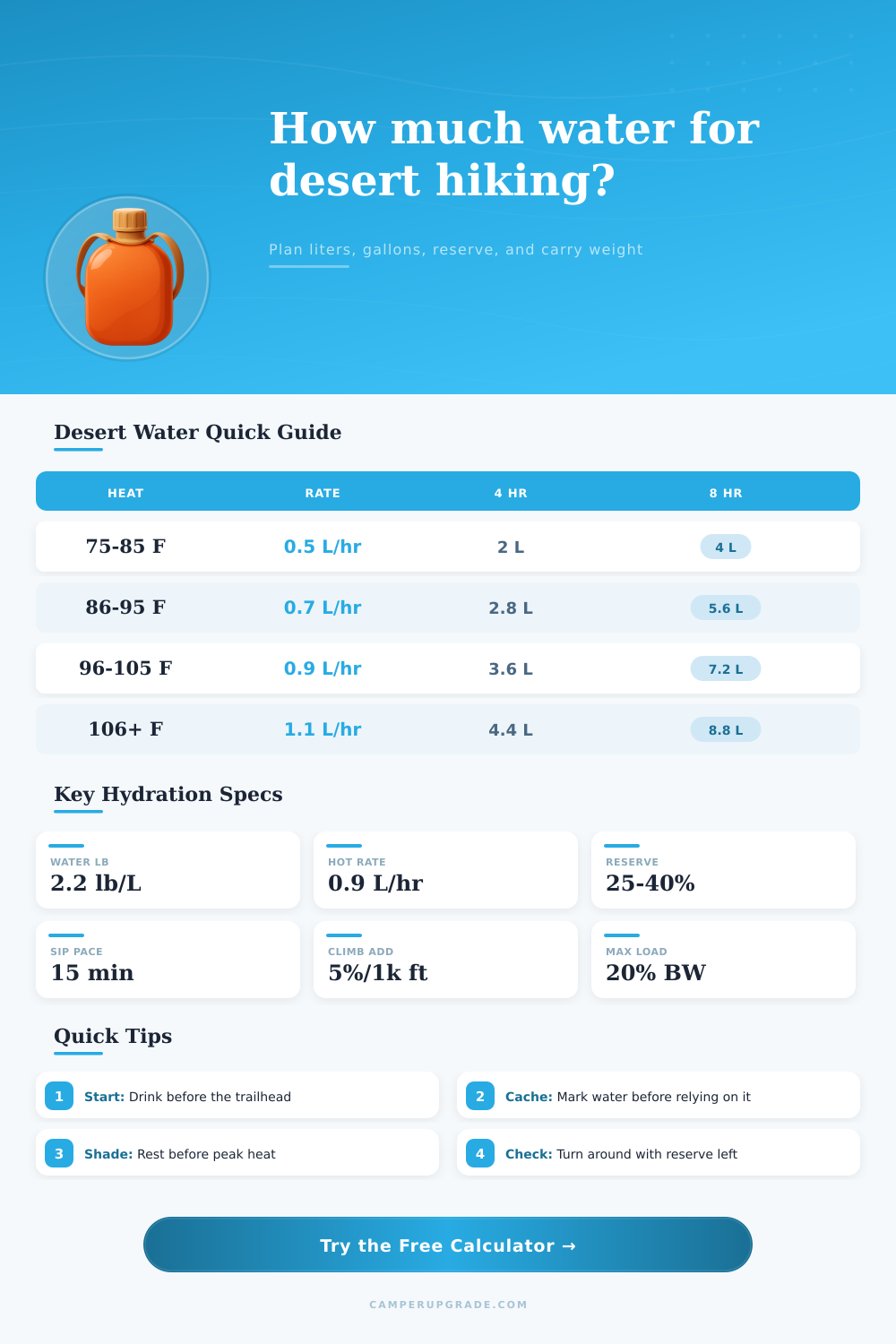
| Temperature | Base Rate | 4 Hours | 8 Hours |
|---|---|---|---|
| 60-74°F / 16-23°C | 0.40 L/hr | 1.6 L | 3.2 L |
| 75-85°F / 24-29°C | 0.50 L/hr | 2.0 L | 4.0 L |
| 86-95°F / 30-35°C | 0.70 L/hr | 2.8 L | 5.6 L |
| 96-105°F / 36-41°C | 0.90 L/hr | 3.6 L | 7.2 L |
| 106°F+ / 41°C+ | 1.10 L/hr | 4.4 L | 8.8 L |
| Route Type | Typical Pace | Water Effect | Planning Note |
|---|---|---|---|
| Maintained trail | 2.4 mph | Normal | Distance estimate is stable |
| Rocky wash | 2.0 mph | +8% | Footing slows progress |
| Soft dunes | 1.4 mph | +22% | Sand raises effort quickly |
| Canyon scramble | 1.2 mph | +28% | Hands, heat, and exits add time |
| Fitness hike | 2.9 mph | +10% | Fast pace raises sweat rate |
| Climb and Sun | Water Add | Example | Use When |
|---|---|---|---|
| Every 1000 ft gain | +5% | 2000 ft = +10% | Uphill or canyon exits |
| Open sun route | +15% | Exposed mesa | Few shade breaks |
| Reflected canyon heat | +10% | Narrow rock walls | Still air and hot stone |
| Reliable shade breaks | -8% | Morning shaded wash | Cool rest locations |
| Midday hiking | +18% | Noon return | Peak solar load |
| Body Weight | Baseline Add | 4-Hr Hot Hike | Carry Signal |
|---|---|---|---|
| Under 120 lb | -8% | 3.3 L | Still keep reserve |
| 120-160 lb | 0% | 3.6 L | Standard estimate |
| 161-200 lb | +8% | 3.9 L | Watch pack load |
| 201-240 lb | +14% | 4.1 L | More water weight |
| Over 240 lb | +20% | 4.3 L | Plan refills carefully |
💡Desert Hydration Tips
When the sun rise and the desert ground no longer provides shade for those who venture into the desert on a hike, that hike transforms into a specific type of problem. While a morning walk into the desert may sound easy, the journey from home to the desert can become a problem if the distance to travel is compared to the amount of water that can be carried on the hike. More specifically, individuals does not have to consider whether they will feel thirsty during the hike; they will feel thirsty.
Instead, the question that must be considered is whether the amount of water that is contained within the individuals pack is enough to last the hike, as the amount of water that they have may not be enough for the hike that they plan to take. The amount of water that an individual need for such a desert hike can change based off a variety of different factors. For instance, those individual water needs can change based upon the distance that they will travel.
How to plan water for a desert hike
However, there are a variety of other factors, as well. For instance, the amount of heat that an individual will experience during the hike will impact their water needs, as will the amount of climbing that they experience. Additionally, the terrain that they travel will impact their needs for water, as will the amount of sun that they absorb during their journey.
Another of the factors that can change water needs is the body weight of the hiker. Individuals that are lighter have lower baseline needs for water than those that is heavier. However, if the lighter hikers are carrying heavy package, their needs for water may actualy become the same as those of the heavier hikers.
Thus, the calculator that is presented to these individuals accounts for their needs. Another of the factors that can play a role in the needs for water is the presence of dry stretch along the route. More specifically, the dry stretches that the hiker experiences do not contain sources of water.
Thus, if the hiker experiences the longest dry stretch and it is the same as the length of the route that is to be taken, the amount of water that is carried must be enough to take the entire route. The percentage of the total water that is to be reserved for emergencies will reveal the degree of uncertainty that the hiker is willing to accept during the hike. Factors such as the time of the start of the hike will influence the length of time that an individual is exposed to the sun.
If an individual begin the hike at dawn, for instance, they will spend the first several hours of the hike in the cooler temperatures. Thus, starting the hike at dawn will reduce the amount of time that the individual is exposed to the peak heat of the day. However, if the individual begins the hike at the middle of the day, they will experience the same hike length, but with increased length of time in which they need water.
Any shade break that are experienced will help the individual reduce their water needs, but only if the shade is reliable and sufficient in the amount of length that they take to become useful for reducing water needs. Any shade breaks in areas that reflect the hottest temperatures of the desert can increase the need for water if these breaks are experienced. Factors related to the rate at which an individual hikes will also impact their water needs.
For instance, an individual that is hiking at a fastly rate will experience increased needs for water due to the additional heat that the increased amount of effort required to hike at such speeds creates. Additionally, hiking at a group pace while taking breaks will expose the bodies of the individuals to the desert sun for long periods of time, even if the individual group members travel at a slower rate. These factors is accounted for in the calculator that is presented to each hiker.
The reference tables that are included in the article can help individuals to understand how different factor will impact the needs for water. These reference tables dont need to be memorized, but they can help to indicate the range of water needs for a variety of different factors before the individual types in their information. For instance, a hike that requires 0.7 liters of water per hour may require even more water if the factors of climbing, sun exposure, and time of day are accounted for.
Thus, seeing how the reference tables change based on these additional factors can help individuals to understand if they can meet their water needs, or if they need to change their plans for that days hike. Many individuals make mistake in planning their hikes for the desert. For instance, the most common mistake of the individuals is to treat the amount of water that they plan to take as a fixed amount.
Many individuals plan for the distance that they would like to hike, but they should of plan for the distance that they may hike. In addition, many individuals only consider the hottest portion of the day when planning their hike, but they should account for the heat of the entire hike. Another of the mistakes that are made is the separation of the individual’s drinking water from the emergency reserve water that they carry.
If the two types of water are contained within the same bottles, the individual may drink their reserve water. If they drink the water that is reserved for emergency situations, then they will have a problem to overcome during the return journey to the start of the hike. Thus, they should mark a portion of their water to be used during the return journey or waits.
While the calculator will show the individual the amount of water that they will have left after the dry stretch, the individual will need to make a decision regarding the carrying of that water. Electrolytes will not reduce the amount of water that is needed for the individual during the hike. While salty snacks might work for shorter hikes, different strategy may be required for longer or hotter portions of the hike.
Thus, the amount of water that is needed will be based upon the body heat, the amount of effort that is required of the individual, and the length of time that those portions occur. The value of planning is that the uncertainty of the hike will be reduced. Given that the length of water needed for the dry stretch is known, as well as the amount of water that is to be reserved for emergencies, the individual can decide whether or not the hike is reasonable.
Additionally, the individual can determine if it is best to turn around before reaching the destination of their hike. Thus, planning the hike with these factors in mind will ensure that the individual earns their reward for completing the planned desert route. The calculator will provide that balance, but they must also ensure that the route that they take into the desert accounts for their water and their limitations.
If the margin and the point of turnaround are known in advance for the individual, the hike will remain within the limits that are established for that journey.