Campsite Wind Direction Calculator
Turn a forecast wind direction, gust speed, terrain exposure, shelter type, windbreak, and camp layout into practical tent, tarp, door, and stove orientation bearings.
🏕Wind And Campsite Presets
🌬Forecast Wind, Terrain, Shelter, And Orientation Inputs
A named wind direction is the upwind bearing. The lee side is 180° opposite, and a shelter ridgeline is usually most stable when the smallest wind angle to its long axis is low.
📊Terrain And Wind Spec Grid
🧭Wind Direction Reference Tables
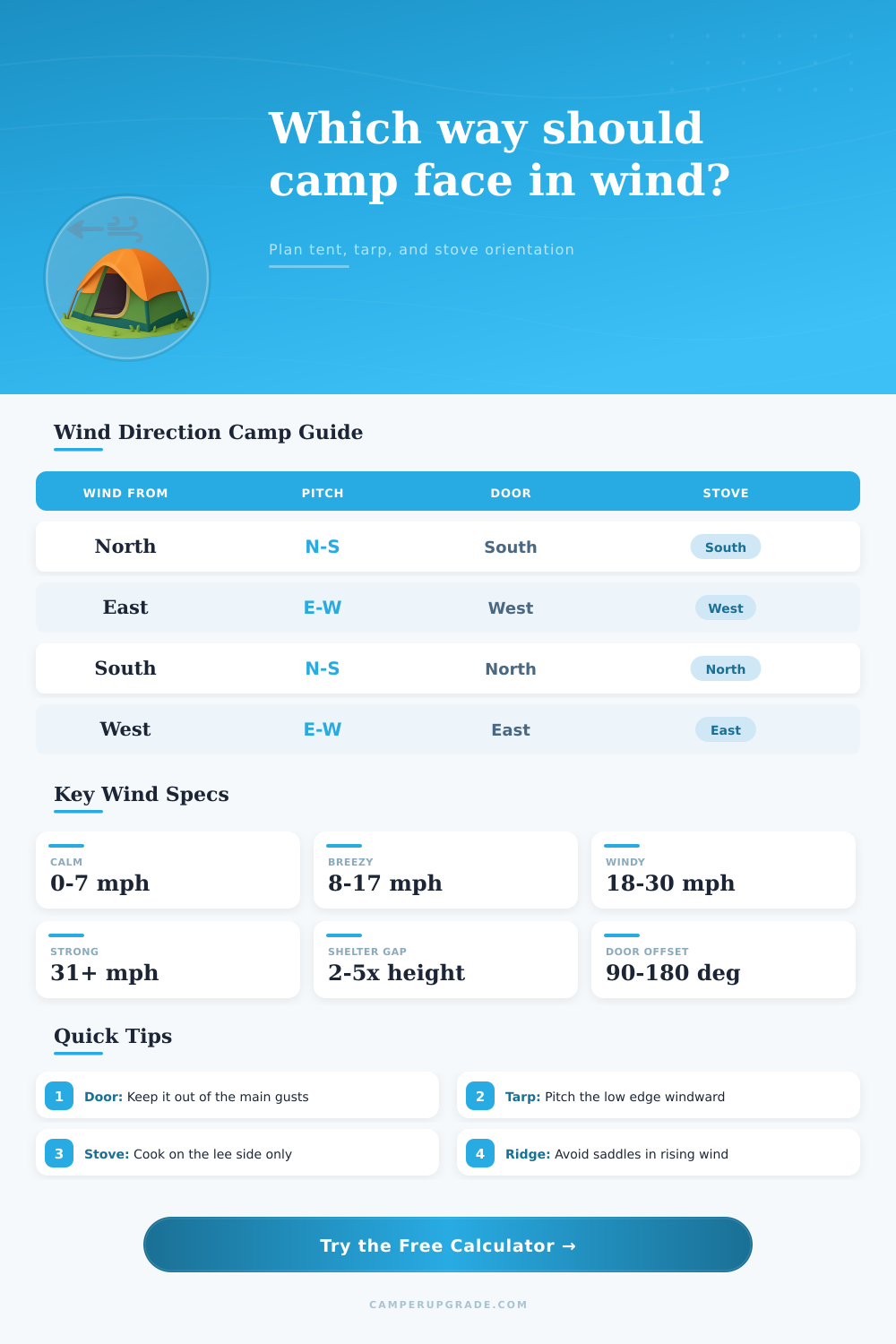
| Wind From | Blows To | Lee Door | Tarp Low Edge |
|---|---|---|---|
| North | South | South | North |
| East | West | West | East |
| South | North | North | South |
| West | East | East | West |
| Gust | Tent Action | Tarp Action | Awning |
|---|---|---|---|
| 0-7 mph | normal pitch | open pitch | usually ok |
| 8-17 mph | stake all points | lower wind edge | watch gusts |
| 18-30 mph | guy out corners | storm pitch | retract often |
| 31+ mph | seek shelter | avoid high tarp | retract |
| Terrain | Wind Effect | Best Camp Spot | Avoid |
|---|---|---|---|
| Forest | reduced | inside cover | dead limbs |
| Ridge | accelerates | below crest | saddles |
| Shore | steady fetch | behind dune | open point |
| Valley | night flow | bench above floor | cold chute |
| Shelter | Axis Goal | Door Goal | Cook Zone |
|---|---|---|---|
| Dome | short side wind | lee side | downwind |
| Tunnel | nose into wind | side lee | lee porch |
| Tarp | low edge wind | open lee | never inside |
| RV | nose to wind | lee entry | away from awning |
💡Campsite Wind Direction Tips
The wind that is felt at a camping site may be different than the wind that is stated in the weather forecast for a variety of reasons. For instance, the wind may bend around tree or it may accelerate over ridges. In addition, the wind may pool in valleys after the sun drops beneath the horizon.
Due to these behaviors of the wind, it is important to orient the tent and the tarp according to the wind to reduce any discomfort at the campsite. In addition, you should also place the door and the stove in locations that provide protection from the wind. Understanding how the wind will behave at a campsite allows an individual to turn weather forecast information into an effective plan for that campsite.
Set up your tent and tarp for the wind
Wind direction is a concept that indicates the direction from which the wind is moving. For instance, if the weather report indicates that there will be a west wind, the wind will move from the west to the east. The calmest area within a campsite will be the lee side of the shelter.
The lee side of the shelter is the side of the shelter that is directly opposite to the direction from which the wind is moving. Thus, if the wind is predicted to move from the west, the lee side of the shelter will be the east side of the shelter. Using the calculator, an individual can enter the direction of the forecasted wind, the gust speed of the wind, and the terrain where the campsite will be establish.
Based on this information, the calculator will provide the lee bearing which will indicate the way in which the door of the tent and the tarp should be oriented. The camper can utilize the terrain that will be utilized by the camper can impact the wind that reaches the tent. For instance, placing a tent in the interior of a forest will reduce the speed at which the wind reaches the tent due to the friction created by the trees.
An interior of a forest will typically reduce the forecasted wind speed by 75%. In contrast, an open meadow or flat area of sand will not contain any obstacle for the wind, and as such, will allow the wind to travel at its forecasted speeds. In addition, ridges and saddles will accelerate the wind, and the wind will be steady along shorelines if the shelter is positioned in such a way that the wind can come off of the water.
These features will be incorporated into the calculator to determine the effective gust speed that will impact the campsite. Windbreaks are feature of the campsite that will block the wind from the campers. For instance, a windbreak may be a tree or a rock wall.
These features will not only block the wind from the campers, but it will also create a protected zone for the campers that extends downwind for distances that are several times the height of the windbreak. An individual must decide at what distance behind the windbreak that the campers will position themselves. Positions too close to the windbreak may expose the campers to turbulence, but positioning the campsite too far from the windbreak will cause the benefit of the windbreak to fade away.
The most effective distances are between two and five times the height of the windbreak. The type of shelter that is utilized will impact the way that the shelter should be positioned relative to the wind. For instance, a dome tent will be most stable if the side of the tent that is the strongest is positioned facing the wind.
A tunnel tent will be most stable if the low (nose) portion of the tent is pointing directly into the wind. A flat tarp will be most stable if the lowest edge of the tarp is placed on the windward side of the tent; if it is not placed on the windward side, the wind may lift the tarp as if it were a sail. The calculator will compare the angle of the ridge line of the tent and shelter to the direction of the forecasted wind.
If the angle of the shelter is close to the angle of the direction from which the wind will blow, the shelter will remain stable; if not, the shelter may flap in the wind and the stakes may be knocked out of the ground. The door of the tent should be placed on the lee side of the tent. This ensures that gusts of wind will not blow into the tent when the door is open.
The calculator will compare the direction of the door to the lee bearing. An offset that is less than 90 degree is typically comfortable for the camper; an offset that is greater than 90 degrees may become uncomfortable for the camper as the wind strength increases. When camping, it is important to consider the direction of the wind when deciding where to place the stove.
The stove should be placed in a position that keeps smoke and sparks from entering the sleeping area. The stove should be placed in a sheltered spot, but the wind should carry the smoke away from the sleeping area. The calculator will provide an angle for the kitchen (stove) that is slightly offset from the main lee side of the shelter.
If the wind is light, the offset will be small. However, if the wind is likely to be strong during the camping trip, the offset will be larger so that the smoke will not blow into the sleeping tent or tarp. The quality of the anchors for the tent will affect how the tent and campsite will experience the wind.
For instance, if the tent is anchored in loose sand or stakes that are driven shallowly into the ground, the tent will not be able to fully utilize the strength of the wind. The calculator will provide a wind rating for the tent that indicates whether the campsite will feel settled or breezy based off the anchor system that is to be utilized at the campsite. Many campers make mistakes with positioning the tent.
For instance, many campers dont look at the ridge line of their tent prior to pitching the tent. Additionally, many campers will forget that gusts of wind are often more strong than the sustained wind that may be recorded in the weather forecast report. The calculator accounts for both the sustained wind and the gusty portion of the wind.
There are also other variable at the campsite that cannot be accounted for in the calculator. For instance, one should look overhead to ensure that no branches of trees may impact the sleeping area of the tent. Another variable to consider is cold-air drainage down the valley.
Finally, the smoker should ensure that the smoke from another fire will not blow into there tent if the wind is from that direction. These problems can be avoided by walking the campsite once the weather forecast is known. By knowing the direction from which the wind will blow during the camping trip, campers can make more informed decisions regarding the placement of their tent, their tarp, their sleeping area, and their cooking area.
By knowing the direction from which the wind will blow, campers will be able to ensure that their tent remains quiet, their tarp remains taut, and that their stove remains usable during there camping trip.