Campsite Bear Hang Height Calculator
Check whether a planned food hang has enough branch height, trunk clearance, ground clearance, rope length, and drop control for a practical backcountry setup.
⛺Bear Hang Presets
📏Branch, Rope, Drop, and Clearance Inputs
🧵Rope and Tree Spec Grid
🌲Hang Method Comparison
PCT Hang
Best all-roundSingle branch, stick toggle, and raised bag make it harder to pull down.
Counterbalance
Needs two bagsWorks when loads match and the branch is high enough for both sacks.
Two-Tree Line
Good in sparse treesUses a span between trees; watch sag and bark friction on long pulls.
Simple Limb
Emergency onlyQuick but easy to defeat if tied near the trunk or left too low.
📋Bear Hang Reference Tables
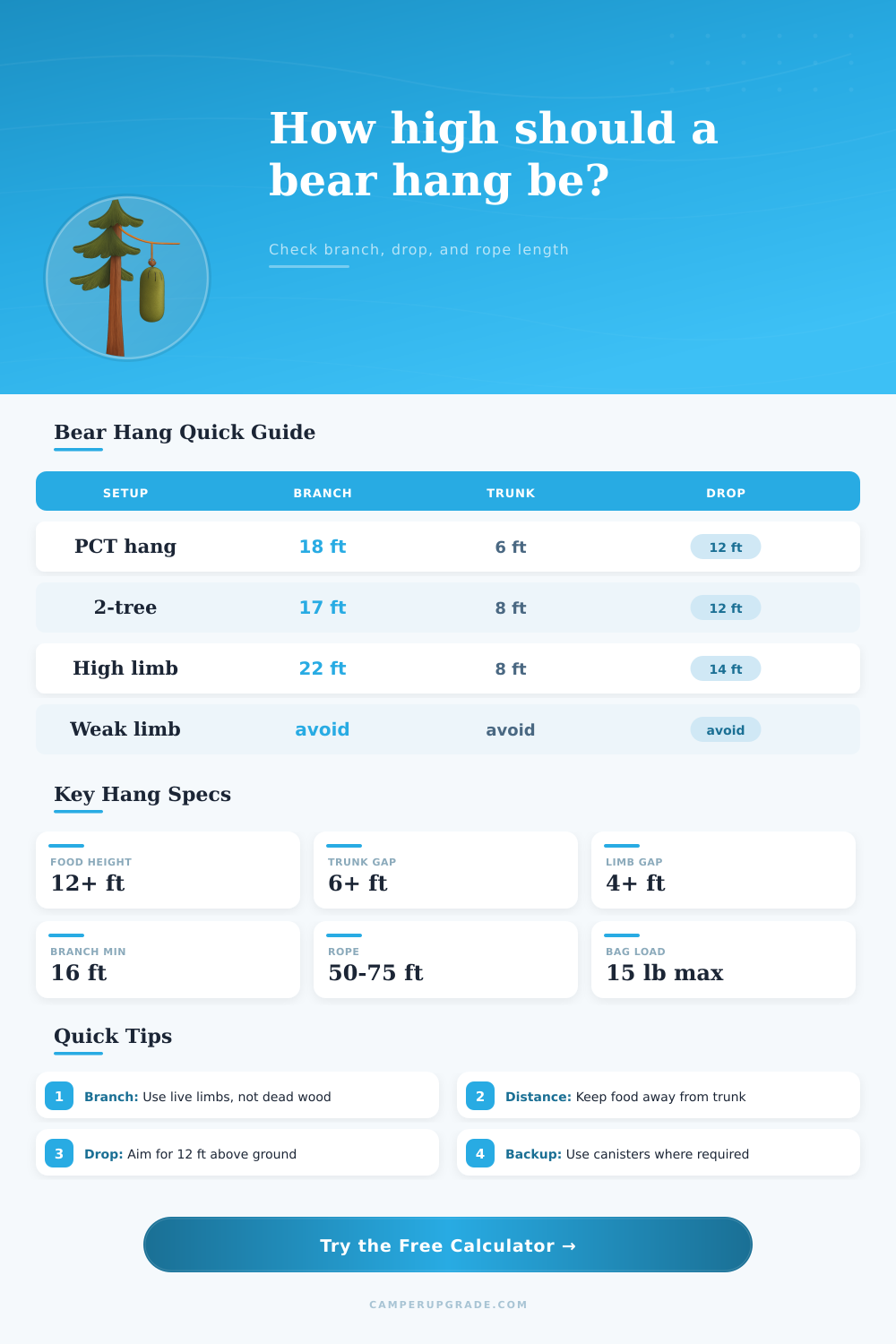
| Clearance item | Field target | Why it matters |
|---|---|---|
| Bag bottom above ground | 12 ft or more | Reduces reach from standing or climbing. |
| Bag from trunk | 6 ft or more | Keeps food away from the main climbing route. |
| Bag below limb | 4 ft or more | Limits reach from the supporting branch. |
| Branch height | 16 to 20 ft | Allows drop, sack height, sag, and ground clearance. |
| Camp distance | 100 yd common | Food should not hang beside the sleeping area. |
| Rope length | Best use | Notes |
|---|---|---|
| 40 ft | Short emergency hangs | Often tight after knots and tail. |
| 50 ft | Solo PCT hang | Works with moderate branch height and distance. |
| 60 ft | Most backpacking hangs | Gives useful throwing and tie-off margin. |
| 75 ft | Two-tree or high limb | Helpful when the food point is far from the trunk. |
| 100 ft | Group or long span | Bulky, but useful for complex sites. |
| Branch condition | Use? | Calculator treatment |
|---|---|---|
| Live 4 to 6 in limb | Usually suitable | Normal load and sag factor. |
| Live 6+ in limb | Strong candidate | Best for heavier food bags. |
| Small live limb | Limited loads | Adds sag and load warning. |
| Dead or cracked limb | Avoid | Returns an unsafe branch verdict. |
| Dense conifer limb | Case by case | May tangle rope and hide deadwood. |
| Food load | Hang note | Better option |
|---|---|---|
| Under 8 lb | Easy solo bag | Small PCT hang works well. |
| 8 to 15 lb | Typical trip load | Use a live limb and smooth cord. |
| 15 to 25 lb | Heavy pull | Split into two smaller bags. |
| 25+ lb | Hard to raise safely | Use locker, canister, or two hangs. |
| Odor items | Include with food | Hang toiletries and trash too. |
💡Bear Hang Tips
When hanging a food bag to store food away from bear, you must consider the geometry of the bag. The geometry of the food bag to be protect from bears isnt just the height of the food bag. Other variable include the horizontal distance from the tree trunk and the vertical drop from the limb to the food bag.
If these variables is not considered, the food bag may end up being either too low or too close to the tree for protection from bears. A calculator can help to ensure that the food bag is geometricly correct to protect the food from bears. Many people will attempt to estimate the height of the branch.
How to Hang a Food Bag to Keep Bears Away
Estimating the height of the branch will not provide accurate measurement of the height of the branch. The horizontal distance from the trunk will impact the height of the food bag that is hung from the branch. The vertical drop from the limb to the food bag will impact the length of the rope that is required for hanging the food bag.
The length of the rope will need to account for the knots in the rope and the length of rope that will be used for a pull-down line for the food bag. If the person does not account for these variables, they may not have enough rope to complete the task of hanging the food bag. The length of the rope is one of the critical variables in determining if the food bag can be successfully hung from the branch.
Fifty feet of rope may be thought to be long enough to hang the food bag. However, the rope may stretch when the food bag becomes wet. Furthermore, the length of the rope will also have to account for the throw end of the rope and the tail of the rope that an individual will be required to grab later in the camping trip.
The calculator makes allowances for both the stretch of the rope and the tail of the rope because the shortest path of the rope is not always a straight line from the branch to the individual camping. Additionally, the length of rope that will be required for a simple PCT hang is less than the length of rope that will be required for a two-tree line. However, both types of hangs will require more rope than the distance from the ground to the branch that is selected for hanging the food bag.
Another variable that will impact the hanging of the food bag is the weight of the food bag. Furthermore, the weight of the food bag can change from time to time. For example, the food bag may weigh 15 pound when first filled with food in the morning.
However, after hours the food bag may weigh more due to the condensation that has collected inside the bag. Furthermore, the weight of the bag may cause the branch to flex. The branch condition selector will help to determine whether or not the branch is strong enough to support the weight of the food bag.
For example, a live branch that is 4 to 6 inches in diameter can support a moderate load of food. However, branches that are less than 4 inches in diameter or dead branches are not recommended for the hanging of food bag. Another variable to consider is the slope of the ground under the food bag.
The slope of the ground will determine how much of a clearance there is for the food bag from the ground. If the ground slopes upward under the food bag, the value will be positive. The positive value indicates that there will be less clearance for the food bag from the ground.
However, if the ground drops under the food bag, the value will be negative. The negative value will provide additional clearance for the food bag from the ground. The calculator will use this value to ensure that the food bag is not touching any potentially problematic objects on the ground.
The reference tables will provide information regarding the variables discussed in the article. For instance, the reference tables will list the common targets for ground clearance, trunk distance and branch diameter. Furthermore, some camping areas do not allow for the hanging of food bags.
For these camping areas, a food canister will need to be used instead of a food bag. Each of the variables has a trade-off that will need to be considered. For example, choosing a limb that is higher will provide greater clearance for the food bag from the person camping.
However, higher limbs will make it more difficultly to throw the rope for the food bag and the rope may get wedged in a fork in the tree. Additionally, the weight of the food bag will impact how difficult it is to raise the food bag. However, using a lighter food bag may require splitting the food into two food bags.
Two food bags require more line to be hung from the branch than one food bag. These types of trade-offs are not made by the calculator. However, the calculator will indicate whether or not the chosen variables meets the requirements for hanging the food bag.
The real campsites may not be the same as the diagram of the food bag hanging from the tree. The limbs may not be perfectly horizontal and the rope may stretch when it gets wet. Furthermore, the ground may be soft and a bear may be able to stand on its hind legs to reach the food bag.
Although the calculator may not account for each of the variables, it does require that the individual measure each of the variables that can be controlled. Furthermore, these measurements have to be taken before it becomes dark in the camping area. The calculator will provide an indication of whether or not the food bag setup is good.
If the calculator indicates that the food bag setup is good, then it will meet the minimum requirement for distance from the camping individual. However, if the calculator indicates that the food bag needs to be adjusted, then the adjustments have to be made while it is still light out camping.