Bear Canister Capacity Calculator
Estimate bear canister volume for food, scented toiletries, trash space, day-one food strategy, group size, calorie density, and the spare margin needed to close the lid.
🏕Bear Canister Trip Presets
⚙Food Volume, Days, Group, and Calorie Inputs
This estimator compares measured food volume with calorie-density volume, subtracts legal day-one food outside the can, adds scented extras and trash, then applies a lid-closure buffer.
🐻Canister Spec Grid
Small Solo Can
5.0 LBest for overnight to short solo trips with dense food and a small toiletries kit.
BV450-Size Can
7.2 LCommon solo weekend or compact three-night choice when food is rebagged tightly.
BV500-Size Can
10.7 LCommon long solo or short pair capacity when the first day is eaten outside.
Expedition Can
12.2 LUseful for long resupply gaps, winter calories, or shared scented extras.
🔢Food Packing Benchmarks
📋Bear Canister Capacity Tables
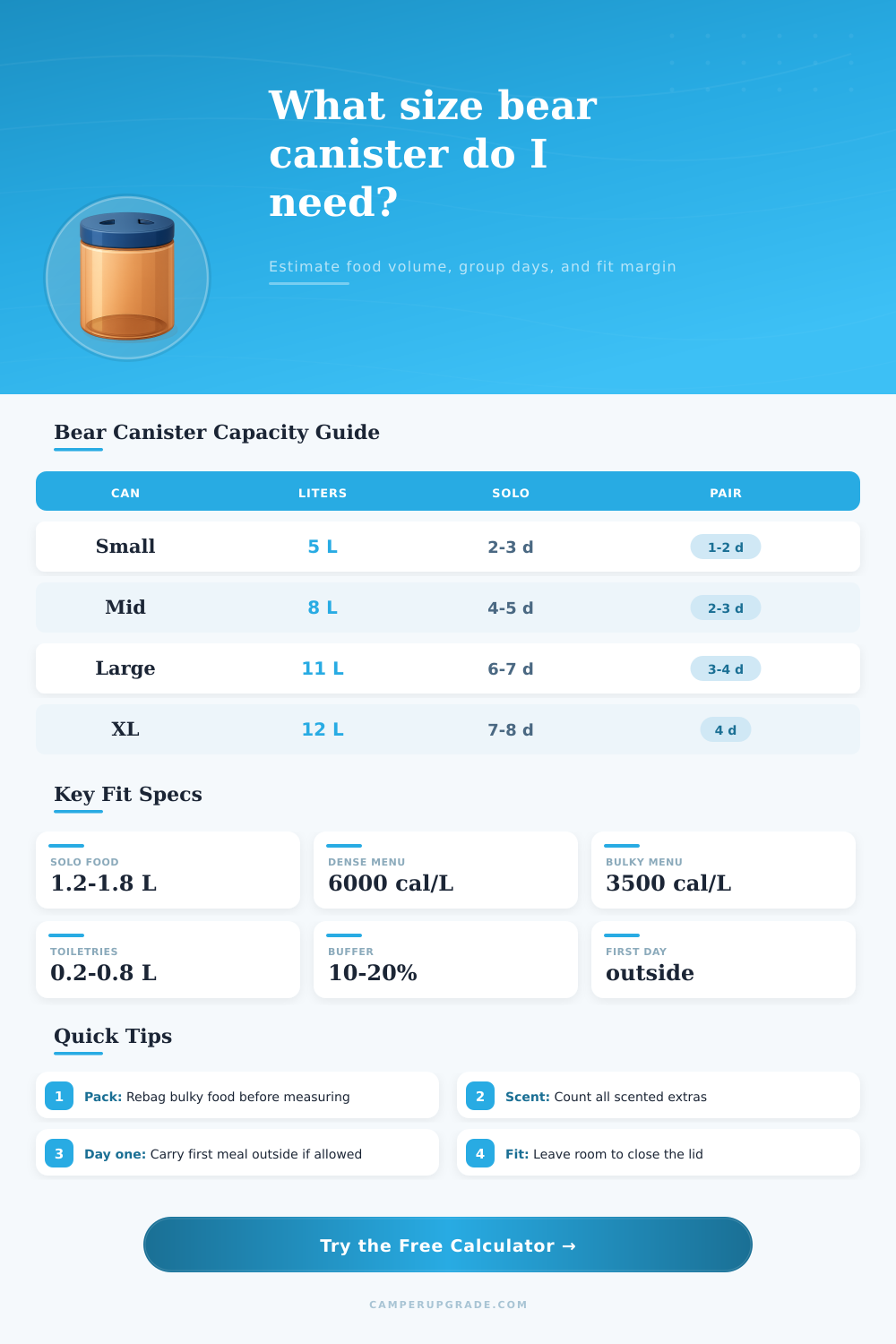
| Canister Class | Usable Volume | Solo Days | Pair Days |
|---|---|---|---|
| Small solo | 5.0 L | 2-3 days | 1 night |
| Short trip | 7.2 L | 3-4 days | 2 days |
| Mid large | 8.2 L | 4-5 days | 2-3 days |
| Large standard | 10.7 L | 6-7 days | 3-4 days |
| Expedition | 12.2 L | 7-8 days | 4 days |
| Menu Style | Cal/L | Volume/Day | Pack Signal |
|---|---|---|---|
| Fresh-heavy food | 3400 | 1.7-2.1 L | Bulky |
| Grocery mix | 4200 | 1.4-1.8 L | Normal |
| Backpacking mix | 5200 | 1.1-1.5 L | Compact |
| High-fat menu | 6200 | 0.9-1.3 L | Very dense |
| Freeze-dried pouches | 3600 | 1.6-2.2 L | Wrapper space |
| Scented Item | Typical Volume | Group Effect | Count It? |
|---|---|---|---|
| Toothpaste and balm | 0.05-0.15 L | Small | Yes |
| Sunscreen and lotion | 0.10-0.35 L | Shared | Yes |
| Trash and wrappers | 3-14% | Grows daily | Yes |
| First aid scent items | 0.05-0.20 L | Small | Yes |
| Clean cookware odor | Variable | Route rule | Often |
| Planning Case | People | Food Days | Likely Can |
|---|---|---|---|
| Solo weekend | 1 | 2-3 | 5-7 L |
| Solo week | 1 | 6-7 | 10-12 L |
| Pair weekend | 2 | 2-3 | 10-11 L |
| Four hikers | 4 | 3 | 2 large |
| Long gap | 1 | 8+ | XL or split |
💡Bear Canister Packing Tips
Choosing a bear canister require you to account for the total volume of all of the scented item that your group will have. Choosing a bear canister also requires you to account for the volume of the food wrapper that your group will produce. You must consider the space that is required for your food, but you must also consider the space that is required for your trash and food wrapper, as these items are also scented and must be contain within the canister.
If you do not account for the volume that is taken up by your trash and food wrapper, the bear canister may not be able to properly close. To calculate the proper size of your bear canister, you must input your group size, the length of your trip, your target calorie count for each group member per day, and the amount of food that you will consume on the first day of your trip. Each person-day of food will determine how much volume your bear canister must have to contain your food.
How to Choose a Bear Canister
Furthermore, the calculator compare the volume of the food that you will bring to the canister to the calorie density of that food to determine whether the food that you plan to bring is likely to be bulky or compact. In addition to the food, your group may also have other item that contain scent and that must be contained within the bear canister. Items like toothpaste, sunscreen, and lip balm contain scents that will require you to place these items within the bear canister.
The calculator account for these items by having an input for those scented items, as well as for the allowance for trash. The allowance for trash allows for the space within the canister for the empty food pouch and food wrapper to be carried out of the wilderness. You can reduce the volume of the food that you will bring by repackaging your food prior to your trip.
While repackaging your food may save you space, you may not save as much space as the packaging material suggest. The calculator allow you to select the level of compression that your food will have after being repackaged. For instance, you can achieve a modest reduction in the volume of food of around 18% by moving the food into lighter bag.
However, a 25% reduction in the volume of food may require vacuum sealing the food or crush the food. The way that you plan to eat the food on the first day of your trip will impact the size of your bear canister. Regulations for many backcountry area allow for the food for the first day of a trip to be carried outside of the bear canister until the group reaches the first camp for that trip.
The calculator will subtract the volume that is taken up by the food for the first day of the trip. However, the food for the first day of the trip must be eaten prior to arrive at the first camp. The calculator will output the volume that is required for the bear canister, as well as the fit margin for that canister.
The fit margin account for the extra space within the bear canister. A negative fit margin will indicate that the food and trash will not fit into the bear canister, and that the lid of the canister will not be able to properly close. A small positive fit margin will indicate that the canister will be very full of food and trash, but will still permit for extra item in the canister.
A large positive fit margin will indicate that there is extra room in the bear canister for any additional items. These calculation may not account for the specifics of your real trip. For instance, the weather may delay your arrival at your destination, which would require an increase in the amount of food that is required to be provided for each member of your group.
Furthermore, the snack that each member of your group eats may also impact the volume of each individual’s bear canister. Each member of your group may also have item that take up space within the shared bear canister. Despite the fact that no calculator can account for all of the variable for each trip, such a calculator can help you to identify the variable that you will need to account for your group prior to embarking on your trip.
The reference table that are provided on the calculator allow you to see the sizes of bear canisters that are commonly available, as well as the different menu style that may be available to backcountry campers. While these table are not rules for the trip, they can help to provide an estimate of whether your menu will be bulky or compact. Once you have used these reference table to estimate your menu, you can use the calculator to determine the actual calculation for your specific trip.