Campsite Water Distance Calculator
Estimate one-way water distance, round-trip hauling effort, refill timing, and group carry workload from terrain, water source, route, container size, and camp demand.
⛺Water Haul Presets
📏Terrain, Water Source, Route, and Group Inputs
The calculator converts your route to an effort distance using terrain, elevation, route shape, and carrying load, then compares that workload with water demand and container capacity.
🏕Terrain and Source Spec Grid
📊Water Distance Reference Tables
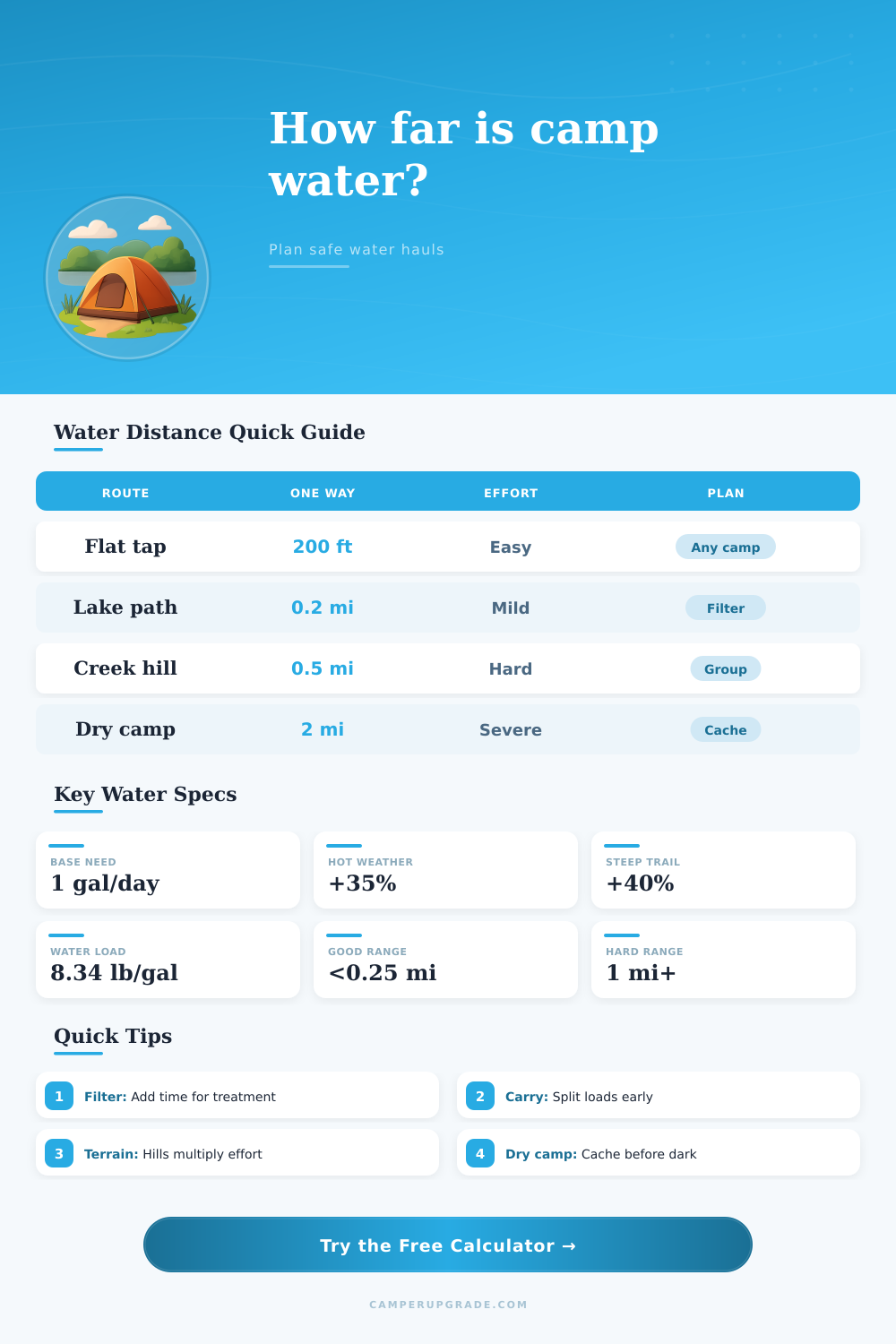
| One Way | Round Trip | Use Case | Plan |
|---|---|---|---|
| 100-300 ft | 200-600 ft | Camp tap | Small jug ok |
| 0.1 mi | 0.2 mi | Lake edge | Filter run |
| 0.5 mi | 1.0 mi | Backcountry | Team carry |
| 2 mi | 4 mi | Dry camp | Cache water |
| Terrain | Factor | Carry Feel | Watch |
|---|---|---|---|
| Paved | 0.9x | Easy | Traffic |
| Forest | 1.2x | Moderate | Roots |
| Sand | 1.45x | Hard | Sinks |
| Snow | 1.6x | Very hard | Ice |
| Source | Refill | Treatment | Best Container |
|---|---|---|---|
| Spigot | Fast | None | Jug |
| Pump | Medium | Usually none | Jug |
| Creek | Medium | Filter | Bladder |
| Snow | Slow | Melt or boil | Pot plus bag |
| Group | Daily Water | 5 gal Jugs | Load Weight |
|---|---|---|---|
| Solo | 1-1.5 gal | 1 partial | 8-13 lb |
| 2 people | 2-3 gal | 1 | 17-25 lb |
| 4 people | 4-6 gal | 1-2 | 33-50 lb |
| 8 people | 8-12 gal | 2-3 | 67-100 lb |
💡Water Haul Tips
The distance between a campsite and a water source will determine the effort that an individual must exert to fetch there water. When camping, it is possible to arrive at a campsite where the water source is farther away than indicate on the map. Additionally, although it may seem easy to walk from the campsite to the water source, the return trip is often more difficult because the individual is carrying heavy container of water.
Each of these factors can increase the difficulty of the trip relative to the distance between the campsite and water source alone. In addition to distance, a number of other factors will impact the effort required to fetch water from a water source. Beyond the fact that the terrain may make it more difficult walk back to the campsite with the heavy containers of water, the time that is required to treat the water after reaching the water source also creates an impact upon the overall effort.
How hard is it to get water at camp
Furthermore, it is also necessary to consider if the group has enough water to last them throughout the trip, and to ensure that they dont run out of water while eating or during the cleanup of their camping area after meals. Each of these factors has the potential to influence the other factors. For instance, an individual may find that walking downhill to a water source is an easy trip to the water’s source, but that same downhill path will be difficult for individuals who are walking back to the campsite with heavy containers of water.
Additionally, walking across sand may be more difficult than walking across gravel, even if the distance walked on each type of terrain is the same. In each of these cases, the calculator allows an individual to input their specific conditions that may influence the effort that must be exerted to collect water from their water source. The conditions under which a group must collect their water will also influence the total effort that must be expended to fulfill that need.
Factors like weather conditions will alter the amount of water that an individual needs; an individual who is exposed to cool weather may only need to consume one gallon of water per day, but the same individual may require one and a half gallon of water if they are exposed to hot weather. Each of these factors the calculator can manipulate, as well as the number of individuals in the trip, the number of days that the individuals will be on the trip, and the total amount of water that will be needed for each individual. Furthermore, elevation changes can also impact the effort that an individual must exert when walking to and from the water source.
For instance, if the water source is located downhill from the individual’s camping area, then the individual may find that the trip to the water source is an easy trip, but the return trip will be difficult for those who are required to transport the heavy containers of water to the camping area. Additionally, the conditions of the footing of the trail to the water source can also create difficulties for those who are required to travel such a distance with such heavy load of water; the calculator also applies a multiplier to the effort if the footing is poor to account for this difficulty. Finally, individual may also encounter difficulties related to the need to treat their water prior to drinking it; water sources like creeks may require that individuals filter their water, while water sources that contain water with high levels of alkalinity may require that individuals perform chemical treatments to their water prior to drinking.
Additionally, water that originates as snowmelt will require that those individuals spend time and effort to melt the snow before they can use that water. These additional minutes of effort are also accounted for in the calculator. Furthermore, individuals may need to consider the number of individuals that are traveling to the camping site; if there are only two individuals within a camping area, then it may be easy for each individual to manage the collection of water for themselves.
However, if there are eight or ten individuals within a camping area, it is possible for those individuals that arrive at the water source at the same time to become competitive for access to that resource. By determining the number of trips that each camping area will require based off the water demands of the group and the size of their water containers, individuals can develop a plan for the camping area that ensures that no individual runs out of water during their camping trip. Additionally, if the camping area is not wet or dry, individuals may have to make a decision about whether or not they wish to cache their water in advance of their camping areas, or whether or not they wish to change the campsite to one that is closer to the water source.
The calculator allows individuals to make such a decision by showing the effort that will be required; if the effort that the calculator calculates is high, the individual can use that information to determine whether or not the camping area is worth the effort that will be required to walk to the water and perform other camping activities. An individual can determine the effort that is required to walk to a water source by measuring the distance from the campsite to that water source while carrying a loaded container of water. This will allow the individual to determine if the distance to the water source will be an effort to transport the water.
Additionally, as with any other calculation that is performed with the tool, the calculator will account for this effort and produce an effort value that includes this factor. Although the calculator will calculate the effort that is required for each of these factors, the individual must still make the last decision as to whether or not the calculated figure is acceptable for the individual. With experience in camping with individuals in their group, an individual will become familiar with which factors have the greatest impact upon the total effort that is required to collect the water that an individual or group requires.
For instance, individuals that travel alone can often travel greater distances than groups. Furthermore, dry camping trips may require an individual to consider the impact of water temperature, as well as the effort that may be required of an individual to heat the water to a desirable temperature; hot weather will increase the amount of water that is required for those individuals. Although the calculator will calculate each of these factors, they will not replace an individual’s judgment; rather, they will ensure that an individual’s judgment is made based upon the calculated effort for each factor.
They’re will also be alot of things to consider. The moddern camper should of prepared for anyting.