Campsite Slope Calculator
Measure rise, run, tent length, pad footprint, and comfort limits to estimate campsite grade, angle, head-to-foot drop, drainage behavior, and leveling needs.
⛺Campsite Slope Presets
📏Rise, Run, Tent Length, Pad, and Comfort Inputs
The calculator uses grade = rise divided by run, angle = arctangent of rise/run, then projects the same slope across your sleeping length, pad length, and cross-slope width.
🏕Campsite Surface Spec Grid
📊Slope and Leveling Reference Tables
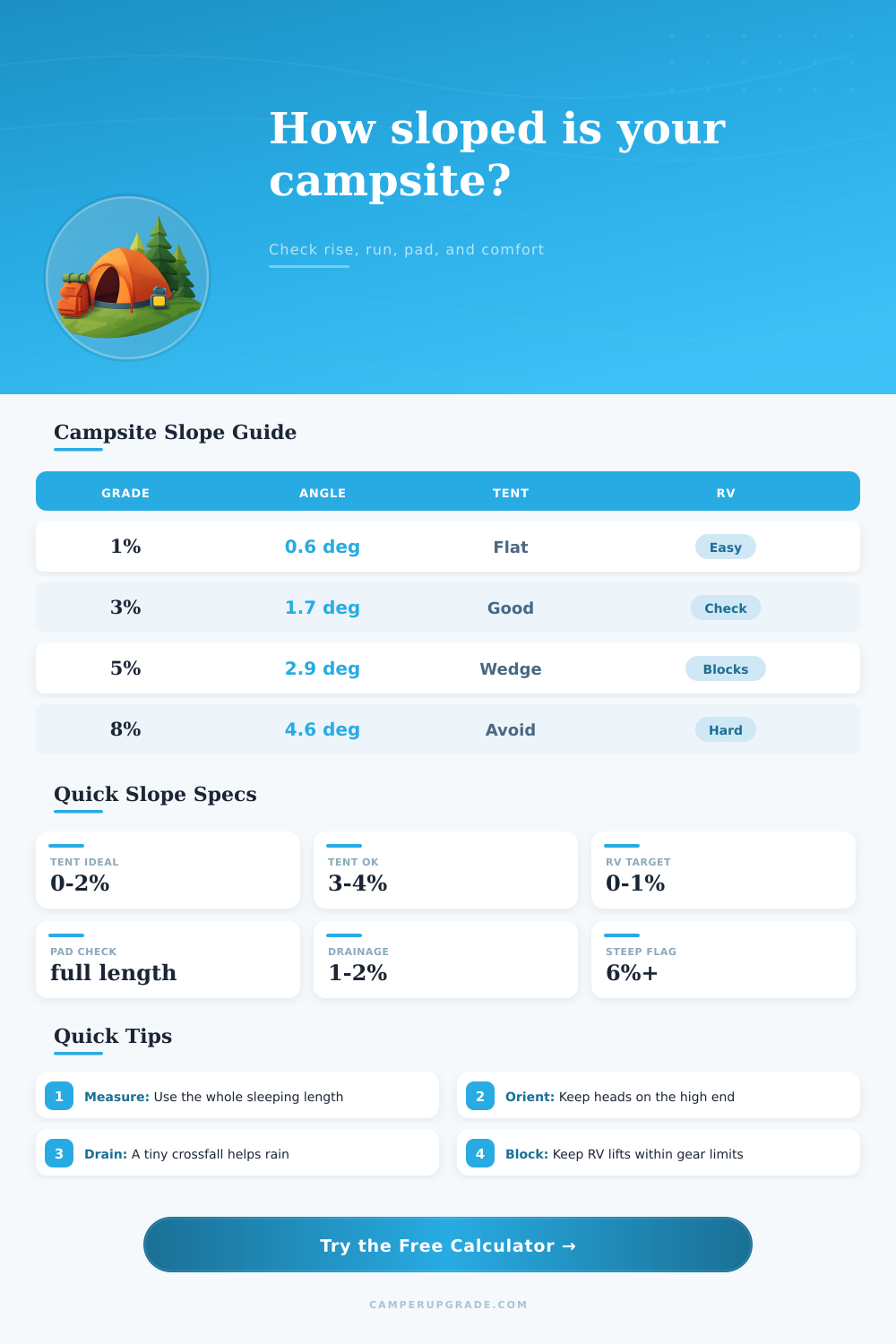
| Grade | Angle | Tent Feel | Action |
|---|---|---|---|
| 0-1% | 0-0.6° | Flat | Use normally |
| 2-3% | 1.1-1.7° | Mild | Head high |
| 4-5% | 2.3-2.9° | Obvious | Wedge pad |
| 6%+ | 3.4°+ | Steep | Move or level |
| Rise | Run | Grade | Angle |
|---|---|---|---|
| 1 in | 8 ft | 1.0% | 0.6° |
| 3 in | 10 ft | 2.5% | 1.4° |
| 6 in | 12 ft | 4.2% | 2.4° |
| 12 in | 16 ft | 6.3% | 3.6° |
| Setup | Length | 2% Drop | 4% Drop |
|---|---|---|---|
| Solo pad | 6 ft | 1.4 in | 2.9 in |
| 2P tent | 7.5 ft | 1.8 in | 3.6 in |
| Family tent | 10 ft | 2.4 in | 4.8 in |
| Small RV | 20 ft | 4.8 in | 9.6 in |
| Surface | Grip | Leveling | Watch |
|---|---|---|---|
| Duff | Good | Compresses | Roots |
| Gravel | Good | Blocks well | Roll stones |
| Sand | Fair | Needs pads | Sinks |
| Rock | High | Hard to shim | Pressure pts |
💡Campsite Slope Calculation Tips
A selection of campsite locations require attention to the slope of the ground at those locations. The slope of the ground is one of the primary factor in determining whether a campsite will be comfortable for the individuals who visit the campground and campground location. While it may appear to be level, the ground may feature a slope that cause sleeping bags to slide off of campers or cause camping refrigerators to tend to tilt.
The slope is a consideration of the change in height to the distance. Such a slope can contribute to an uncomfortable camping experience. To calculate the percentage grade of the slope of the ground at the campground location, you can enter both the vertical rise of the ground and the horizontal distance to that vertical rise into the provided calculator.
How to Check the Slope for a Comfortable Campsite
The calculator will provide a percentage grade for that slope. In addition to calculating the percentage grade of the slope, you can enter the sleeping length or the length of the camping vehicle into the calculator as well. The calculator will display the drop in inches of the sleeping or camping vehicle based on the percentage grade of the slope.
Such a drop can contribute to an uncomfortable sleeping experience. For instance, a two percent grade with a seven foot sleeping length will result in an inch and a half drop. However, a five percent grade with the same sleeping length will result in nearly four inches of drop.
The ground surface impact the feeling of the slope and how that slope may behave beneath the sleeping camper. For instance, duff and pine needles may provide some grip for camping furniture and sleeping individuals, but the duff and pine needles may compress beneath those sleeping individuals. Thus, the slope may feel steeper than it would when the duff and pine needles is not compressed.
Additionally, gravel may allow for the placement of leveling blocks to level the sleeping area, but the gravel may roll beneath the sleeping vehicle if the slope is too aggressive. Sand may allow for level camping furniture, but the sleeping camping equipment may shift on the sand. Finally, rock may be a stable sleeping surface, but the rock will not permit even distribution of the sleeping individuals body weight across the sleeping pad since the rock will not compress.
Each of these surfaces can be chose with the calculator, and you can adjust the recommendations for comfort according to the selected ground surface. The sleeping equipment may be oriented in a variety of ways on the slope. For instance, sleeping with the head of the sleeping individual on an uphill slope is more comfortable than sleeping with the sleeping head positioned downhill.
However, the campground may force sleeping individuals to sleep with there heads positioned downhill due to the placement of trees or the sleeping individual must sleep with their face to the wind. Finally, side hill sleeping setups may be forced upon sleeping individuals due to the sleeping location of the sleeping individual’s camping area. The calculator also includes an orientation selector that will allow you to choose whether the drop that you want to create is going to be head to foot or side to side.
Drainage is another reason that you may want to consider the slope of the ground that you’re about to camp on. Drainage is the process of creating a gentle slope on the ground that will allow water to naturally move away from your tent. A slope of one to two percent will help with drainage, and those percentages are generally gentle enough to allow people to remain comfortable on those slopes.
While a steeper slope would work better for drainage, it may make it difficult for those camping to sleep comfortabley on such a slope. You can use the drainage mode on the calculator, as the calculator will provide different recommendations to you should you select this mode. Leveling gear has a limit to how high it will go.
Whether you are using RV blocks or tent wedges, there will be a maximum thickness for these product. If the drop that you calculate that your slope will produce is more than the maximum height that your leveling gear can go, then the campsite is likely not going to be practical for your camping situation. The calculator will allow you to input the lift that you have available with your leveling gear, and it will let you know whether or not that lift will allow you to compensate for the drop that your slope will produce.
Many people make mistakes when using the slope calculator. For example, many people will make mistakes in that they only measure a few feet of the ground. For instance, it is possible that three feet of the ground may be flat, but the remainder of the ground that you need to level may have a significant drop.
Use the actual length of your tent or RV when you are measuring the slope with the calculator. Additionally, make sure you take cross slope into consideration. The reference tables located on this page can provide context to the calculations that you perform with the calculator.
The reference tables include information about how grades (percentages) can become angles, and vice versa. Additionally, the tables also include information about how different angles will affect tents and vehicles. These tables are not strict rules that need to be followed for camping trips.
However, they do help to provide context and an understanding of the measurements that you create with the calculator. The goal is to find an even campsite, but the ground is rarely even with real campsites. There may be roots or depressions in the ground that may not be measured by a single measurement of slope.
Use this calculator and your own judgment to find an even spot for your tent and RV. The goal is to ensure that the slope of the ground falls within a range that your body and your gear can handle.