Camp Heater BTU Calculator
Estimate heater output for tents, truck campers, vans, RV bunks, and small cabins from shelter volume, target temperature rise, insulation, wind exposure, leakage, and fuel type.
🏕Camp Shelter Presets
⚙Shelter Volume, Temperature, Insulation, and Wind Inputs
This calculator estimates heat load only. Use heaters rated for the space, follow manufacturer ventilation and clearance rules, and use a working carbon monoxide alarm with fuel-burning heaters.
📐Formula Cards
Shelter Volume
V = L × W × HBox shelters use full volume; domes and wedges use shape factors to avoid oversizing.
Temperature Rise
ΔT = target - lowThe required rise drives most of the load, especially in thin-walled shelters.
Heat Load
BTU/hr = V × ΔT × FFactor F blends insulation, wind, leakage, and floor contact multipliers.
Fuel Estimate
Fuel = BTU × hrs / energyFuel draw is adjusted by heater efficiency and the selected runtime.
🔥Heater and Fuel Spec Grid
📊BTU and Heater Reference Tables
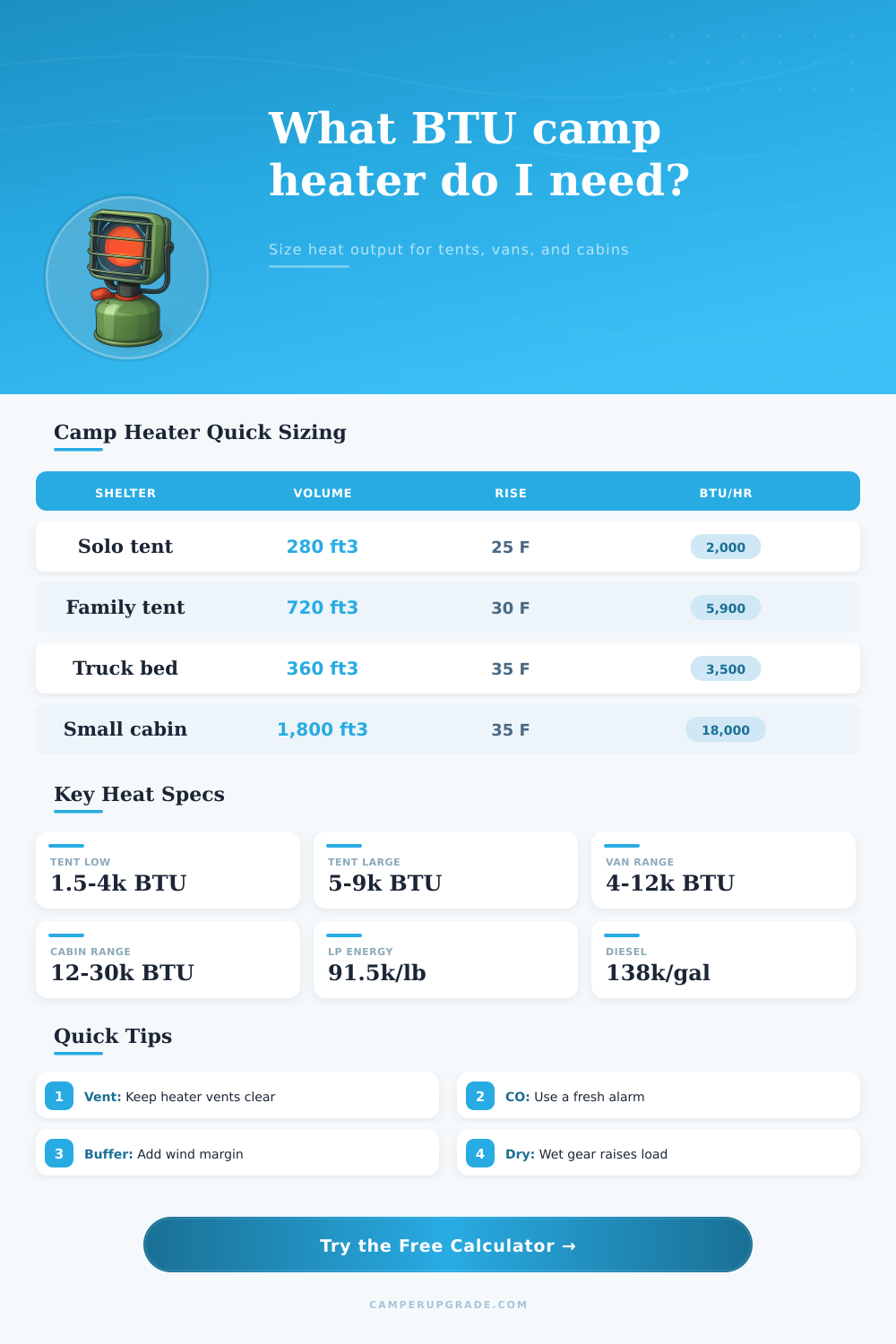
| Shelter type | Typical volume | 30°F rise | BTU/hr range |
|---|---|---|---|
| Solo backpacking tent | 120-260 ft³ | Cold sleep target | 1,200-3,000 |
| Two-person dome tent | 250-450 ft³ | Moderate comfort | 2,500-5,000 |
| Family cabin tent | 650-1,100 ft³ | Group shelter | 5,500-10,000 |
| Canvas wall tent | 900-1,800 ft³ | Stove-ready shell | 8,000-18,000 |
| Small camp cabin | 1,500-3,000 ft³ | Insulated shell | 12,000-30,000 |
| Temp rise | 250 ft³ | 750 ft³ | 1,500 ft³ |
|---|---|---|---|
| 15°F rise | 900-1,500 | 2,700-4,500 | 5,400-9,000 |
| 25°F rise | 1,500-2,500 | 4,500-7,500 | 9,000-15,000 |
| 35°F rise | 2,100-3,500 | 6,300-10,500 | 12,600-21,000 |
| 45°F rise | 2,700-4,500 | 8,100-13,500 | 16,200-27,000 |
| 55°F rise | 3,300-5,500 | 9,900-16,500 | 19,800-33,000 |
| Heater type | Output style | Usual efficiency | Best use |
|---|---|---|---|
| Propane radiant | Spot heat | 80%-90% | Tents with required venting |
| Propane catalytic | Gentle radiant | 85%-95% | Small spaces, low air movement |
| Diesel forced air | Ducted warm air | 75%-88% | Vans, campers, hard shells |
| Electric resistance | Fan or radiant | 100% | Shore power or generator sites |
| Wood tent stove | Radiant cycles | 40%-65% | Canvas shelters with stove jack |
| Condition | Multiplier | Why it matters | Input match |
|---|---|---|---|
| Single-wall fabric | High | Fast conductive loss | Insulation |
| Open windy camp | Medium-high | More infiltration | Wind |
| Required heater vent | Medium | Warm air is exhausted | Leakage |
| Bare frozen ground | Medium | Cold floor sink | Floor |
| Damp gear drying | Low-medium | Latent heat load | Buffer |
💡Practical BTU Sizing Tips
To choose a camp heater correctly, you must understand the relationships between the camp heater, the shelter, and the weather. The camp heater must be able to heat the volumes of the shelter to the desired temperature. You must consider how much heat escape from a shelter and how many fuel a camp heater will consume.
The volume of air in a shelter is the first factor to consider when choosing a camp heater. A small shelter will have a small volume of air to heat, while a large shelter will have a large volume of air to heat. The larger the volume of air that a shelter contains, the more heat outputs a camp heater must possess to heat each cubic foot of air in the shelter.
How to Choose a Camp Heater
If there is a large volume of air in a shelter, the camp heater will have to work hard to heat that many cubic feet of air to the desired temperature. The temperature difference between the outside air in a shelter and the inside air of a shelter is the second factor to consider. For example, if the outside temperature is thirty degrees and the desired indoor temperature is fifty-five degrees, then the camp heater will have to create that difference in temperature.
The larger the gap between the outside and inside air temperature, the more heat output a camp heater will need to providing that gap in temperature. Many underestimations occur in this calculation because most people only consider the temperature that a camp heater should reach, not the temperature it should maintain. The insulation levels of a shelter will change the performance of the camp heater that is used within the shelter.
For instance, if the shelter is made of single wall nylon fabric, it will lose heat quick compared to a shelter made of double wall fabric or canvas. Additionally, an insulated van will retain heat better than a tent shelter, meaning the camp heater will have to work less hard in a camp vehicle compared to a tent. Thus, a shelter that loses heat at a higher rate will require a larger output of heat from a camp heater to maintain the same internal temperature.
One of the most significant factors to consider when choosing a camp heater is the exposure to the wind. Campgrounds in the shelter may be surrounded by trees, while other camping sites may feature open ridges with high exposure to the wind. A shelter in a sheltered forest will lose heat more slow than a shelter situated on an open ridge.
The higher the exposure to the wind, the more heat will be lost from the shelter. Thus, a lightweight shelter exposed to the wind will require a larger camp heater than one that is sheltered from the wind. Air leakage and the way that a shelter’s floor contact the ground can also impact the performance of a camp heater.
Warm air leaves a shelter when a door is opened or when a zipper on a sleeping bag is not fully closed. Cold air enters a shelter when warm air leave a shelter. A bare snow floor will pull heat away from the shelter, increasing the demand on a camp heater.
Each of these factors needs to be accounted for when determining the actual heating requirements of the shelter. The type of camp heater that will be used will impact how that heat is delivered to those within the shelter. For instance, propane radiant heaters will heat the individuals within the shelter directly, while a diesel forced air heater will heat the air within the shelter.
Electric resistance heaters will heat the air within the shelter, but will require access to either a generator or shore power to provide the electricity necessary to run the heater. Finally, wood stoves will provide high levels of heat to the shelter, but will also provide periods of cooling to the shelter. Each of these factors will impact the choice of camp heater type.
The runtime that is selected for the camp heater will impact the fuel consumption of that camp heater. For instance, the larger the size of the tent, the more fuel that will be consumed over the course of the trip, regardless of the type of heater that is used. Similarly, the smaller the tent that is used, the less fuel will be consumed over the course of the trip.
Each of these factors will impact the fuel requirements of the shelter. It is common for many people to make mistakes in the camping world in relation to the size of a camp heater. For instance, individuals may purchase a very large camp heater only to find that the fuel consumption of that camp heater is often too rapid to effectively warm the shelter.
Alternatively, individuals may purchase a very small camp heater only to find that the shelter becomes too cold during those very cold camping trips. These mistakes can be avoided by using a calculator to determine the size of the camp heater that is required according to the dimension of the shelter and the sleeping individuals. When burning fuel, safety is a consideration for each of the camp heaters.
Any camp heater that burns fuel will require ventilation, clearance from the shelter fabric, and the inclusion of a carbon monoxide alarm. The requirement of ventilation for the fuel-burning camp heater will cause warm air to leave the shelter. This will increase the load on the camp heater to account for the warm air that will leave the shelter, thus increasing the amount of fuel that will be consumed.
Therefore, individuals must ensure that the camp heater has the ability to account for such an environmental factor. In order to effectively determine the correct camp heater for the shelter, the dimensions of the shelter must be measured, the intended temperature within the shelter must be decided, and the impact of the wind, insulation, and ground conditions within the shelter must be accounted for. If each of these factors are accounted for, and if the camp heater that is selected has an output that helps to fulfill each of those factors, the camp heater will maintain a steady temperature within the shelter throughout the sleeping period.