Solar Lantern Runtime Calculator
Estimate camp lantern battery runtime, nights of light, solar recharge, charge time, and brightness draw from practical lighting inputs.
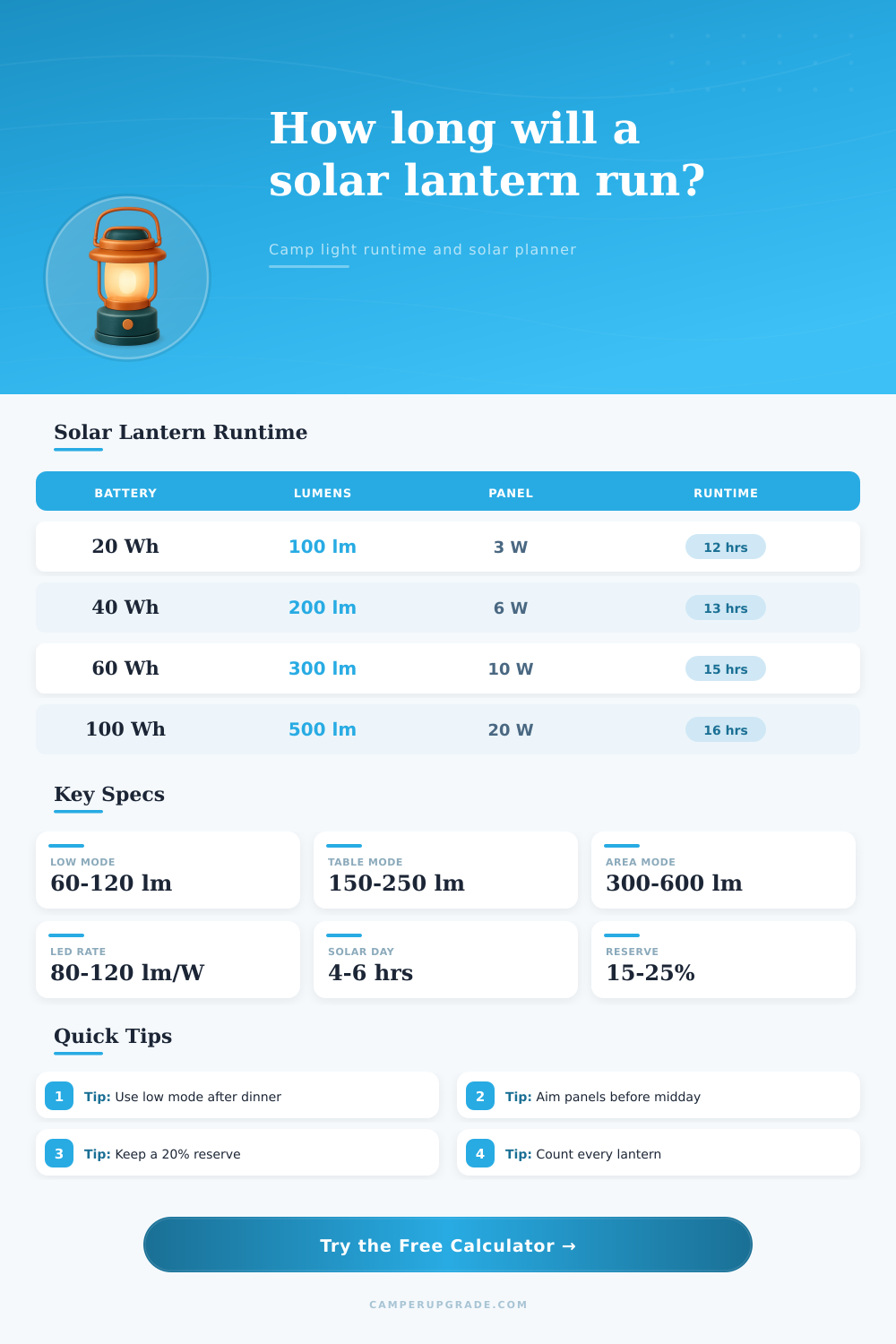
Lantern runtime breakdown
| Lighting mode | Brightness per lantern | Estimated LED draw at 90 lm/W | Best camp use |
|---|---|---|---|
| Moonlight / night marker | 20-50 lumens | 0.2-0.6 W | Tent locator, kids sleeping, late-night path light |
| Low tent mode | 60-120 lumens | 0.7-1.3 W | Reading, changing clothes, low battery use |
| Table mode | 150-250 lumens | 1.7-2.8 W | Cooking prep, cards, sorting gear, picnic table |
| Area mode | 300-600 lumens | 3.3-6.7 W | Group camp chores, awning zone, camp kitchen |
| High / work mode | 700-1000 lumens | 7.8-11.1 W | Short repairs, late arrivals, large shared shelter |
| Battery capacity | Usable after 20% reserve | Runtime at 100 lumens | Runtime at 300 lumens |
|---|---|---|---|
| 10 Wh compact lantern | 7.2 Wh usable | About 6.5 hours | About 2.2 hours |
| 20 Wh camp lantern | 14.4 Wh usable | About 13 hours | About 4.3 hours |
| 40 Wh family lantern | 28.8 Wh usable | About 26 hours | About 8.6 hours |
| 60 Wh lantern / power bank | 43.2 Wh usable | About 39 hours | About 13 hours |
| 100 Wh power station light | 72 Wh usable | About 65 hours | About 22 hours |
| Panel setup | Good sun harvest | Cloudy harvest | Lantern capacity matched |
|---|---|---|---|
| 1.5 W built-in mini panel | 4-6 Wh/day | 1-3 Wh/day | Small marker lights and low modes |
| 3 W built-in lantern panel | 8-13 Wh/day | 3-6 Wh/day | 10-20 Wh lanterns with modest use |
| 6 W fold-out panel | 16-25 Wh/day | 6-12 Wh/day | 20-40 Wh lanterns or two low lights |
| 10 W USB panel | 28-42 Wh/day | 10-20 Wh/day | Family lanterns and regular table light |
| 20 W portable panel | 56-84 Wh/day | 20-40 Wh/day | Multiple lanterns or a lantern plus phone top-up |
| Scenario | Battery and panel | Brightness plan | Expected result |
|---|---|---|---|
| Solo tent weekend | 20 Wh battery, 3 W panel | 80 lumens for 4 hours/night | About 5 nights battery-only, solar usually covers daily use |
| Two-person dinner table | 40 Wh battery, 6 W panel | 180 lumens for 5 hours/night | About 3 nights battery-only, partial cloudy-day recovery |
| Family camp kitchen | 60 Wh battery, 10 W panel | 350 lumens for 5 hours/night | About 2-3 nights battery-only, full recharge in strong sun |
| Group shelter high mode | 100 Wh battery, 20 W panel | 700 lumens for 4 hours/night | About 3 nights battery-only, best with daily panel aiming |
| Storm reserve | 40 Wh battery, no reliable solar | 60 lumens for 6 hours/night | About 8 nights if kept on low mode |
A solar lantern is a tool that can be used to provide light to camping trips. The lantern utilizes a battery to provide the light to those camping trips. Many people believes that the solar lantern will always contain enough light to illuminate the camping trip.
However, if you dont manage the battery power of that lantern correctly, then the lantern may run out of battery power prior to the end of that camping trip. The battery life of the lantern is dependent upon the brightness settings of that lantern. If the brightness of the lantern is increased, the battery life will decrease.
How to Make Your Solar Lantern Battery Last Longer
However, if the brightness of the lantern is decreased, the battery life will increase. Thus, there is a more direct relationship between the brightness of the lantern and the lifespan of the battery of that lantern. The capacity of the battery of the lantern are measured in watt hours.
Watt hours is a measurement of the total amount of energy that is contained within that battery. However, the battery may not be able to use all of that energy. Many batteries has a voltage cutoff value.
This means that the battery will not drain to zero; instead, completely drained batteries may be damaged, so the battery is protected from draining to zero. Thus, a safety margin of battery power must be provided for emergencies so that the battery does not completely drain. A twenty percent safety margin would of be establish so that twenty percent of the battery power is left unused so that there is still battery power for emergencies.
The efficiency of the LEDs of the lantern will also impact the amount of battery power that the lantern uses. LED bulbs that are high efficiency will emit more light for the same amount of battery power input. Furthermore, high efficiency LEDs will allow the battery of the lantern to remain lit for longer periods of time.
However, if the lantern has LED bulbs that are of older designs than the newer LED bulbs, the newer LED will require less battery power to emit the same amount of light as the old LED. Thus, if an older LED is used in the lantern, more battery power will be consume than with a lantern that contains newer LED bulbs. The charging of the battery of the lantern is accomplished through the use of sunlight.
During these camping trips, many people believe that the solar panel will always charge the battery at the maximum rate. However, the solar panel will only reach the maximum wattage during the peak sun hours. Peak sun hours are the hours during which the sun is the strongest and in the middle of the day.
During these times, the solar panel will collect the most energy. If the camping site is exposed to clouds in the sky, the solar panel will not be able to collect as much energy from the sunlight. Similarly, if the solar panel is in the shade or is not angled correctly for the position of the sun, the solar panel will collect less energy then if it were positioned correctly.
You must also consider the difference between built-in solar panels and portable USB solar panels. Built-in solar panels is typically built into the lantern and are attached to the top of the lantern. These built-in solar panels typically have limited energy.
In comparison, portable USB solar panels are separate device that can be used to provide more energy to the lantern. If the lantern is used at high brightness levels for long periods of time, the built-in solar panel may not be able to recharge the lantern batteries completely. In this situation, then, the portable USB solar panel will be a better choice for camping trips.
The battery life of the solar lantern may be managed by adjusting the brightness settings of the lantern throughout the camping trip. For example, high brightness may be set for the task of preparing food for camping trip guests. After the camping trip guests have finished preparing their meals, the brightness of the lantern can be lowered.
Brightness settings to low will reduce the amount of battery power that the lantern consumes. Thus, the battery will last for several more camping trips. By managing the brightness settings of the solar lantern and understanding how the solar panel is able to charge the lantern batteries, camping trip guests can ensure that their lantern has enough battery power to provide light throughout the camping trip.