Propane Lantern Fuel Calculator
Estimate lantern runtime, propane pounds, cylinder count, BTU burn, and a practical spare-fuel reserve for camp lighting.
Fuel Breakdown
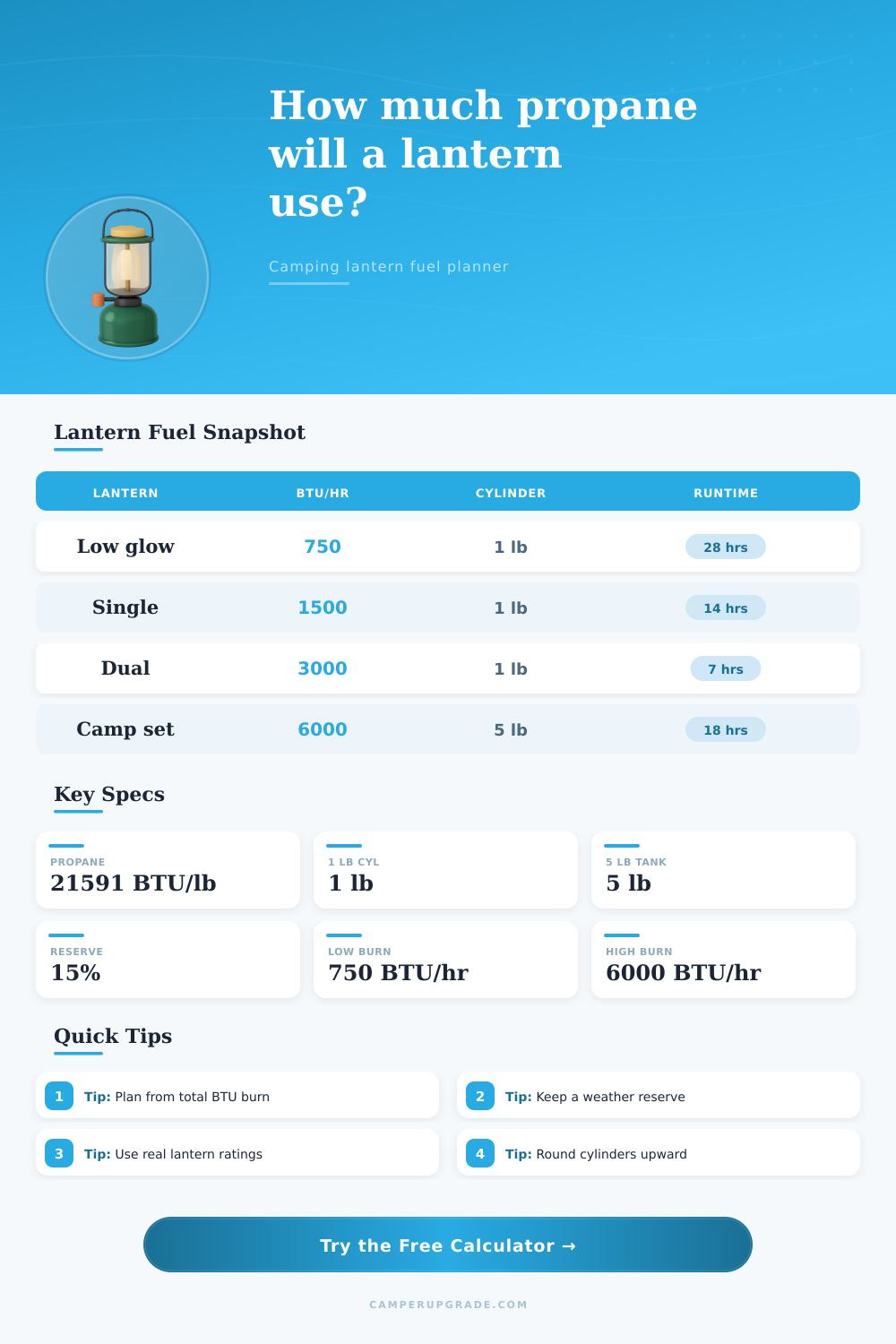
| Lantern Output | Fuel Use | 1 lb Runtime | Best Use |
|---|---|---|---|
| 750 BTU/hr low glow | 0.035 lb/hr | 28.8 hours | Table light or late-night low setting |
| 1,500 BTU/hr single mantle | 0.069 lb/hr | 14.4 hours | Small tent site or cooking table |
| 2,200 BTU/hr bright single | 0.102 lb/hr | 9.8 hours | Compact campsite work light |
| 3,000 BTU/hr dual mantle | 0.139 lb/hr | 7.2 hours | Common family campsite lantern |
| 4,000 BTU/hr bright dual | 0.185 lb/hr | 5.4 hours | Awning or picnic table lighting |
| 6,000 BTU/hr large lantern | 0.278 lb/hr | 3.6 hours | Group kitchen or basecamp light |
| Cylinder Size | Usable Propane | At 3,000 BTU/hr | At 6,000 BTU/hr |
|---|---|---|---|
| Disposable cylinder | 1 lb | 7.2 hours | 3.6 hours |
| Small refillable tank | 5 lb | 36.0 hours | 18.0 hours |
| Refillable tank | 10 lb | 72.0 hours | 36.0 hours |
| Standard barbecue tank | 20 lb | 143.9 hours | 72.0 hours |
| Camping Pattern | Total BTU/hr | Trip Hours | Propane Needed |
|---|---|---|---|
| One low lantern, 3 nights | 750 | 12 hours | 0.42 lb before reserve |
| One dual lantern, 2 nights | 3,000 | 8 hours | 1.11 lb before reserve |
| Two dual lanterns, weekend | 6,000 | 12 hours | 3.33 lb before reserve |
| Group kitchen, 4 nights | 12,000 | 20 hours | 11.12 lb before reserve |
| Reserve Choice | When It Fits | Fuel Multiplier | Example on 3 lb |
|---|---|---|---|
| 0% reserve | Short backyard test or exact backup nearby | 1.00x | 3.00 lb |
| 10% reserve | Mild weekend with one spare option | 1.10x | 3.30 lb |
| 15% reserve | Typical camping fuel cushion | 1.15x | 3.45 lb |
| 20% reserve | Long evenings or shared camp kitchen | 1.20x | 3.60 lb |
| 30% reserve | Cold, windy, remote, or uncertain use | 1.30x | 3.90 lb |
Propane consumption are not a variable process. Propane consumption isnt a flat rate. Many peoples believe that lanterns consume teh same amount of propane for all individuals.
However, the consumption of propane change based on the individual using the lantern and the environment in which the lantern is used. In order to determine how much propane is needed for a trip, there is three variables that must be considered. Those three variables are the BTU rating of the lantern, the number of hours that the lantern will be used, and the environment in which the lantern will be used.
How Much Propane Do You Need for a Trip
The BTU rating of the lantern will tell an individual how much heat energy the lantern consumes each hour. If the BTU rating of the lantern is high, it will emit a large amount of lights. However, the high BTU also mean that the lantern will use up propane at a much fasterer rate than a lantern with a low BTU rating.
The higher the BTU of the lantern, the less the runtime of the lantern will be compared to a lantern with a low BTU. In order to find the total amount of propane needed for the trip, you can use the BTU rating of the lantern and the number of hours that it will be used in an equation to find the total pounds of propane that will be needed for a trip. Another variable that will impact the propane consumption of the lantern is the environment in which it is used.
Cold weather can impact the propane in that it can impact the pressure of the propane and the efficiency with which the propane perform. Additionally, if you use the lantern in an environment with alot of wind, the lantern will have to be set to a more higher brightness level to compensate. In this case, the variable of the weather can be accounted for in the planning of the trip.
The weather factor will ensure that there is enough propane for these conditions and that the lantern wont run out of propane while on the trip. Another variable in the equation is a reserve of propane. A reserve of propane in the lantern should of be fifteen or twenty percent of the total amount of propane that is calculated for the trip.
The theoretical amount of time that the propane will last may not equal the actual amount of time that the propane will last. Factors like the efficiency of the regulator on the lantern can impact the length of time that the lantern will last. By having a reserve of propane, there will always be enough for the trip and there wont be an issue of running out of propane.
The size of the propane cylinder also impact the amount of propane that will be used. One-pound disposable propane cylinders are convenient and come in various quantity. However, each of these propane cylinders is for single use.
Additionally, five-pound or ten-pound propane tanks that you are to be refilled is different than disposable propane cylinders. It is much easier to use a five- or ten-pound propane tank instead of a variety of single use propane cylinders. Furthermore, larger propane tanks are better for long term base camps or campsites for extended periods of time.
Many people make the mistake of counting the number of lanterns that they will be using instead of calculating the total BTU burn that will be used during the trip. Instead of simply counting the lanterns, it is more important to determine the BTU output of each of the lanterns. One lantern might be a low-output lantern and the other might be a high-output floodlight.
The total BTU burn will reveal the total weight of propane that will be needed for the trip. Once you know the total pounds of propane, you can calculate the total number of propane cylinders by dividing the total pounds by the size of each propane cylinder. By accounting for each of these variable, including the BTU rating of each lantern, the environment in which the lantern will be used, and the need for a reserve of propane, there will be enough propane to supply all the lanterns on the trip.