Camping Cot Size Calculator
Size a camping cot from sleeper height, shoulder width, sleep style, pad loft, frame clearance, tent footprint, and usable headroom.
🏕Cot Fit Presets
⚙Sleeper, Cot, and Tent Inputs
📐Formula Cards
Minimum Length
Height + GapSleeper height plus combined head and foot clearance sets the minimum usable cot length.
Minimum Width
Body + RailsShoulder width, sleep style, bag loft, and two edge clearances determine comfortable frame width.
Tent Floor Fit
Cot + Fabric GapOutside frame dimensions plus required tent-wall gap must fit inside the flat sleeping zone.
Headroom Stack
Tent - DeckUsable tent height minus cot deck, pad, and sleeper shoulder height estimates sit-up clearance.
🛏Cot and Frame Spec Grid
📊Cot Sizing Reference Tables
| Cot class | Typical frame | Sleeper fit | Tent note |
|---|---|---|---|
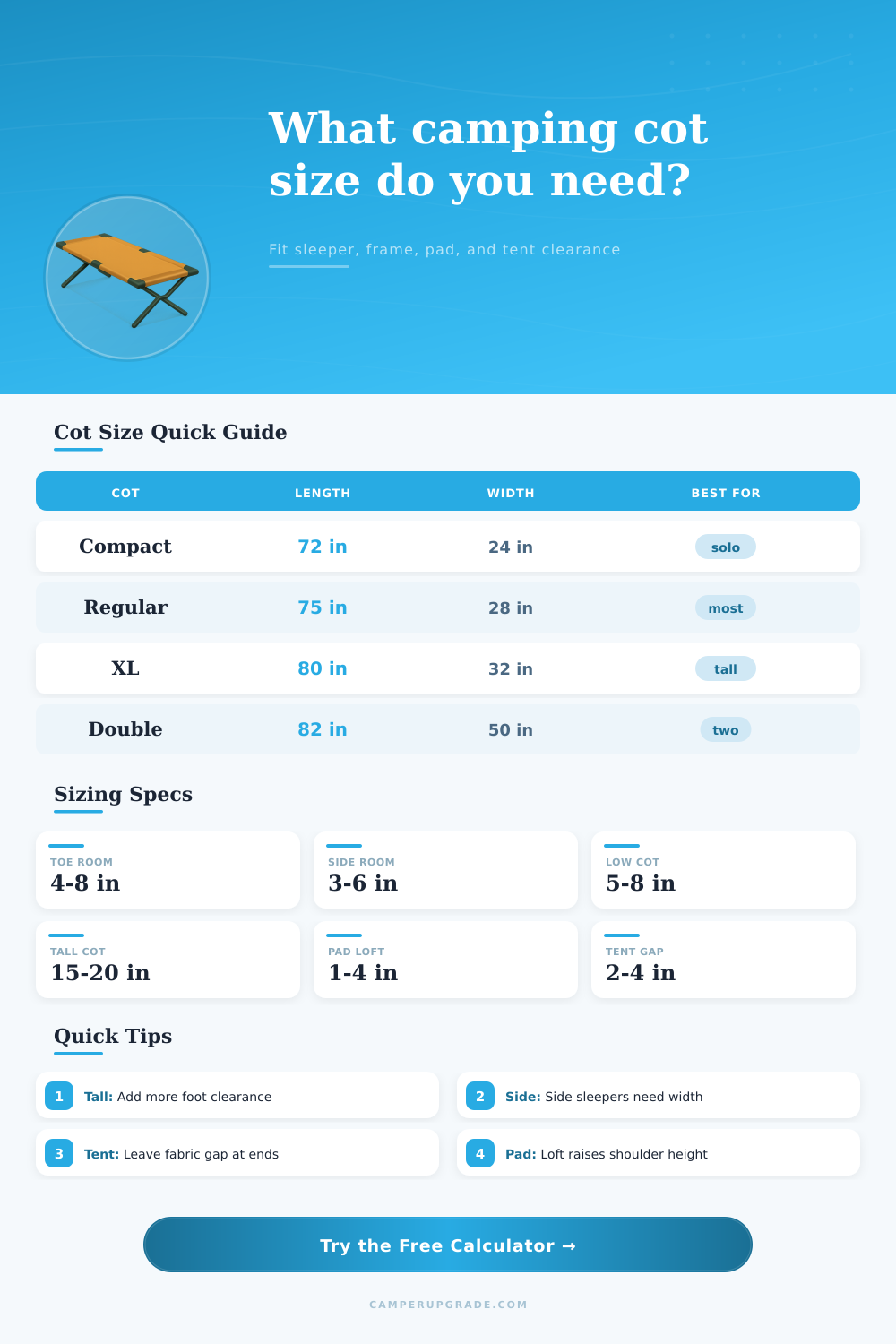
| Compact | 72 x 24 in | Up to 5 ft 8 in | Small tents |
| Regular | 75 x 28 in | Up to 5 ft 11 in | Most 2P floors |
| XL | 80 x 32 in | Up to 6 ft 4 in | Longer tent |
| Double | 82 x 50 in | Two sleepers | Cabin tent |
| Sleep style | Side add | Best width | Reason |
|---|---|---|---|
| Back | 4-6 in | 26-28 in | Arms close |
| Side | 6-8 in | 28-32 in | Knees rotate |
| Active | 8-12 in | 32-36 in | Roll room |
| Shared | 10-14 in | 48-55 in | Two bodies |
| Deck height | Range | Use case | Tradeoff |
|---|---|---|---|
| Low | 5-8 in | Small tents | Less storage |
| Mid | 9-14 in | Dome tents | Balanced |
| High | 15-20 in | Cabin tents | Needs height |
| Bunk | 22+ in | Tall tents | Check roof |
| Tent floor | Cot width | End gap | Side gap |
|---|---|---|---|
| 84 x 48 in | 24-28 in | 2-4 in | 10+ in |
| 90 x 52 in | 28-32 in | 4-6 in | 10+ in |
| 96 x 60 in | 32-36 in | 6-8 in | 12+ in |
| 120 x 96 in | 50-55 in | 10+ in | 20+ in |
💡Cot Fit Tips
When you chooses the camping cot that will sleep with you on camping trips, you must ensure that the dimensions of the camping cot are compatible with the dimensions of the tent in which you will sleep. Many people makes the mistake of purchasing the camping cot based off the label on the box of the camping cot. However, the dimensions on the box does not always take into account your tent’s dimensions.
Camping cots often has protruding legs or hinge brackets that extend out from the cot. These protrusions may reduce the area available within the tent for you to sleep within. If the camping cot is too long for the tent, then the camping cot will strain the nylon floors of the tent.
Choose a Camping Cot That Fits Your Tent
Additionally, the vibration of the tent caused by the sleeping cot may be a problem in areas where there is strong winds. A camping cot will raise your body higher into the tent. Because of this, you will have less headroom within the tent then if you were sleeping on the ground.
If you use a high-profile camping cot and a thick sleeping pad, the height of your sleeping system may bring you closer to the tent ceiling. The height of your sleeping system is important to take into account because if you are too tall for the tent, you may not be able to sit up straight without hitting the rainfly of the tent. Therefore, you must account for the head room that exists within your tent when you are choosing your camping cot.
When measuring your sleeping body to ensure that it will fit within the camping cot, you must account for more than just your height. When sleeping, most people are not sleeping on their backs in a straight line. Many people are side sleepers who rotate their knees and ankles to rest on their side during sleep.
Additionally, active sleepers may require more room to allow for their sleeping bodies to stay within the cot while they sleep. You should use a camping cot measuring calculator to take into account the width your body requires in order to accommodate your sleeping style and sleeping loft to ensure that your sleeping body fit within the camping cot. Another variable to consider between the camping cot and the tent is your bedding loft.
Bedding loft refers to the thickness of your sleeping bag or sleeping quilt. If the sleeping bag is thick and wider than the camping cot, the sleeping bag will drape over the sides of the camping cot. This circulation of cold air underneath the sleeping bag will reduce the insulation provided by your sleeping bag.
You must ensure that you have enough clearance along the edges of the camping cot so that your sleeping bag does not drape over the side of the cot. The relationship between your camping cot and the tent floor is based upon the geometry of the tent. Most tents has sloped walls that extend from the floor to the peak of the tent.
The floor of the tent is the widest part of the tent. The ceiling of the tent is the narrowest part of the tent. If the camping cot is too wide for the tent, the camping cot will push against the tent walls.
The camping cot pushing against the tent wall may create a bridge for condensation to form between the tent wall and the sleeping bag within the sleeping system. To avoid this problem, ensure that there is a small gap between the camping cot and tent wall. Your choice between a low-profile camping cot and a tall camping cot will depend on your needs for under-bed storage and head space.
If you have small dome tents that you use for camping trips, then a low-profile camping cot will give you more head space and you will take up less floor space in the tent. However, there is very little room to store your gear underneath the sleeping cot. A tall camping cot will store your gear such as boots and bags underneath the cot.
However, you will need a cabin-style tent to use such a camping cot. Using such a cot in a small dome tent will cause the camping cot to extend too close to the tent ceiling. If you are camping with a partner and using a double camping cot, you must account for the sleeping dimensions and sleeping style of both you and your camping partner.
You need to allow for a shared buffer zone between both sleeping individuals sharing the cot. The shared buffer zone is the space in which each person can move within the sleeping system without knocking the other person off of the sleeping cot. A double camping cot may save you space in a large cabin tent.
However, it will require a larger amount of floor real estate within the tent. Make sure that the tent is wide enough to accommodate the sleeping cot and allow for the cot to be clear of the tent walls. Finally, when selecting a camping cot for camping trips, aim to create a sleeping system for which no part of your gear is under tension.
If you take the time to plan for the height of your sleeping system and the sleeping bags, you will avoid the tension on the tent floor and your sleeping gear. By selecting camping gear according to the geometry of your sleeping system, your camping cot will correctly fit within the tent for which it will be used.