Sunscreen Reapplication Calculator
Estimate a practical sunscreen reapplication time from SPF, UV index, water resistance, sweating, shade, clothing coverage, skin sensitivity, application amount, and time already outside.
🏕Outdoor Sunscreen Presets
⚙SPF, UV, Water, Sweat, and Time Inputs
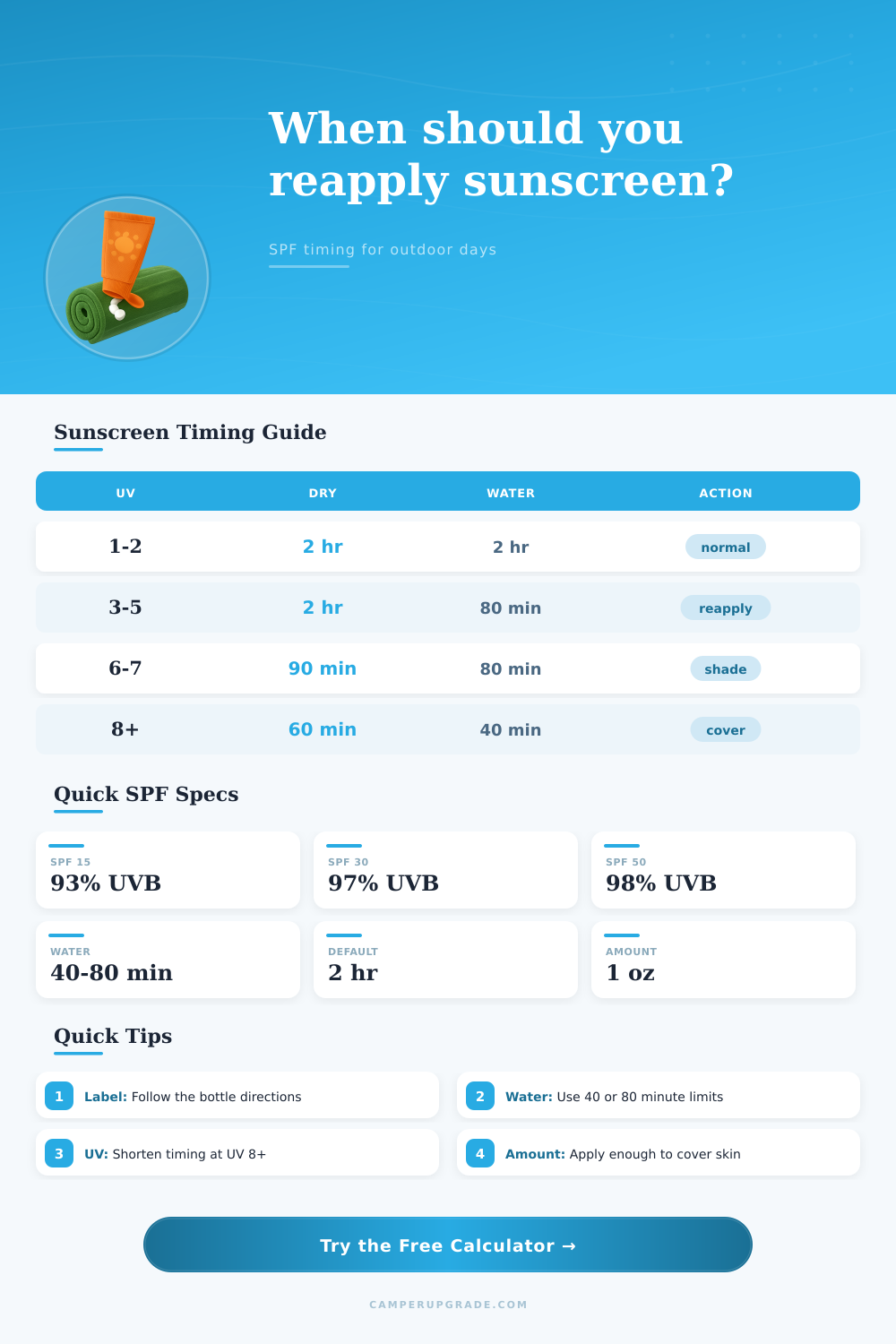
This calculator estimates timing only. Follow the product label, reapply at least every two hours, and reapply sooner after swimming, sweating, or towel drying.
📐Four Formula Cards
Label Ceiling
max 120 minThe regular dry-skin ceiling is two hours; water-resistant labels cap water exposure at 40 or 80 minutes.
UV Multiplier
UV 8+ shortensHigher UV index values apply a caution factor because intense sun leaves less room for missed spots.
Film Loss
sweat x rub x waterSweat, toweling, straps, and splashing reduce the useful sunscreen film before the normal two-hour mark.
Coverage Quality
amount + skinUnder-application and sensitive skin move the reminder earlier, while clothing lowers exposed-skin load.
🧴Sunscreen and Exposure Spec Grid
📊Sunscreen Timing Reference Tables
| UV Index | Intensity | Dry Reapply | Extra Action |
|---|---|---|---|
| 0-2 | Low | 120 minutes | use routine cover |
| 3-5 | Moderate | 120 minutes | hat and shade help |
| 6-7 | High | 90-110 minutes | check exposed edges |
| 8-10 | Very high | 60-90 minutes | seek shade breaks |
| 11+ | Extreme | 45-75 minutes | cover skin first |
| Label Claim | Water Limit | Dry Limit | Reapply Trigger |
|---|---|---|---|
| Not water resistant | none | 120 minutes | after sweat or water |
| Water resistant | 40 minutes | 120 minutes | after 40 minutes wet |
| Very water resistant | 80 minutes | 120 minutes | after 80 minutes wet |
| Towel dried | immediate | reset needed | reapply after drying |
| Heavy sweating | label limit | shorter check | inspect before 2 hr |
| SPF | Approx UVB Block | Best Use | Timing Note |
|---|---|---|---|
| 15 | 93% | low UV errands | still every 2 hr |
| 30 | 97% | general outdoor | common minimum |
| 50 | 98% | high UV days | small gain over 30 |
| 70 | 98.6% | missed-spot buffer | not a time extender |
| 100 | 99% | sensitive users | apply generously |
| Outdoor Scenario | SPF Range | Typical Check | Risk Driver |
|---|---|---|---|
| Shaded camp | 30+ | 2 hours | missed edges |
| Lake swim | 30-50+ | 40-80 minutes | water and towel |
| Desert hike | 50+ | 60-90 minutes | UV and sweat |
| Snow spring day | 50+ | 60-90 minutes | reflection |
| Boat fishing | 30-50+ | 80-120 minutes | open exposure |
💡Sunscreen Timing Tips
Sunscreen is an film that sits on the skin to protect it from the harmful effect of ultraviolet radiation. Sunscreen must be regularly reapply to the skin to maintain this protective barrier. Sunscreen dont remain on the skin indefinitely due to various factor that degrade or remove the sunscreen from the skin.
For example, ultraviolet radiation can break down the sunscreen’s active ingredient. Sweat can thin the layer of sunscreen that is on the skin’s surface. Additionally, friction from clothing or towels can remove sunscreen from the skin.
When to Reapply Sunscreen
Because these factors can remove sunscreen from the skin, individuals must regularly reapply sunscreen to maintain its protective property on the skin. The UV index indicate the strength of the ultraviolet radiation in the environment. Additionally, the UV index determines how quickly the sun can damage the skin.
For example, on cold day, the atmosphere is thin and the snow can reflect the ultraviolet radiation back onto the skin. On days with a high UV index, there is a high amount of ultraviolet radiation. High amounts of ultraviolet radiation means that individuals must apply sunscreen more careful.
Individuals must ensure that they dont miss any spot on there skin since any missed spots can lead to skin burns. Some sunscreen product have a label on the bottle indicating that the sunscreen is water resistant. However, water resistance do not mean that the sunscreen will remain on the skin continuously.
For example, if sunscreen is water resistant for eighty minutes, the sunscreen will protect the skin for eighty minutes of submersion. After that period, the protection level change. If an individual dries with a towel, friction is introduced that remove sunscreen from the skin.
Therefore, if an individual dries with a towel, they must reapply sunscreen to those area. The amount of sunscreen that an individual apply is another factor that impact the amount of protection that the sunscreen will provide. Many individual apply too little sunscreen.
If an individual applies too little sunscreen to their body, they will recieve less protection then they would if they applied an even layer of sunscreen. To ensure that the individual applies an even layer of sunscreen to the skin, the individual should of apply a full ounce of sunscreen to their body. An individual’s clothing and the equipment that they wear can also impact how often they must apply sunscreen to their skin.
For example, if an individual wear a shirt that has a UPF rating, that UPF shirt will provide extra protection for their skin. However, sunscreen must still be applied to any skin that is not cover by the UPF clothing. For example, if an individual wears a backpack, the straps of the backpack will rub against the skin.
The friction that the straps create against the skin will remove the sunscreen. Therefore, individuals who wear a backpack must reapply sunscreen more often since the friction from the straps will remove the sunscreen from their skin. Finally, individuals must use a sunscreen calculator to determine when they need to reapply sunscreen.
Sunscreen calculators take into account various factors such as the environment in which an individual is, their activity level, and the UV index. The calculator can also factor in the individuals clothing and skin tone to determine how often they should reapply sunscreen for maximum protection. Additionally, individuals must incorporate the reapplication of sunscreen into their routine.
This routine should be adjusted according to the intensity of the sun and the amount of friction that their skin is experiencing.