Caving Battery Duration Calculator
Estimate underground headlamp runtime, required spare cells, temperature loss, reserve margin, and practical turnaround time from lumens, battery chemistry, capacity, lamp efficiency, and cave pace.
🔋Caving Light Presets
⚙Headlamp, Battery, Temperature, and Reserve Inputs
Carry at least two independent light sources underground. This calculator estimates energy planning only; local cave risk, route finding, flooding, and group speed still matter.
📐Four Formula Cards
Lamp Power
lumens / lm per WAverage light output divided by lamp efficiency estimates steady electrical watts.
Adjusted Energy
Wh x sets x factorsBattery watt-hours are multiplied by carried sets, temperature, chemistry, driver, and usage factors.
Runtime
adjusted Wh / WAvailable energy divided by adjusted lamp draw gives estimated main-light duration.
Reserve Margin
runtime - trip - reservePositive margin means the planned cave time leaves the chosen exit reserve unused.
🔦Battery and Headlamp Specification Grid
📊Caving Battery and Runtime Tables
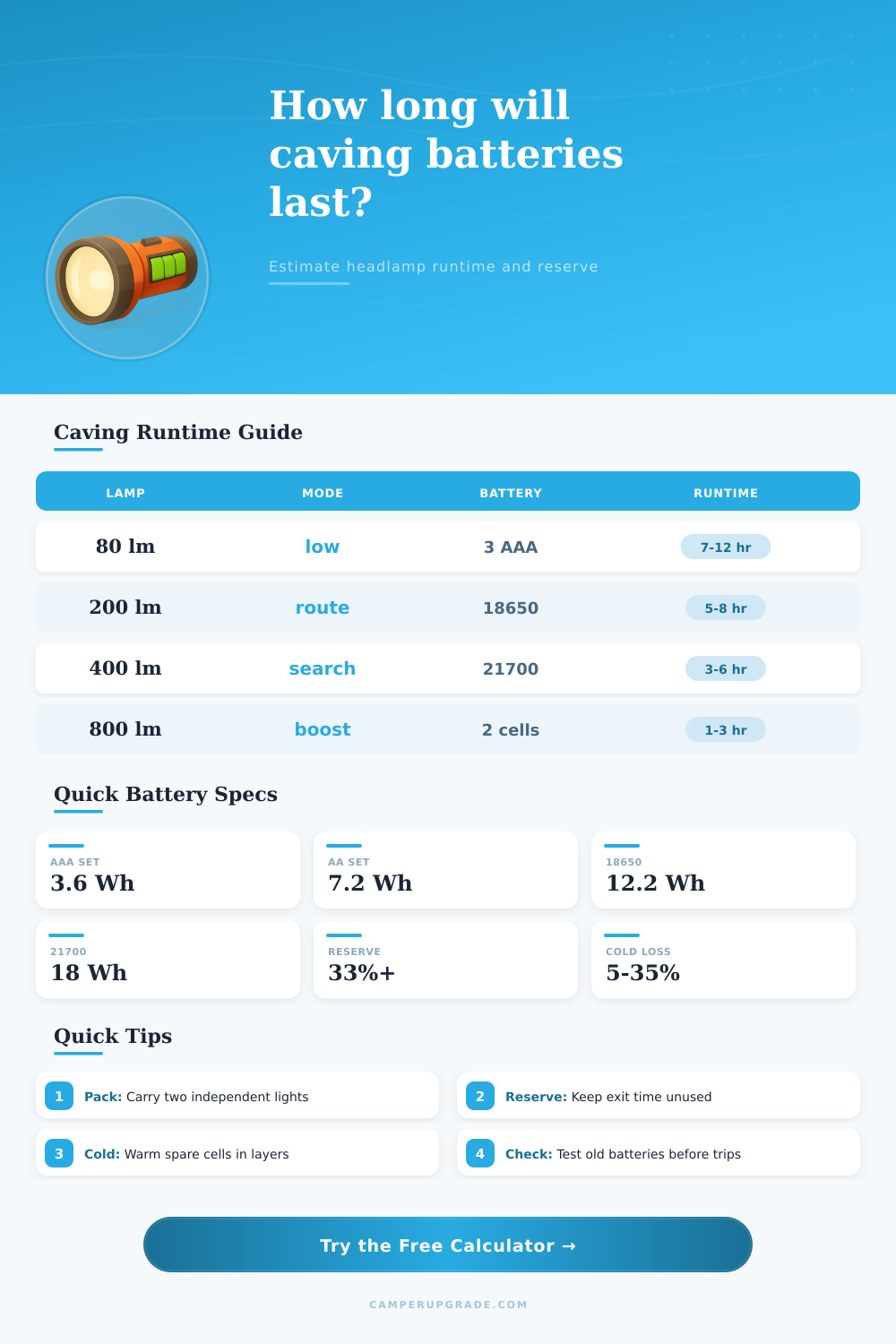
| Battery | Usable Wh | Best Use | Notes |
|---|---|---|---|
| 3 AAA | 3-4 Wh | backup | small cells sag |
| 4 AA | 6-8 Wh | loaner | good with NiMH |
| 2 CR123A | 8-10 Wh | cold trips | long shelf life |
| 18650 | 10-13 Wh | main lamp | common caving cell |
| 21700 | 16-20 Wh | long trips | higher capacity |
| Output | Estimated W | 12 Wh Cell | 18 Wh Cell |
|---|---|---|---|
| 80 lm | 0.8 W | 12-14 hr | 18-21 hr |
| 150 lm | 1.6 W | 6-8 hr | 9-12 hr |
| 250 lm | 2.6 W | 4-5 hr | 6-7 hr |
| 400 lm | 4.2 W | 2.5-3 hr | 4-5 hr |
| 800 lm | 8.4 W | 1-1.5 hr | 2 hr |
| Cave Temp | Li-ion | NiMH | Alkaline |
|---|---|---|---|
| 60°F+ | 100% | 100% | 95% |
| 50°F | 95% | 92% | 82% |
| 40°F | 88% | 84% | 65% |
| 32°F | 78% | 72% | 45% |
| Wet cold | 70% | 65% | 35% |
| Trip Type | Main Light | Reserve | Spare Plan |
|---|---|---|---|
| Short tour | 80-150 lm | 2 hr | 1 spare set |
| Survey | 150-250 lm | 3-4 hr | 2 spare sets |
| Vertical | 200-400 lm | exit time | 2+ sets |
| Photo trip | 400+ lm | 33%+ | high-cap cells |
| Cave camp | low mode | night exit | separate camp light |
💡Caving Battery Planning Tips
When you enter a cave, you have to worry about your light source because the light is the only way to find your way out of the cave. Light becomes a necessity within the cave once you are deep into the cave, but light also becomes a danger to your cave trip if something happen to your light source before you can reach the cave entrance. Many people will tell you that they know how long their battery source will last for their headlamp.
However, the life of the battery is not a simple number to the caver. The life of the battery change based on two things: the temperature of the cave and the way in which they use the light source. The temperature within the cave can have a significant impact on the life of your battery.
Plan Your Cave Light and Battery Use
The temperature within the cave will impact the energy that your batteries can provide to your headlamp. Batteries creates energy from chemical reactions. The rate of those chemical reactions will slow if the temperature of the environment drops.
In cold caves, the voltage of your batteries will drop at a faster rate than if you were in a warmer environment. For example, alkaline batteries will last for ten hours in your garage when it is warm outside. However, the same batteries will last for six hours in a cold cave.
You need to account for this with your trip planning because the temperature of the cave will change the life of your batteries. One alternative is to use a lithium-ion cells which perform better in cold temperatures. Another alternative is to use NiMH rechargeable cells.
The problem with using rechargeable cells is that their chemical reaction will also slow with decreasing temperatures in the cave. Your behavior within the cave will also have an impact on the life of your batteries. How you use your headlamp will change the life of your batteries.
You may want to use your headlamp on the lowest setting to extend the life of your batteries. However, you may need a higher light setting when you are moving through tight squeezes in the cave or when you are mapping the cave chambers. These periods when you need your headlamp on a higher setting will drain your batteries at a faster rate.
You can plan for these uses of your headlamp so that you understand how much of a battery life you will use when you are in the cave. You can plan for a mixed setting of uses for your headlamp because this is the most accurate way to calculate your battery life usage while in the cave. You must also set aside a specific amount of battery life for the exit from the cave.
You should reserve this life of your headlamp for the exit from the cave, and you should never use the life of your batteries for that purpose. This amount of battery life you set aside will ensure that you have light when you exit the cave. For example, if you calculate that you need three hours of light to exit the cave, you should think of those three hours as unavailable for the rest of your cave trip.
This amount of time is known as your exit reserve. The safe turnaround time is the time at which you must begin to exit the cave to ensure that you do not use your exit reserve. If you find yourself using your exit reserve before you reach the entrance to the cave, then you have not planned your trip correctly.
Your backup lamp is completely different than both your headlamp and your exit reserve. Many cavers will make the mistake of using their backup lamp as their primary light while they are in the cave. You should only use your backup light in the case that your primary headlamp should fail.
The backup headlamp should be an independent system from your primary headlamp. You should use your primary headlamp and all spare batteries to get you home from the cave. You should always keep your backup headlamp in pristine condition so that it can be used in the case of the failure of your primary headlamp.
The type of headlamp that you use will also have an impact on how you perceive the life of your batteries. Moddern regulated headlamps will maintain a steady beam of light even if the battery life drop. This is beneficial because it will provide even light on the objects of interest to you in the cave.
However, the steady beam of light is potentially misleading. Older headlamps would gradually dim their beam as their battery life declined. This would alert the cave traveler to the fact that the batteries were winding down.
Headlamps with regulated beams may abruptly turn off when the battery life declines to 0. Thus, you can not rely upon the brightness of the beam of light to show you when your battery life is declining. Instead, you can only rely upon your calculated plan for your battery life while in the cave.
One last consideration when planning your cave trip is the idea of creating a safety buffer in your plan. This is specifically true if the cave that you are exploring is a technical cave or a vertical cave. In these types of caves, your travel is slower and the trip takes longer in the cave.
In these scenarios, you will want to provide some form of safety buffer. For example, a twenty-five percent buffer in your travel time will allow your travel time to be extended in the case of unexpected delays. If, while traveling through the cave, you become flooded or you lose your map of the cave, your safety buffer will allow for extra light to travel through the detour that you must make to continue on your travel path.
By using a mathematical model to calculate the amount of headlamp battery life that you need during your trip, you can calculate how many spare batteries you need to carry in order to maintain your exit reserve.