Caving Rope Length Calculator
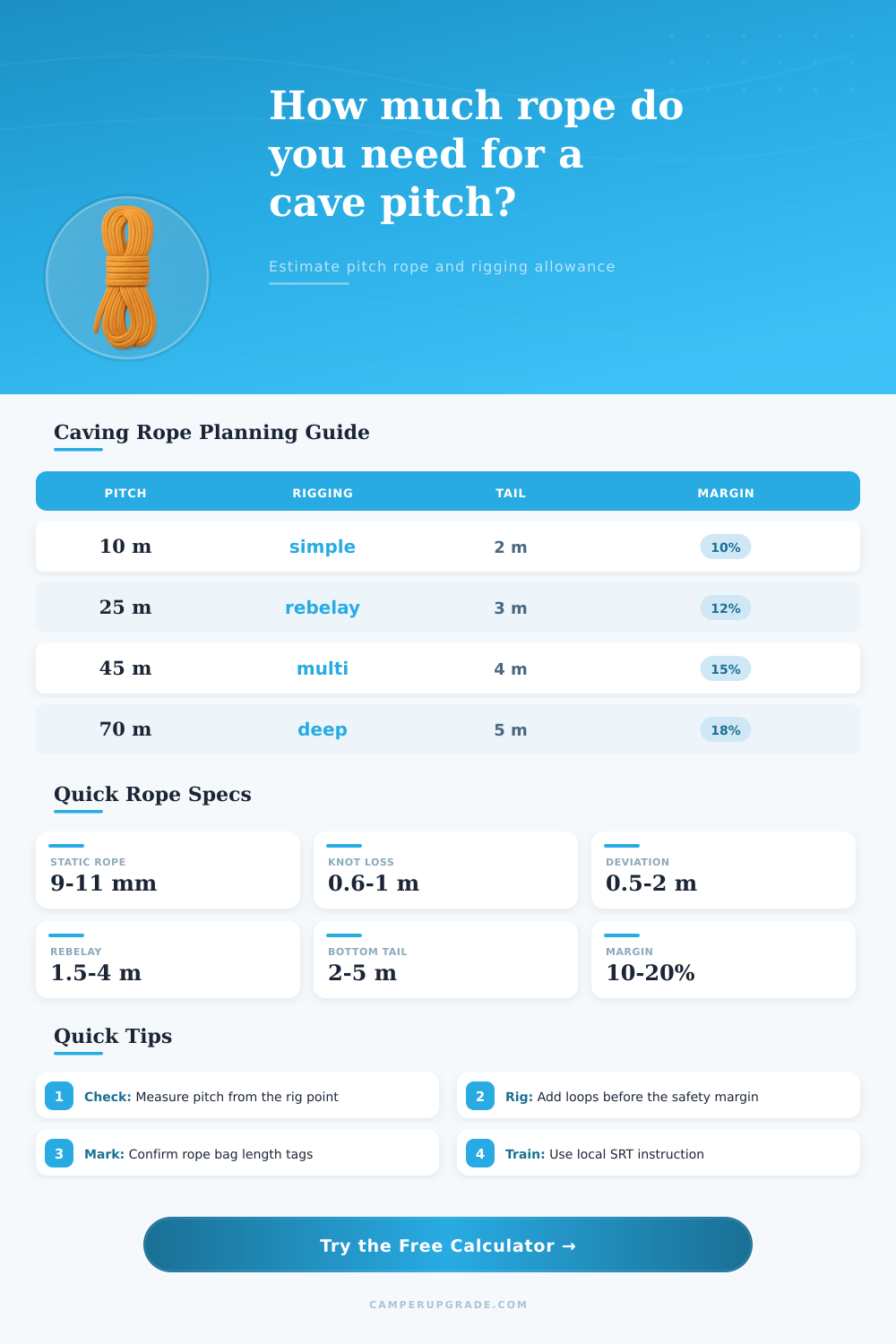
Estimate the rope length to pack for a cave pitch using surveyed drop, rigging approach, deviations, rebelays, knots, tail allowance, rope stretch, and safety margin.
🧭Cave Pitch Presets
⚙Pitch, Deviation, Rebelay, and Knot Inputs
This calculator supports trip planning only. Rigging choices must be made by trained cavers using local anchors, rope condition, cave hazards, backup plans, and club or regional SRT practice.
📐Four Formula Cards
Base Rope
depth + approachSurveyed vertical pitch plus the rope needed before the drop from the first rig point.
Rigging Additions
top + loops + knots + tailAnchor allowance, rebelay loops, deviation allowance, extra knots, and bottom tail are added before margin.
Loaded Stretch
depth x stretch %Stretch is estimated on the hanging section so the bottom tail is not accidentally consumed.
Pack Length
ceil(total / bag) x bagThe final result rounds up to the selected rope-bag or rope-tag increment.
🪢Rope and Rigging Specification Grid
📊Caving Rope Reference Tables
| Pitch Style | Depth | Typical Add | Margin |
|---|---|---|---|
| Simple training pitch | 8-18 m | 4-7 m | 10% |
| Single rebelay pitch | 18-35 m | 7-12 m | 10-15% |
| Multi-rebelay shaft | 35-70 m | 12-22 m | 15% |
| Deep free-hang | 60-120 m | 10-20 m | 15-20% |
| Exploratory rig | varies | high | 20-25% |
| Rigging Item | Low | Normal | High |
|---|---|---|---|
| Top y-hang allowance | 1 m | 2 m | 4 m |
| Rebelay loop | 1.5 m | 2.5 m | 4 m |
| Deviation allowance | 0.5 m | 1 m | 2 m |
| Extra knot | 0.6 m | 0.8 m | 1 m |
| Bottom tail | 2 m | 3 m | 5 m |
| Rope Diameter | Approx g/m | 40 m Bag | 80 m Bag |
|---|---|---|---|
| 9 mm | 52 g | 2.1 kg | 4.2 kg |
| 10 mm | 65 g | 2.6 kg | 5.2 kg |
| 10.5 mm | 72 g | 2.9 kg | 5.8 kg |
| 11 mm | 78 g | 3.1 kg | 6.2 kg |
| Wet rope note | +10-30% | heavier | heavier |
| Calculated Need | 5 m Round | 10 m Round | 30 m Round |
|---|---|---|---|
| 27 m | 30 m | 30 m | 30 m |
| 42 m | 45 m | 50 m | 60 m |
| 68 m | 70 m | 70 m | 90 m |
| 93 m | 95 m | 100 m | 120 m |
| 116 m | 120 m | 120 m | 120 m |
💡Caving Rope Length Tips
When planning to descend a cave, calculating teh total length of ropes that will be needed for the descent is an critical aspect of the planning process. Many people make the mistake of assuming that the total length of rope that will be required to complete the descent is the same then the surveyed depth of the pit from which they will descend. However, there is several different variables that must be accounted for in the calculation of the total length of rope that will be required for the descent.
Beyond the depth of the pit that is to be ascended, additional rope lengths are required to account for the distance from the anchor point to the edge of the drop, the length of the rope that will be lost to the tying of knot in the rope, and the length of the rope that will be used for rebelays and deviations in the drop. If there is only the surveyed depth of the pit that is packed as the descending caver, the rope may not be long enough to allow for the descent to the floor of the pit. One of the variables that can contribute to the length of rope that are required for a descent is the horizontal distance that must be traveled to reach the anchor point.
How Much Rope You Need to Descend a Cave
Often, the anchor point is not located directly at the edge of the drop, but instead into the surrounding terrain. The distance that must be traveled horizontally into the terrain will contribute to the length of rope required. In addition to the length of rope that is required to travel the horizontal approach to the drop, rebelays and deviations will also be required to allow the descender to avoid any abrasion that the rope may experience against the limestone terrain.
Each of these deviations will require a length of rope that does not contribute to the vertical drop into the pit, but which is still required to reach the drops floor. In addition to the rope that will be used for the drop into the named pit, the length of rope that will be consumed in the descents will also contribute to the total length of rope that will be required. Numerous knots will be required to anchor the descents and to provide additional safety in the event of a fall.
The length of the rope that these knots will consume will contribute to the total length of rope required for the descent. Additionally, a length of rope is required to form a bottom tail for the descents into the pit; without a bottom tail, the descender would likely land on the end of the rope and be unable to safely exit the pit. Thus, rope that is only thirty meters in length may actualy require forty meters of rope to descend the named drop.
Another variable in the calculation of the length of rope that will be required is the stretch that the static rope will experience. Static rope is manufactured to resist stretching, but the rope still experiences some stretch when the weight of the descender is placed upon it. While the stretch of the rope may provide some additional length to the descenders movement into the pit, the length of rope that will be accounted for in the planning of the descent should not account for this stretch.
In other words, when calculating the length of rope required, it is best to always round that calculation up to the nearest length of static rope that is available in standard lengths. For example, if the calculations indicate that sixty-two meters of rope will be required, it is better to pack a seventy meter length of static rope. This additional length of rope will act as a safety margin for the descent, and a safety margin accounts for potential additional distances that may be required, such as if the anchor point is further from the drop than expected, or if the depth into the drop is deeper than surveyed.
The weight of the rope that will be used in the descent is another variable that must be considered. The additional length of rope will contribute to the additional weight of the descents. The caver can manage this weight by the choosing of different diameters for the ropes.
For instance, a rope with a diameter of nine millimeters will be lighter than a rope with an eleven millimeter diameter, and is therefore better suited to faster descents. However, the eleven millimeter rope will be better suited to areas with abrasion risks. Thus, you’re must still consider the additional weight of the rope in the planning of the descent.
By planning the descent based off each of these individual variables, a caver will ensure that they can reach the floor of the pit with enough rope to stand on comfortable.