Canyoneering Rope Length Calculator
Estimate rope length for canyoneering rappels from measured drop height, anchor setback, rigging method, retrieval path, stretch, shrinkage, knot tails, edge offsets, pull side choice, and reserve margin.
🏜Canyon Rappel Presets
⚙Rappel, Rigging, Retrieval, and Reserve Inputs
This calculator is a planning aid only. Confirm canyon beta, inspect anchors, tie stopper knots when appropriate, use trained canyon techniques, and follow local conditions before rappelling.
🧮Four Rope Length Formula Cards
Rappel Side
drop + path + rigDrop height plus anchor setback, lip travel, knot tails, and selected rigging allowance.
Stretch Check
loaded length x stretchEstimated stretch is subtracted from static rope needed because loaded rope elongates during rappel.
Shrinkage Reserve
static need / usable percentRope age and wet-canyon shrinkage are treated as lost usable length before rounding.
Retrieval Side
pull path + drag marginPull cord is based on rappel-side path plus setback, offset, throw room, and retrieval difficulty.
🪢Rope and Anchor Spec Grid
📊Canyoneering Rope Reference Tables
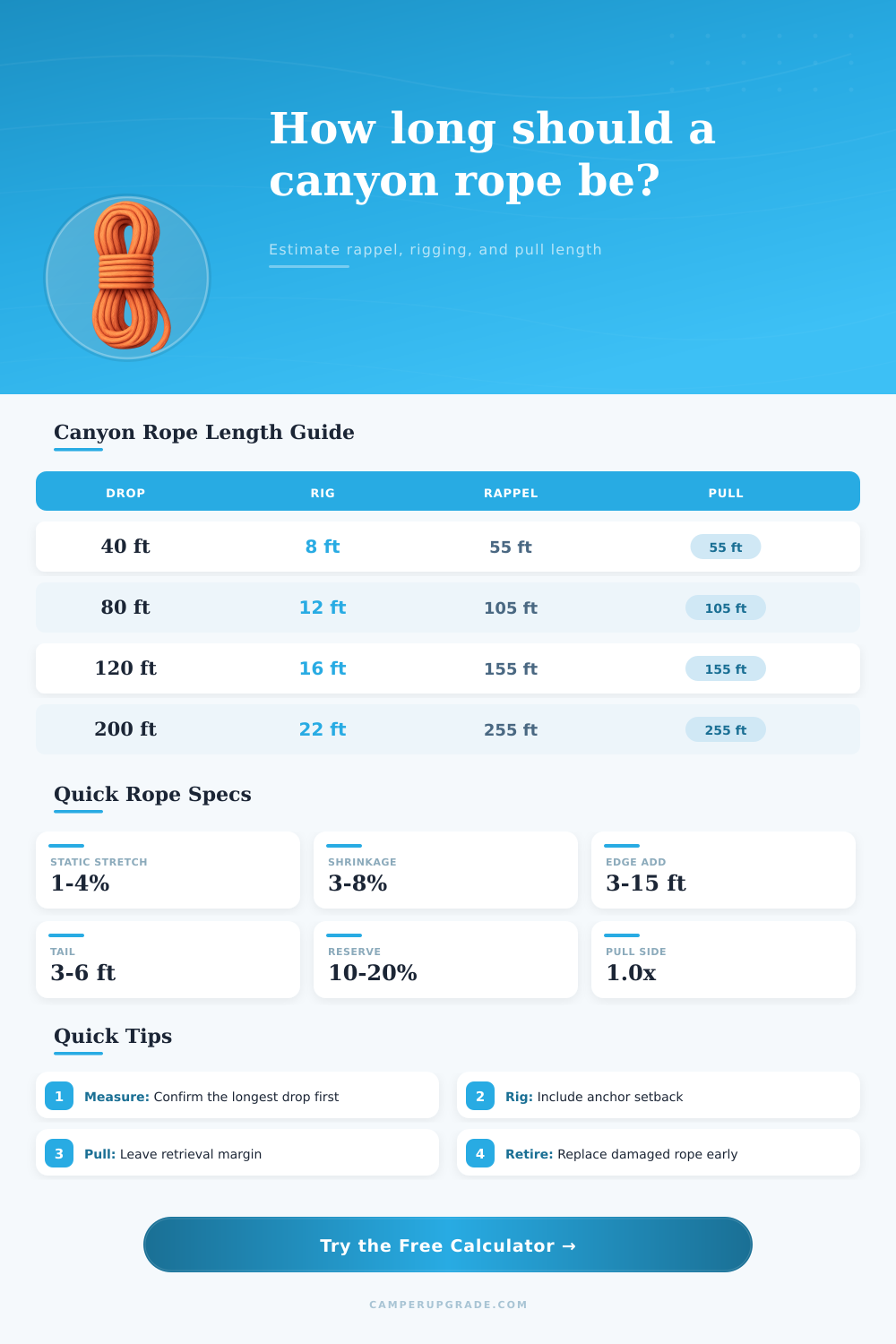
| Measured Drop | Basic Rig | Rappel Side | Round Up |
|---|---|---|---|
| 40 ft | 8 ft | 55 ft | 60 ft |
| 80 ft | 12 ft | 105 ft | 120 ft |
| 120 ft | 16 ft | 155 ft | 170 ft |
| 160 ft | 18 ft | 205 ft | 230 ft |
| 200 ft | 22 ft | 255 ft | 280 ft |
| Rigging Style | Extra Rope | Pull Need | Best Use |
|---|---|---|---|
| Fixed block | 5-10 ft | same path | standard single strand |
| Double strand | 4-8 ft | same rope | short drops |
| Contingency | 10-18 ft | same path | group management |
| Guided line | 15-35 ft | higher | pools or hydraulics |
| Water exit | 12-25 ft | higher | floating disconnect |
| Rope Length | Practical Drop | With Pull Cord | Notes |
|---|---|---|---|
| 100 ft | 65-80 ft | yes | short canyon drops |
| 120 ft | 80-95 ft | yes | common compact rope |
| 165 ft | 115-135 ft | yes | 50 m rope class |
| 200 ft | 145-165 ft | yes | classic canyon length |
| 300 ft | 220-250 ft | yes | big rappel kit |
| Retrieval Risk | Add Margin | Cause | Check |
|---|---|---|---|
| Clean | 2-5 ft | direct pull | ring aligned |
| Normal | 5-10 ft | minor drag | rope path seen |
| Rough | 10-18 ft | edge bend | pad or redirect |
| Wet | 12-22 ft | heavy rope | pool exit |
| Complex | 18-35 ft | ledge or angle | test pull |
💡Canyon Rope Planning Tips
When you calculates the length of the rope that are required for a rappel down a canyon, many people makes the mistake of only calculating the length of the canyon based off the vertical measurements of the drops. However, this vertical measurement isnt an only measurement that must be accounted for. The distance from the rappeller to an edge of the cliff (known as the anchor setback) is another measurement that must be accounted for in the calculation of the amount of rope that is require for the rappel.
If the anchor is situated deep within a cave or on a ledge, the amount of rope that are required before the rappeller begin to descend will use up some of the rope that is required for the rappel. Another measurement that can alters the amount of rope that is required for a rappel is the path that the rope will take during the rappel. The vertical measurement of a canyon do not account for any deviation in the path of the rappeller.
How Much Rope Do You Need for a Canyon Rappel
Any bends in the canyon that are created by ledges or waterfalls will require an allowance for rope to be added to the calculations to account for the extra length that the rope will require to reach the canyon’s bottom. An allowance for the landing path and the edge of the canyon should be accounted for to ensure that the rope will reach the bottom of the canyon, even if the rappel is not conducted with a straightly rope. Another issue to consider regarding the length of the rope is the stretch of the static rope.
Static rope are manufactured to have minimal stretch when being use in a rappelling system. However, even the static rope will stretch when the weight of the rappeller are placed upon it. The stretch of the rope is sometimes helpful to the rappelling team, as the stretch provide some of the length that may be required to allow the rappeller to safely reach the bottom of the canyon.
However, rope can also shrink in length over time due to the exposure of the rope to water and its use in rappelling systems. Any rope that has shrunk will be shorter than the length of the rope listed on the manufacturer label for the rope. These variable create additional considerations that the rappeller must account for when calculating the length of rope that will be required for the canyon rappel.
The third consideration of the amount of rope required is the rappelling system that will be used. A simple rappel system that utilize only two strands of rope will require less rope than a more complexly rappelling system. However, systems that incorporate components like a releasable block may be required to allow for the rappeller to have security in situations in which there rope becomes stuck in the canyon.
While the releasable system for rappelling ropes may provide security for the rappeller, such systems require more rope than simple rappelling systems. Thus, another decision that a rappeller must make is whether the security provided by the releasable system is worth the additional weight of the rope that will be required to build that system. Rappelling systems and the rope that is utilized in the system will be used to descend the canyon, but often the retrieval of the rope from the canyon may be difficultly.
In instances in which abrasive edge or pools of water are encountered in the canyon, the retrieval of the rope may be difficult due to friction between the rope and those canyon features. In those situation, the pull cord that is attached to the rappeller’s body must also be accounted for. If the pull cord is too short, it will not be able to reach the rappeller once they have walked away from the rappel line.
Finally, another consideration of the amount of rope that will be required is the inclusion of a planning reserve for the rappel. A planning reserve is an extra amount of rope that is often use as a means of accounting for any error in the measurement of the canyon. For instance, if the canyon is measured as having a drop of one hundred feet, it is likely that an error may occur in that measurement.
Therefore, more than one hundred feet of rope will be required. A planning reserve of ten or twenty percent for the rappel is often a necessity for the rappeller to account for this potential error in measuring the drop; the margin can act as a safety buffer for the rappelling team. By calculating both the rappel side and the retrieval side of the system, the rappeller can ensures that they have the proper amount of rope to descend the canyon.