Multi Day Backpacking Calculator
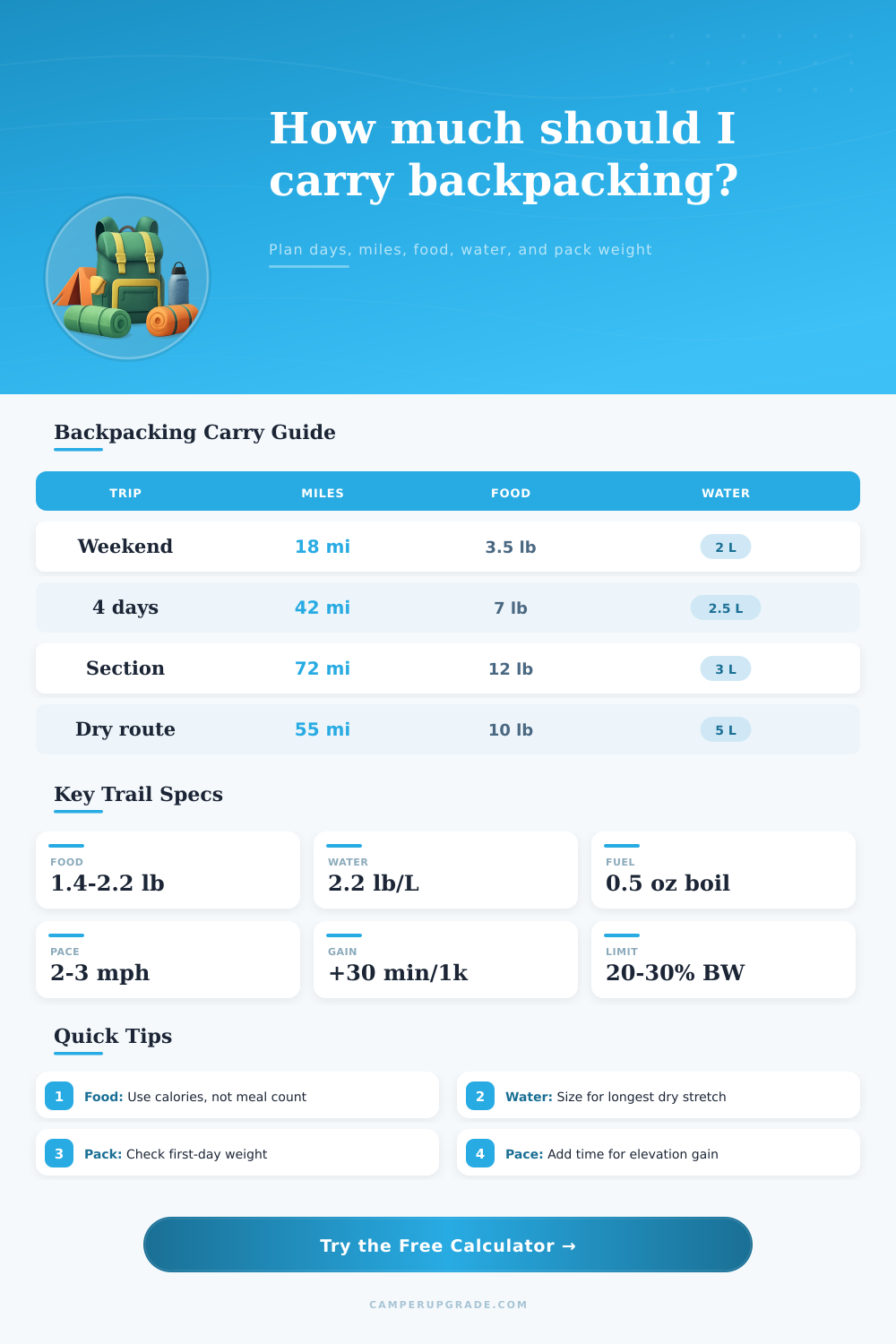
Estimate day-by-day backpacking load, food weight, water carry, fuel, hiking pace, elevation penalty, pack percentage, and resupply pressure before a multi-day trail.
🏕Multi-Day Backpacking Presets
⚙Trip, Food, Water, and Pack Inputs
The calculator uses mileage per day, elevation time penalty, food calories divided by calorie density, 2.2046 lb per liter of water, stove fuel by boil style, and first-day consumable load for pack-weight checks.
🔢Backpacking Formula Cards
Food Weight
cal / densityTotal food equals daily calories times food-carry days, divided by calories per ounce, then multiplied by the chosen buffer.
Water Weight
L x 2.2046Average carried water is converted to pounds, then compared with dry-stretch water need from the selected water rate.
Trail Time
mi / pace + gainMoving time starts from trail speed, then adds about thirty minutes for every one thousand feet of climbing.
Pack Load
gear + food + waterFirst-day pack weight adds base gear, resupply food, fuel, average water, and any selected practical reserve.
🎒Gear and Consumable Spec Grid
📋Backpacking Planning Tables
| Trip Length | Typical Miles | Food Weight | Planning Note |
|---|---|---|---|
| 1 night | 8-20 mi | 1.8-3.8 lb | Pack is mostly gear |
| 3 days | 24-42 mi | 4.5-7.5 lb | Food becomes visible |
| 5 days | 45-75 mi | 8-12 lb | Watch first-day load |
| 7 days | 65-110 mi | 11-17 lb | Resupply may matter |
| 10 days | 90-150 mi | 16-24 lb | Food volume is limiting |
| Food Type | Calories/Oz | Daily Weight | Best Use |
|---|---|---|---|
| Fresh-heavy menu | 80-100 | 2.1-2.8 lb | Short trips |
| Mixed grocery food | 105-120 | 1.7-2.2 lb | Casual weekends |
| Backpacking staples | 120-140 | 1.4-1.9 lb | Most trips |
| High-fat dense menu | 140-165 | 1.2-1.6 lb | Long carries |
| Cold-weather menu | 125-155 | 1.8-2.4 lb | High calories |
| Water Condition | Rate | 10-Mile Carry | Route Signal |
|---|---|---|---|
| Cool shaded trail | 0.35 L/mi | 3.5 L | Frequent creeks |
| Moderate hiking | 0.50 L/mi | 5.0 L | Normal planning |
| Hot exposed climb | 0.70 L/mi | 7.0 L | Start early |
| Desert dry stretch | 0.90 L/mi | 9.0 L | Cache or reroute |
| Cold snow route | 0.40 L/mi | 4.0 L | Fuel limits water |
| Pack Ratio | Feel | Planning Use | Adjustment |
|---|---|---|---|
| Under 15% | Light | Fast days possible | Keep food dense |
| 15-20% | Comfortable | Most backpackers | Good target |
| 20-25% | Noticeable | Long food carry | Check extras |
| 25-30% | Heavy | Remote or winter | Slow pace |
| Over 30% | Very heavy | Needs review | Split or resupply |
💡Backpacking Planning Tips
When planning a hiking trips, you will experience the heaviness of an hiking pack on the first day of the trips. This heaviness of the hiking pack are due to the fact that a hiking pack is the heaviest when it has all of the foods and all of the water for the trip. Many hikers makes the mistake of planning there hiking trips with the average weight of the hiking pack.
However, this isnt an accuracy weight to use for hikers because the weight of the hiking pack will change throughout the trip. As hikers consumes the food and water in the pack, the weight of the hiking pack will decrease. Thus, hikers should of plan for the weight of the heaviest portion of the hike, not an average weight of the hiking trip.
Plan for the Heaviest Pack, Not the Average
You must understand the diffrence between base weight and the total pack weight for hiking trip planning. The base weight of the hiking pack is the weight of the gear that dont change during the hike.