Camp Shower Temperature Calculator
Estimate final shower temperature, hot-water blend, usable warm volume, and cooling losses from water temperatures, container volume, flow, ambient air, and camp shower hardware.
🏕Camp Shower Temperature Presets
⚙Water Temperature, Mixing, Volume, and Ambient Inputs
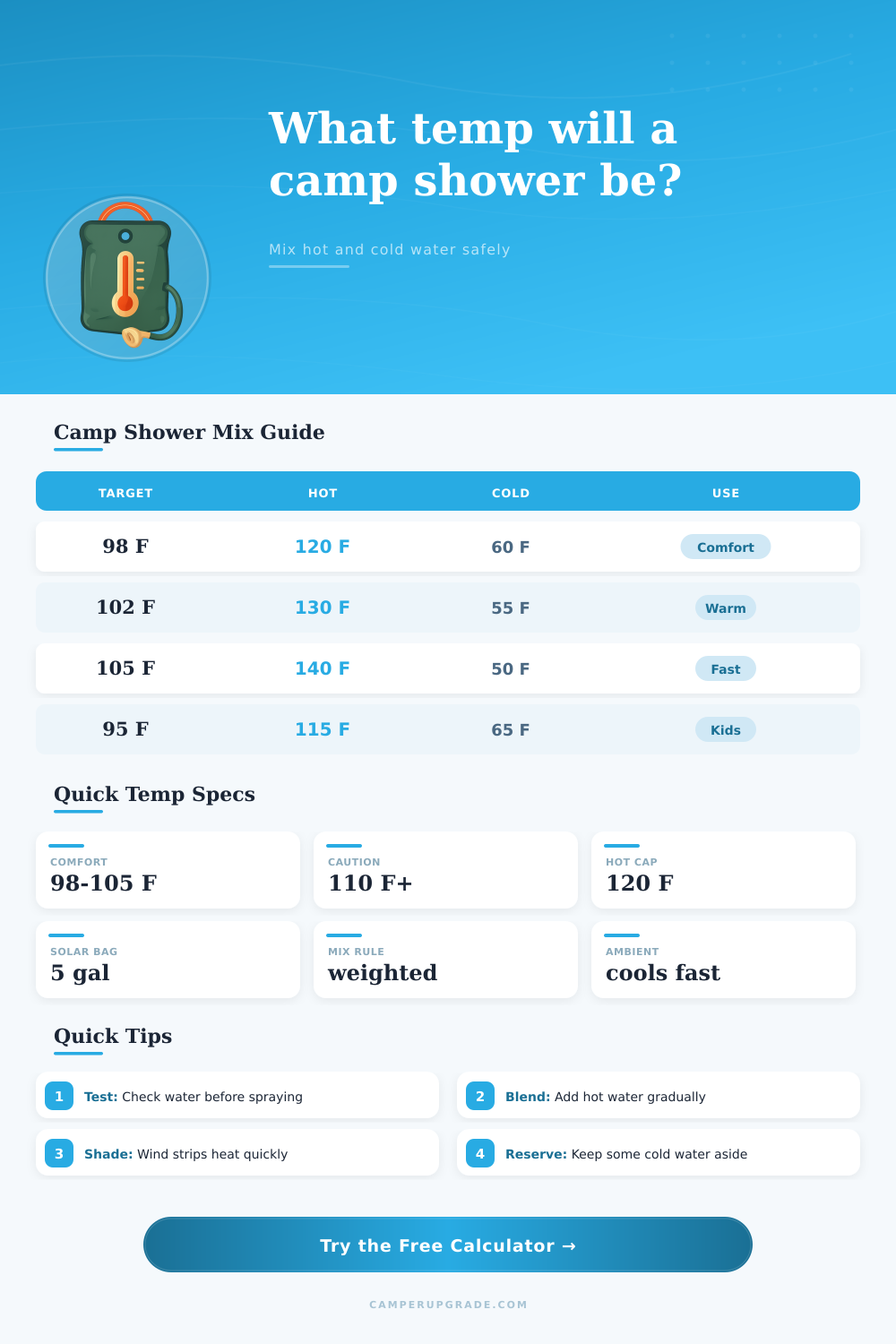
The calculator uses a weighted water-mixing equation, then estimates container limit, reserve water, hose loss, ambient exposure loss, flow effect, and shower-minute capacity.
🧮Formula Cards Used by the Calculator
Weighted water temperature
Final tank temp equals hot gallons times hot temp plus cold gallons times cold temp, divided by total gallons.
Hot-to-cold blend
Hot gallons for a target are total gallons times target-minus-cold divided by hot-minus-cold.
Camp cooling adjustment
Hose length, wind exposure, ambient air, flow, and prewarm setting estimate the drop before water reaches skin.
Usable warm shower volume
Usable gallons divided by flow rate gives spray minutes, then planned spray time gives shower count.
🚿Shower System and Temperature Spec Grid
📊Temperature and Mixing Reference Tables
| Comfort Zone | Outlet Temp | Best Use | Watch For |
|---|---|---|---|
| Cool rinse | 85-94 F | Hot afternoons | Chilly wind |
| Comfort warm | 98-102 F | Most adults | Long hose loss |
| Very warm | 103-108 F | Cold mornings | Test first |
| Caution | 109-120 F | Hardware only | Blend down |
| Hot Temp | Cold Temp | Target | Hot Share |
|---|---|---|---|
| 120 F | 55 F | 100 F | 69% |
| 130 F | 60 F | 102 F | 60% |
| 140 F | 50 F | 104 F | 60% |
| 150 F | 65 F | 105 F | 47% |
| Total Water | 0.5 gpm | 0.8 gpm | 1.5 gpm |
|---|---|---|---|
| 3 gal | 6.0 min | 3.8 min | 2.0 min |
| 5 gal | 10.0 min | 6.3 min | 3.3 min |
| 10 gal | 20.0 min | 12.5 min | 6.7 min |
| 20 gal | 40.0 min | 25.0 min | 13.3 min |
| Ambient | Exposure | Likely Drop | Fix |
|---|---|---|---|
| 75 F | Sheltered | 1-2 F | Normal mix |
| 60 F | Light wind | 3-5 F | Mix warmer |
| 45 F | Windy | 6-10 F | Short hose |
| 35 F | Exposed | 10 F+ | Prewarm gear |
💡Camp Shower Mixing Tips
To properly prepare a camp shower, one must account for the loss of heats that occurs between the water and the skin. Even if the water within the container is hot to the touch, the water that comes out of the shower head may not be as hot. This is due to the fact that the water may have traveled through the hose and through the air from the water source to the shower head.
Thus, understanding how water lose heat allows for the water to be kept at a comfortable temperature for the individual taking the shower. When water is in contact with objects, it naturaly transfer heat to those objects. The hose, the air, and even the shower head act as heat sink that draw heat from the water.
Keeping Camp Shower Water Warm
In cold or windy environments, the temperature of the water will drop quick. To calculate the amount of heat loss from the water, there is calculators available to assist in calculating this value. This is made more difficult without the calculator since the air and water temperature will be variables in the calculation.
Creating the proper mixture of water is a necessary part of preparing for the shower. The water that is stored in the tank need to be hotter than the desired temperature of the water on the skin. Boiling water and cold water will require the use of a specific ratio of each water types.
A head start and overshoot of the target temperature is required due to the environment stripping heat from the water. The flow rate of water is another variable to control for a proper camp shower. High flow rates of water will use much of the water quickly.
However, the high flow rate will result in the individual quickly running out of warm water. Low flow rates will use less water but will result in the water being in the air for longer period of time. Thus, this will result in more greater loss of heat from the water to the air.
The temperature of the ambient air and the exposure to the wind will affect the temperature of the water. Water that is within a shelter like a van annex will experience less variation in temperature compared to water that is within an open field and exposed to the wind. The wind will remove heat from the water and from the water spray.
Thus, accounting for the air temperature around the water will affect the water temperature spray onto the skin. Prewarming the gear before use can improve the consistency of the water temperature. If you pour hot water into a cold hose, heat will be lost to the hose.
This will result in the water that exits the hose having a temperature that is less then that of the water that entered the hose. Rinsing the hose with warm water prior to adding hot water will result in the water maintain its heat as it passes through the hose. When mixing water, it is critical to ensure that the individual is not exposed to burns from the water.
Adding boiling water to a container can result in burns to the individuals skin. Thus, one should take care when mixing the water to ensure that the temperature of the water does not become too hot for the individual. Additionally, the use of a safety cap on the container allows for the individual to set a maximum temperature to which the water should heat.
It is important to keep a reserve of cold water near the mixing area of the water. If the water becomes too hot, you can add cold water to the mixture to even out the temperature. Maintaining the temperature of the water is the most important part of preparing a camp shower that will be successful for the individual.