Camping Pot Capacity Calculator
Estimate total pot capacity, safe cooking volume, serving fit, boil-over headspace, and packed pot weight from real camping cookware dimensions and meal needs.
🏕Camping Pot Presets
⚙Pot Size and Meal Inputs
The calculator uses cylinder and tapered-frustum geometry, 1 quart = 57.75 cubic inches, 1 liter = 61.024 cubic inches, and safe-fill headspace for boil-over control.
🧪Pot Material and Spec Comparison
Hard-Anodized Aluminum
5.5 oz/LBalanced camp choice with even heat spread, moderate weight, and good simmer control.
Titanium
3.0 oz/LVery light and durable, but thin walls can create hot spots with thicker meals.
Stainless Steel
7.5 oz/LTough, scratch resistant, and group-friendly when pack weight is less critical.
Nonstick Aluminum
6.0 oz/LUseful for sticky meals, eggs, and rice, with gentler utensil requirements.
Cast Iron Camp Pot
34 oz/LExcellent heat retention for basecamp cooking, but very heavy for trail use.
Collapsible Pot
8.0 oz/LPackable for RV drawers and car camping, with lower heat tolerance at sidewalls.
Wide Pot Shape
Fast boilBetter stove contact and stirring access, but needs a stable burner support.
Tall Pot Shape
CompactGood for pack nesting and water boiling, but less stable on small stoves.
📏Capacity Reference Cards
📊Camping Pot Reference Tables
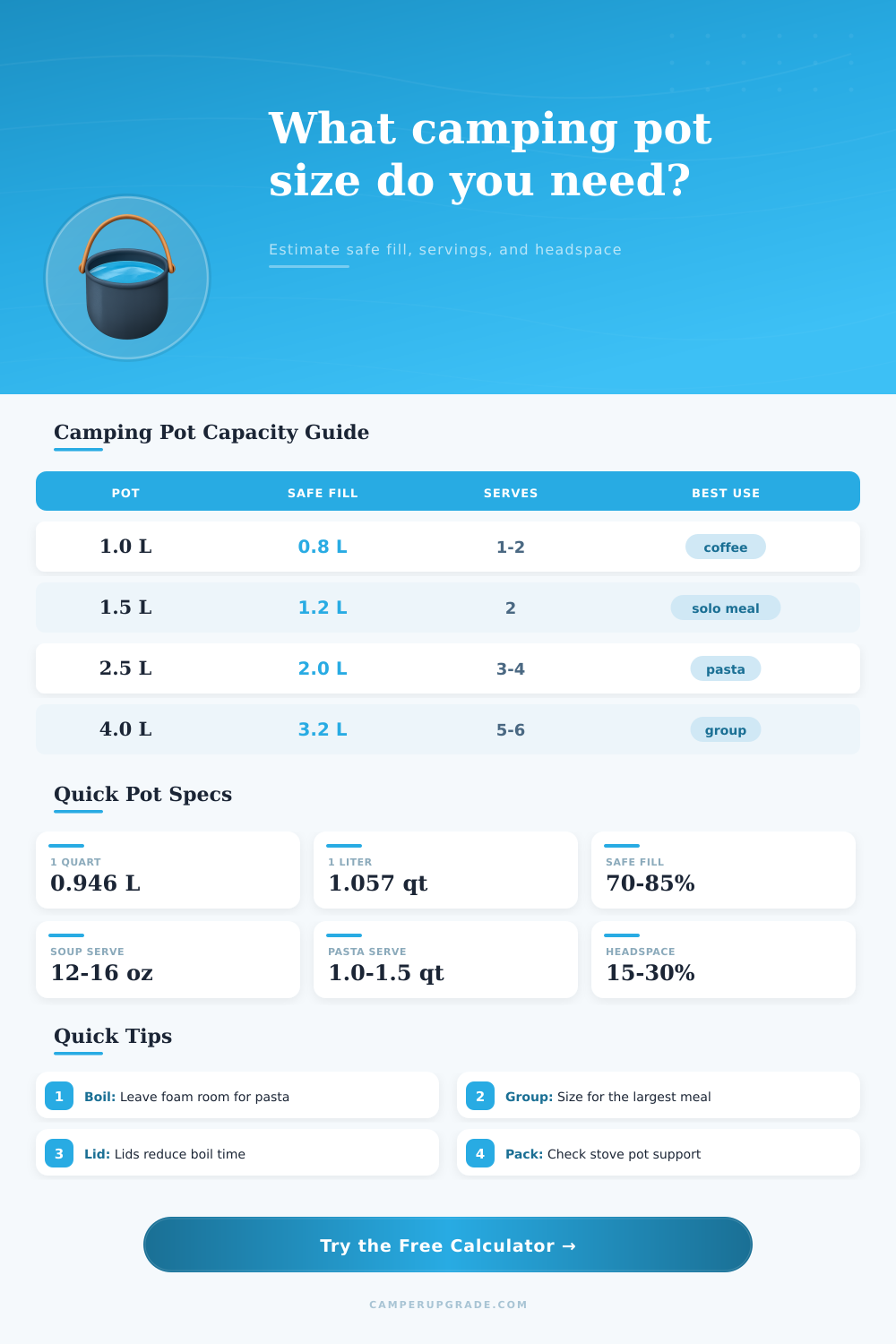
| Marked Size | Safe Fill 70% | Safe Fill 80% | Best Group |
|---|---|---|---|
| 0.75 L / 0.8 qt | 0.53 L | 0.60 L | solo drinks |
| 1.0 L / 1.1 qt | 0.70 L | 0.80 L | solo meal |
| 1.5 L / 1.6 qt | 1.05 L | 1.20 L | 2 light |
| 2.5 L / 2.6 qt | 1.75 L | 2.00 L | 3 to 4 |
| 4.0 L / 4.2 qt | 2.80 L | 3.20 L | 5 to 6 |
| 6.0 L / 6.3 qt | 4.20 L | 4.80 L | 8 to 10 |
| Meal Type | Per Person | Expansion | Headspace |
|---|---|---|---|
| Coffee or tea | 10-12 fl oz | 1.00x | 12% |
| Freeze-dried water | 12-16 fl oz | 1.00x | 15% |
| Soup or chili | 12-16 fl oz | 1.10x | 20% |
| Oats or couscous | 10-14 fl oz | 1.25x | 25% |
| Rice or beans | 12-18 fl oz | 1.40x | 28% |
| Pasta boil | 32-48 fl oz | 1.60x | 35% |
| Inside Diameter | 3 in High | 4 in High | 5 in High |
|---|---|---|---|
| 4.5 in | 0.83 qt | 1.10 qt | 1.38 qt |
| 5.5 in | 1.23 qt | 1.65 qt | 2.06 qt |
| 6.5 in | 1.72 qt | 2.30 qt | 2.87 qt |
| 7.5 in | 2.30 qt | 3.06 qt | 3.83 qt |
| 8.5 in | 2.95 qt | 3.93 qt | 4.91 qt |
| 10 in | 4.08 qt | 5.44 qt | 6.80 qt |
| Camp Scenario | People | Meal Need | Pot Size |
|---|---|---|---|
| Solo coffee and oats | 1 | 0.6-0.9 L | 1.0 L |
| Two backpack meals | 2 | 1.0-1.3 L | 1.5 L |
| Family soup lunch | 4 | 1.8-2.2 L | 3.0 L |
| Pasta night | 4 | 4.0-5.5 L | 6.0 L |
| Patrol stew | 8 | 4.0-5.0 L | 6.0 L |
| Snow melting | 3 | 3.0-4.0 L | 5.0 L |
💡Pot Capacity Tips
When cooking in a pot while camping, it is important to understand the difference between the total capacity of the pot and the safe cooking capacity of that pot. Many individuals may think that if the pot is stamped with a number indicating it’s total capacity of one liter, then the pot can hold one liter of the food that is to be cooked. However, the one-liter pot cannot hold one liter of food when cooking.
The total capacity of the pot is the amount of liquid that the pot can hold when filled to the very top of the pot. However, the safe cooking capacity of the pot is the amount of food that should be cooked within the pot, leaving some space at the top of the pot for the boiling food to expand, and to allow for the food to expand within the cooking pot. This space within the cooking pot is referred to as headspace.
How Much Food a Camping Pot Can Hold
Headspace allows for the food to remain within the cooking pot, and ensures that the boiling cooking liquids dont extinguish the stove burner. The type of food that will be cooked within the pot will affect the amount of headspace that should be provided within the cooking pot. For example, foods that contain grains, like rice, will expand when cooked.
Additionally, the starch within the food will create bubbles within the cooking pot that can boil over the food. Therefore, headspace should be provided for this type of food, and you should only use two-thirds of the total capacity of the cooking pot for these types of meals. Furthermore, the amount of expansion that the food will exhibit when cooked should be accounted for when purchasing the cooking pot.
If too little headspace is provided for cooking the individual’s meal, the meal may spill out of the cooking pot. The shape of the cooking pot will also impact the cooking of the meal. For example, pots that are relatively wide but shallow have a larger surface area than pots that are tall and narrow.
This larger surface area helps to distribute the heat evenly to the food that is within the cooking pot, preventing the food from scorching at the base of the cooking pot. However, these types of cooking pots may be less stable when placed upon a stove burner. Additionally, tall and narrow cooking pots allow for the food to be transported more easy within the individuals backpack, and these types of cooking pots tend to retain the heat that is distributed to the food.
However, these types of cooking pots are more likely to experience boiling over of the food due to the potential for the steam and bubbles to easily exit the cooking pot. Finally, some cooking pots are tapered, meaning that they are wider at the top of the pot than the bottom of the cooking pot. This change in the diameter of the cooking pot can change the mathematical calculation of the total capacity of that cooking pot.
The material that is used to create the cooking pot will impact the even distribution of heat to the food within the cooking pot. For example, cooking pots that use titanium as its main material is often very lightweight for camping trips. However, because titanium is thin, hot spots may form within the cooking pot that could burn the food.
Additionally, using hard anodized aluminum for the cooking pot will allow the heat to be distributed evenly, making it easier to simulate the food. Finally, using cast iron will allow the cooking pot to retain its heat, but the weight of the cast iron cooking pot may be too heavy to bring on camping trips. When measuring the cooking pot, it is important to measure the interior of the cooking pot, not the exterior of the cooking pot.
Cooking pots has thick walls and rims that roll over the edge of the cooking pot. These thick walls and rims increase the exterior size of the cooking pot but not the amount of space within the cooking pot. Therefore, to determine how much food the cooking pot will be able to hold, the cook should measure the interior diameter and interior height of the cooking pot.
For instance, if the meal requires 1.2 liters of cooking space, a cooking pot of 1.2 liters is too small; a larger size cooking pot should be used. By considering the amount of headspace that will be required according to the type of meal to be cooked, the amount of expansion of the food, and the measurement of the cooking pot, it is possible to ensure that the food will remain within the cooking pot.