Campfire Safety Distance Calculator
Estimate the minimum all-around, downwind, tent, gear, and overhead clearances for a campfire using flame height, wind, fuel dryness, fuel type, slope, and nearby shelter distances.
🏕Campfire Distance Presets
⚙Fire, Wind, Fuel, and Shelter Inputs
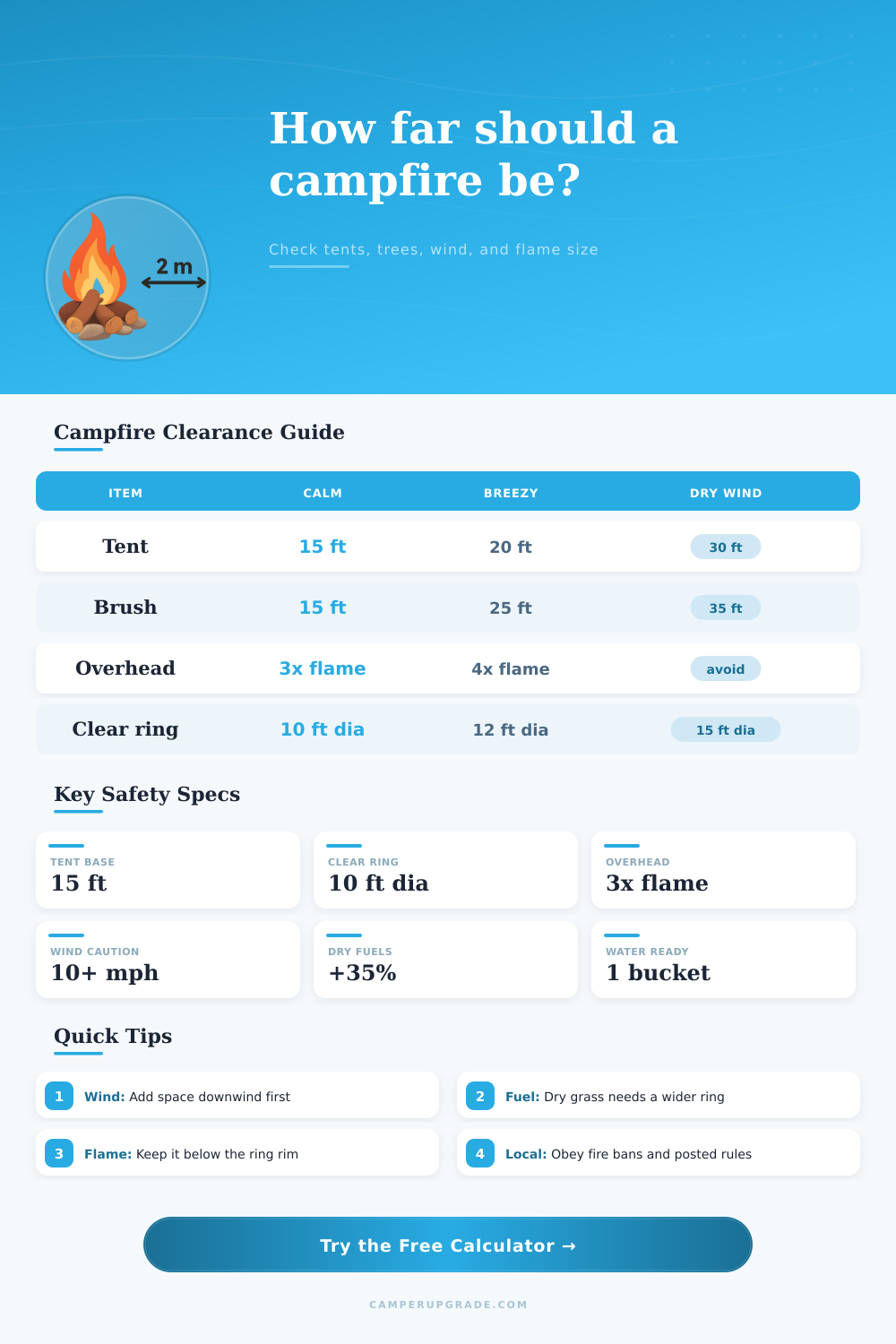
Baseline distances use common public-agency campfire guidance: keep tents, gear, and flammables at least 15 ft away, clear a 10 ft diameter down to nonburnable surface, avoid overhead limbs, and keep water plus a shovel ready.
🔥Hazard Spec Comparison Grid
⚠Campfire Hazard Comparison
Contained Propane
Lower ember riskNo wood embers, but heat, wind, fuel hose, and local fire restrictions still control placement.
Hardwood Ring Fire
Moderate riskBest for normal camping when flames stay low and the 10 ft cleared circle is real dirt or gravel.
Softwood Spark Fire
Higher riskPopping sparks and resin need extra downwind space, especially near nylon shelters and dry leaves.
Brush or Tall Flames
High riskTwiggy fuel, tall flames, slope, and dry grass can exceed ordinary campground-ring assumptions.
📊Clearance and Reference Tables
| Reference Item | Calm Minimum | Breezy Use | Do Not Use When |
|---|---|---|---|
| Tent or tarp fabric | 15 ft | 20 to 30 ft | Sparks land on fabric |
| Dry brush or leaves | 15 ft | 25 to 35 ft | Cannot clear to dirt |
| Overhead branches | 3x flame height | 4x flame height | Branches hang over pit |
| Cleared ground circle | 10 ft diameter | 12 to 15 ft diameter | Grass remains inside ring |
| Woodpile and fuel cans | 15 ft | 20 ft plus | Leeward sparks hit pile |
| Wind Speed | Wind Feel | Distance Change | Fire Choice |
|---|---|---|---|
| 0 to 4 mph | Smoke rises | Baseline | Small ring fire |
| 5 to 9 mph | Smoke drifts | +10% downwind | Low flames only |
| 10 to 15 mph | Leaves move | +30% downwind | Consider no fire |
| 16 to 20 mph | Gusty embers | +55% downwind | Use stove instead |
| 20+ mph | Sparks travel | No open fire | Do not light |
| Ground Fuel | Clear Radius | Multiplier | Main Concern |
|---|---|---|---|
| Mineral soil or gravel | 5 ft | 0.90x | Heat only |
| Short grass or duff | 6 ft | 1.05x | Creeping edge |
| Dry leaves or needles | 8 ft | 1.25x | Fast surface spread |
| Tall dry grass | 10 ft | 1.40x | Wind-driven flame |
| Brush or wood debris | 12 ft | 1.55x | Heavy fuel ignition |
| Flame Height | Overhead Min | People Zone | Best Use |
|---|---|---|---|
| 1 ft | 15 ft | 3 ft edge | Cooking coals |
| 2 ft | 15 ft | 4 ft edge | Small campfire |
| 3 ft | 15 ft | 6 ft edge | Social ring fire |
| 4 ft | 16 ft | 8 ft edge | Reduce fuel load |
| 5+ ft | 20 ft plus | 10 ft edge | Too tall for camp |
💡Distance Planning Tips
Fire safety at the campsite require an understanding of the physical variables that influence the behavior of fire. Many individuals use the notion of intuition to calculate the distance that they should maintain from fire. However, using intuition isnt a reliable way to measure fire safety at the campsite.
Fire is influenced by the type of fuel that you burn, the speed of the wind at the campsite, and the slope of the ground. Due to the way in which these three variables influence fire, individuals must perform specific calculation before setting up camp to determine the distance that they should maintain from campfire. The type of wood that you use as fuel determine the rate at which the fire spreads.
Campfire Safety at the Campsite
Hardwood logs will burn slow compared to softwood logs. Softwood logs will emit resin from the logs which creates the popping sound that is often heard when setting up a campfire. The popping of the wood release high-velocity embers into the air which can travel a significant distance from the campfire.
Therefore, if you are burning softwood logs, you must increase the radius of your safety from the campfire. Depending on the size of the logs, the high-velocity embers can travel more further from a campfire than the flames from that fire. The speed of the wind at the campsite will increase the distance that the embers will travel from the campfire.
In calm condition, the heat that is released from the campfire will rise vertically. However, the wind speed will change the course of the heat from the campfire. The increased speed of the wind will allow that heat to exit the campfire and travel horizontal.
The wind will carry the embers from the campfire to the tent and gear located downwind of the campfire. Therefore, the tent and gear should be located upwind of the campfire. Additionally, if the wind is gusting or change direction at the campsite, you must increase the safety distance between the campfire and the gear.
The type of ground on which you build your campfire can drastically increase the danger of your campfire. The safest ground on which to build a campfire is mineral soil or gravel. These type of ground will not ignite from the fire.
However, campgrounds may contain dry needle or dry grass on the ground. These element are a fuel source for the fire. If a campfire ember lands on dry grass or dry needles, the fire can spread to the gear located nearby.
Therefore, you must clear a ring of bare dirt around the campfire. When building a campfire on the ground with a slope, the fire will move uphill faster than it will move on flat ground. This is due to the preheating of the fuel source located uphill of the campfire.
Therefore, if camping on a slope, the area that is uphill of the campfire is the most dangerous for camping gear. To avoid setting your gear on dangerously hot ground, you should of position your shelter further away from the campfire on the uphill side of the campfire. An overlooked metric for fire safety is the overhead clearance.
The fire can ignite low-hanging branches or tarp on your tent. The overhead distance between the campfire and the objects hanging from the branches or tarp should be at least three times the height of the flame from your campfire. Therefore, if you have flames that burn tall with your campfire, you will need to create a large overhead clearance for your sleeping bag and gear.
The hazard score that the fire safety calculation tool provides will help you to determine if the campfire is at risk of endangering your gear. If the hazard score is high, you may want to use a propane pit instead of a wood fire. The propane pit pose fewer risks because propane logs do not emit popping embers.
While it is necessary to prepare for the heat of the propane pit and the propane hose, using a propane fire will not result in the sparks from the fire land on your sleeping bag and gear. In order to maintain fire safety with the propane alternative, ensure that the gear is positioned upwind of the campfire, ensure that the overhead distance from the sleeping bag and gear is large, and ensure that you have enough water for camp drinking or cooking teh meals.