2 Stroke Fuel Mix Calculator
Calculate exact two-stroke oil for gas cans, trail tools, camp generators, outboards, minibikes, and vintage engines.
⛽ Named Two-Stroke Presets
🧪 Fuel and Ratio Inputs
📊 Oil Amount Quick Grid
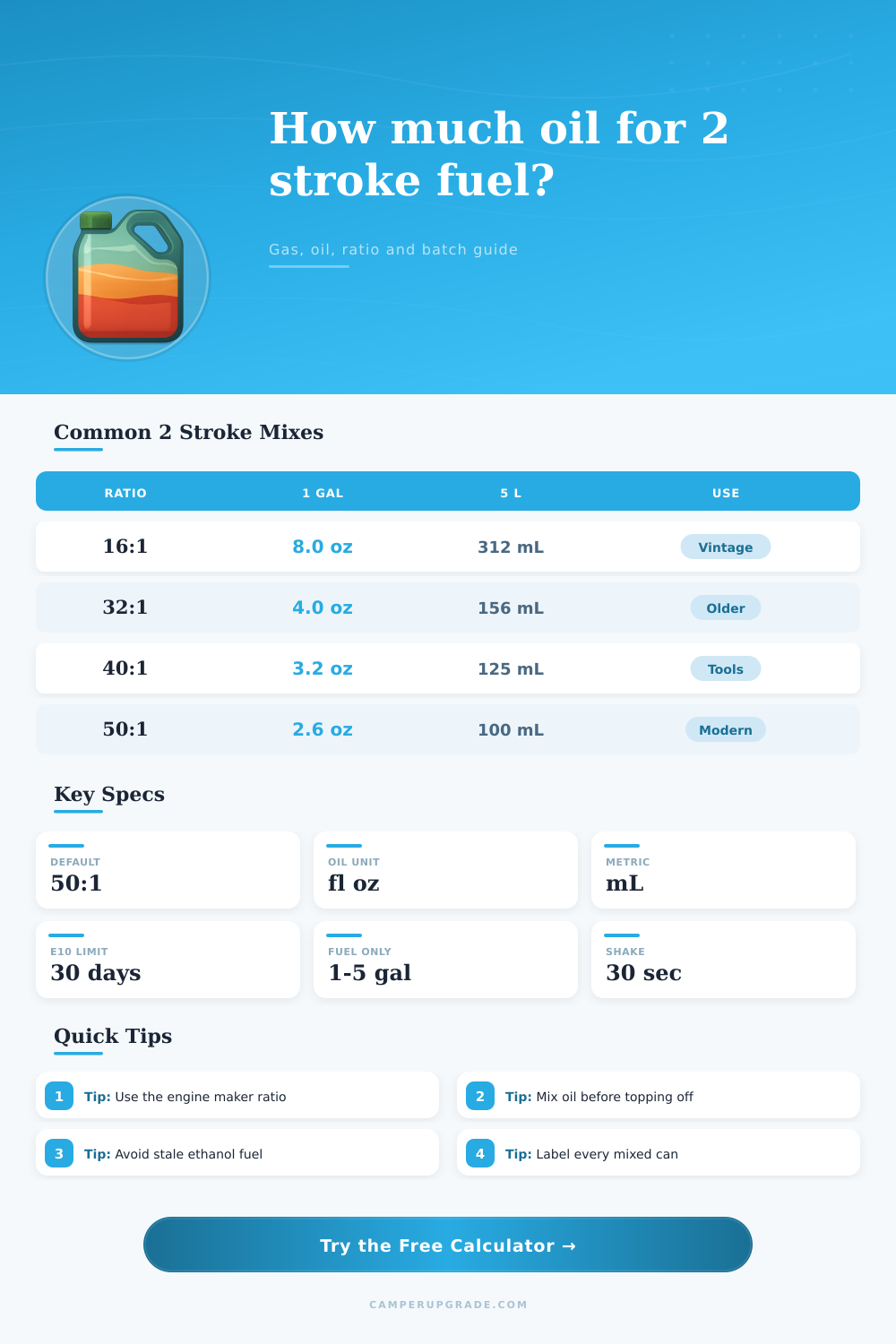
📘 Common Mix Ratio Table
| Ratio | Oil Percent | Oil per 1 US gal | Oil per 5 L |
|---|---|---|---|
| 16:1 | 6.25% | 8.00 fl oz | 312.5 mL |
| 20:1 | 5.00% | 6.40 fl oz | 250.0 mL |
| 25:1 | 4.00% | 5.12 fl oz | 200.0 mL |
| 32:1 | 3.125% | 4.00 fl oz | 156.3 mL |
| 40:1 | 2.50% | 3.20 fl oz | 125.0 mL |
| 50:1 | 2.00% | 2.56 fl oz | 100.0 mL |
| 60:1 | 1.67% | 2.13 fl oz | 83.3 mL |
🛢 Gas Can Reference Table
| Gas Volume | 50:1 Oil | 40:1 Oil | 32:1 Oil |
|---|---|---|---|
| 1 US quart | 0.64 fl oz / 19 mL | 0.80 fl oz / 24 mL | 1.00 fl oz / 30 mL |
| 1 US gallon | 2.56 fl oz / 76 mL | 3.20 fl oz / 95 mL | 4.00 fl oz / 118 mL |
| 2 US gallons | 5.12 fl oz / 151 mL | 6.40 fl oz / 189 mL | 8.00 fl oz / 237 mL |
| 2.5 US gallons | 6.40 fl oz / 189 mL | 8.00 fl oz / 237 mL | 10.00 fl oz / 296 mL |
| 5 US gallons | 12.80 fl oz / 379 mL | 16.00 fl oz / 473 mL | 20.00 fl oz / 591 mL |
| 6 US gallons | 15.36 fl oz / 454 mL | 19.20 fl oz / 568 mL | 24.00 fl oz / 710 mL |
🧴 Metric Mix Reference Table
| Fuel Volume | 50:1 Oil | 40:1 Oil | 25:1 Oil |
|---|---|---|---|
| 1 L | 20 mL | 25 mL | 40 mL |
| 2 L | 40 mL | 50 mL | 80 mL |
| 5 L | 100 mL | 125 mL | 200 mL |
| 10 L | 200 mL | 250 mL | 400 mL |
| 20 L | 400 mL | 500 mL | 800 mL |
✅ Oil Spec Comparison Grid
| Oil Spec | Typical Use | Strength | Check Before Use |
|---|---|---|---|
| JASO FD / ISO-L-EGD | Modern air-cooled tools | High detergency, low smoke | Use engine maker ratio |
| JASO FC | General small engines | Low smoke performance | Less detergent than FD |
| NMMA TC-W3 | Water-cooled outboards | Ashless marine formula | Not always for hot air-cooled tools |
| API TC | Legacy two-stroke gear | Older service category | Confirm modern replacement |
| Castor racing blend | Race or vintage engines | Strong film at high heat | Can gum if stored poorly |
🔢 Measuring Conversion Table
| Measure | US fl oz | Milliliters | Kitchen Equivalent |
|---|---|---|---|
| 1 teaspoon | 0.167 fl oz | 4.93 mL | 1 tsp |
| 1 tablespoon | 0.500 fl oz | 14.79 mL | 3 tsp |
| 1 US cup | 8.00 fl oz | 236.59 mL | 16 tbsp |
| 1 liter | 33.81 fl oz | 1000 mL | 4.23 cups |
💡 Mixing Tips
Two-stroke engines requires a mixture of gasoline and oil because their internal design dont include an dedicated oil reservoir to provide lubrication to the engines internal components. The oil must travel through the engine with the gasoline fuel mixture to provide lubrication to the engine components. If the gasoline and oil isnt mix correctly, the two-stroke engine can suffer a catastrophic seizure that will ruin the piston within the engine.
The mix ratio is a measurement of the relationship of the parts of gasoline to the parts of oil that should be used within the engine. For instance, a 50:1 ratio means that 50 parts of gasoline should be mixed with 1 part of oil. The proper ratio of gasoline to oil must be used in the two-stroke engine.
How to Mix Gas and Oil for a Two-Stroke Engine
The proper ratio for a two-stroke engine can vary depending on the age of the engine and the type of engine that is being used. For instance, moddern two-stroke engines are typical designed to utilize a 50:1 ratio of gasoline to oil. Using this ratio in modern two-stroke engines ensures that the engine creates less smoke and leaves few carbon deposits on the spark plug.
However, older and vintage two-stroke engines tend to require a richer ratio of oil to gasoline, such as a ratio of 16:1. Using too lean of a mixture in vintage two-stroke engines may lead to those vintage engines becoming lock in position. Furthermore, another factor in mixing the gasoline and oil together is the type of oil that is to be used in the engine.
Different types of oil have different specifications for two-stroke engines, such as whether the oil should contain JASO FD or TC-W3 oil. For instance, the designer specifically design TC-W3 oil for use within water-cooled outboard motors. However, the use of TC-W3 oil within air-cooled equipment, like a chainsaw, can lead to the oil break down too quick due to the high level of heat that are created by the air-cooled tools.
Another factor to consider is the quality of the gasoline that is used within the engine. Most gasoline contain ethanol. Ethanol is hygroscopic in that it will pull moisture from the air and incorporate that moisture into the gasoline.
That moisture within the gasoline can lead to the engine sputter, or it can lead to the carburetor becoming corroded. Therefore, to avoid the moisture in the gasoline, it is possible to change to an ethanol-free gasoline or to use alkylate fuel. Furthermore, if the gasoline that is used contains E10 gasoline, it is only necessary to prepare small batches of gasoline and oil mixtures, and to utilize those prepared mixtures quick.
When mixing the gasoline and oil, it is important to utilize a specific order in which the liquids are mixed. First, measure the amount of gasoline that is to be used. Then, add the calculated amount of oil to the gasoline.
If you add the oil to the fuel tank first, before you pour the gasoline into the tank, the volume of the mixture will change. Furthermore, the measurements that are made with measuring tools are rarely perfect in there measurements. Therefore, it is best to round the measurements towards a richer ratio.
A richer ratio indicates the addition of more oil to the gasoline mixture. While this may lead to the engine producing more smoke, the addition of too little oil to the gasoline mixture may result in the gasoline becoming too lean. A lean gasoline mixture can result in a seizure of the engine, which will require the engine to be rebuilt.
Therefore, adding too much oil is more better than adding too little oil to the gasoline fuel mixture. Furthermore, once you have mixed the gasoline and oil together, you must shake them in order to ensure that the oil and gasoline are combine together. Gasoline and oil will not naturaly combine together.
To properly mix the two liquid, the fuel tank containing the gasoline and oil must be shaken for at least thirty seconds. Finally, label the fuel tank with both the ratio of the gasoline and oil mixture, as well as with the date when the fuel tank was filled with gasoline and oil. By labeling the fuel tank with the ratio of the gasoline and oil mixture, others will know the ratio of the fuel mixture.
Furthermore, by labeling the fuel tank with the date that the fuel was added to the tank, those who fill the fuel tank will know when to replace the gasoline and oil mixture. If each of these step are followed, the two-stroke engine will be protected from damage, and will reliably start when attempting to start the engine. You should of checked the ratio twice.