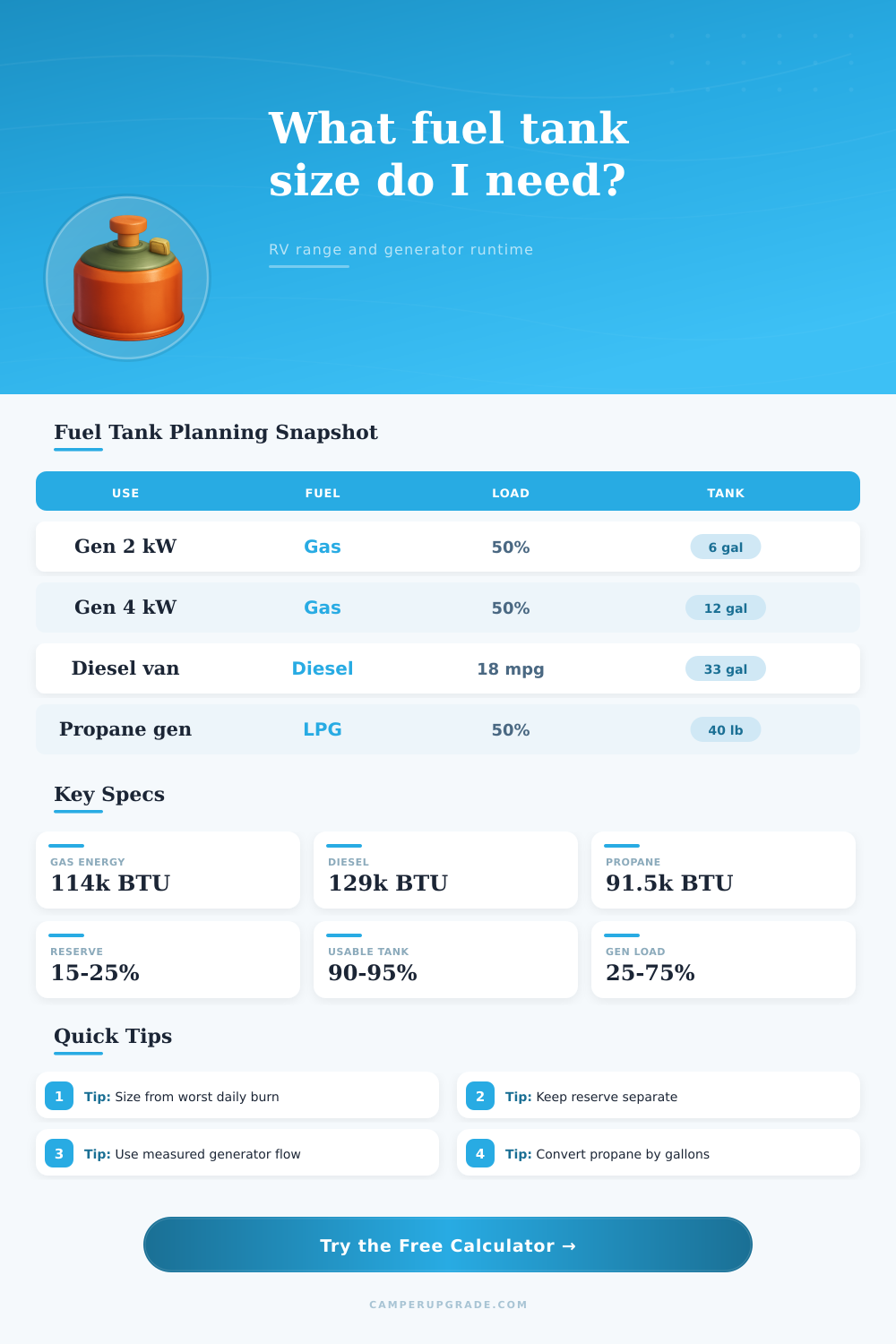
Fuel Tank Size Calculator
Estimate RV fuel capacity from generator runtime, vehicle range, daily consumption, reserve margin, and usable tank percentage.
Formula breakdown
| Generator size | 25% load | 50% load | 75% load |
|---|---|---|---|
| 2.0 kW inverter gasoline | 0.10-0.14 gal/hr | 0.17-0.22 gal/hr | 0.26-0.34 gal/hr |
| 3.0 kW gasoline RV generator | 0.18-0.24 gal/hr | 0.30-0.40 gal/hr | 0.46-0.58 gal/hr |
| 4.0 kW gasoline RV generator | 0.24-0.32 gal/hr | 0.42-0.55 gal/hr | 0.62-0.80 gal/hr |
| 6.0 kW diesel generator | 0.24-0.34 gal/hr | 0.45-0.62 gal/hr | 0.70-0.92 gal/hr |
| 5.5 kW propane generator | 0.35-0.48 gal/hr | 0.65-0.85 gal/hr | 0.95-1.25 gal/hr |
| RV or vehicle type | Typical fuel | Common tank capacity | Planning note |
|---|---|---|---|
| Class B camper van | Gasoline or diesel | 24-31 gal | Range is usually limited by mpg before generator fuel. |
| Class C motorhome | Gasoline | 55-80 gal | Built-in generators often draw from the main chassis tank. |
| Class A gasoline coach | Gasoline | 75-100 gal | Reserve margin matters because mpg can drop below 7. |
| Diesel pusher motorhome | Diesel | 90-150 gal | Diesel generators may share the main tank with pickup limits. |
| Truck camper tow rig | Gasoline or diesel | 26-48 gal | Auxiliary tanks are common for remote highways. |
| Portable generator setup | Gasoline or propane | 1-7 gal onboard | Carried fuel size determines safe overnight runtime. |
| Scenario | Fuel use | Reserve | Suggested capacity |
|---|---|---|---|
| 4 kW gas generator, 4 hr/day, 3 days | About 6.0 gal | 20% | 8 gal carried fuel |
| 55 gal Class C tank, 8 mpg route | 48 gal usable | 12% | 380 mi practical range |
| Diesel van, 24.5 gal tank, 18 mpg | 21 gal usable | 15% | 375 mi practical range |
| Propane gen, 0.75 gal/hr, 20 hours | 15 gal LPG | 20% | 75-80 lb propane |
| Truck camper, 300 mi at 11 mpg | 27.3 gal driving | 20% | 34 gal usable fuel |
Gasoline
Easy to find and common for RV generators. Lower energy density than diesel, with storage life that benefits from rotation or stabilizer.
Diesel
Higher energy per gallon and common in larger coaches. Excellent for long range when the generator and engine share one tank.
Propane
Clean storage and common cylinders, but lower energy per gallon. Convert pounds to gallons before sizing runtime.
Shared Tank
Convenient for built-in systems. Many generator pickups stop above empty, so usable percentage should be conservative.
When planning to travel in an RV, a consideration of the fuel that is use to power the RV is necessary. The fuel that is stored in the RV can power two differents systems within the RV. One system is the engine that is used to move the RV from one location to an other, and the other system is a generator that is used to supply power to the RVs living areas.
Because both of these systems utilize the fuel that is contained within the RV, the use of that fuel by the generator reduces the amount of fuel that can be used to power the RVs engine. Thus, in calculating the fuel need for the RV, it is necessary to consider the worst possible circumstances for the use of fuel rather than the typical circumstances. For instance, if the fuel is used to power the engine to travel to another location and if there is also use of the generator to power the RVs air conditioner, it is possible that the fuel will be depleted more fast than if the RV was traveling typical distances and using fewer of the RVs electrical device.
How to Plan Fuel for Your RV Trip
Some of the fuel that is contained within the fuel tank within the RV is not use by the RV itself. The fuel that does not get use by the RV can be due to the position of the fuel pickup tube that draws the fuel from the tank, or because some of the fuel becomes stuck within the fuel tank while the RV is traveling uphill. The fuel that is not use by the RV or that remains within the tank is referred to as unusable fuel.
Thus, in calculating how much fuel the RV will need, it is necessary to account for this unusable fuel so that the RV doesnt become depleted of fuel. In many instances, RV travelers tend to disregard this fuel and begin to running out of fuel while the RV is idling. Another factor that those that plan to travel within their RV should consider is the fuel reserve margin.
A reserve margin for fuel within an RV is the amount of fuel that is maintained within the tank beyond the amount that is calculated as being necessary to complete the trip. That fuel can be used in the case that some unexpected issue arise that prevents the RV from continuing on its journey, such as encountering a road that is closed for construction. An example of the reserve margin that is often applied to the fuel tank of an RV is the reserve of 20% of the fuel that is calculated to be need for the trip.
Thus, while the unusable fuel is a fixed number that is set for the RV and its fuel tank, the reserve margin is established as a means of securing the RV traveler and there contents. The generator that is included in most RVs may utilize fuel at different rates. For instance, if the generator is only lighting the RVs interior lighting, then that generator will use less fuel than if that generator is also use to power the air conditioner within the RV.
Thus, in calculating the fuel that will be used by the RVs generator, it is necessary to calculate the fuel burn rate of the generator according to the electrical load that will be placed upon it. If such calculations are not performed, it is likely that the fuel needs of the RV will be underestimate. Within the RV, the type of fuel can also have an impact upon the amount of energy that is available to the RV.
For instance, the type of fuel that is use in RVs can be gasoline, diesel, or propane. Diesel fuel contains more energy per gallon of fuel than does gasoline, which is why diesel fuel is often use for long distances. Additionally, people often purchase propane fuel by the pound rather than by the gallon, but the generator often consumes propane according to the gallon amount of propane fuel.
Thus, if the weight of propane fuel is not converted to gallons, RV travelers may find themselves out of propane fuel more fast than expected. Environmental factors may also impact the amount of fuel that is used by the RV. For instance, if the trip that is to be taken by the RV includes traveling to high altitudes, the engine and generator will have to work harder to produce the power that is required to move the RV forward against the thin atmosphere.
Thus, the RV will consume more fuel at high altitudes, which is why fuel efficiency often decrease at high altitudes. Thus, it is important to account for this increased fuel consumption of the RV within the mountains where it is to travel. Another consideration of the fuel needs of an RV is the consideration of what is referred to as the limiting leg of the trip.
The limiting leg of an RV trip is the longest distance that the RV will travel between two location that have fuel. Thus, if the fuel needs of the RV can be ensured to last for the length of the limiting leg with the reserve fuel, then the RV will have enough fuel to complete the entire trip. Thus, it is only necessary to ensure that there is enough fuel to travel the limiting leg of the trip rather than the entirety of the trip that is to be take by the RV.
Finally, planning for the fuel needs of the RV is a means of managing the risk of the trip. In planning for the RV, factors such as unusable fuel, generator load, and reserve fuel need to be account for. In accounting for these factors and ensuring that the RV has enough fuel to account for the risks that may emerge from the trip, then the stationary power that is provide by the RV will not interfere with the movement of that RV.
Thus, through planning the fuel usage within the RV, the traveler ensures that the RV will always have the ability to move, and that they will feel secure in there travel.