Ground Frost Depth Calculator
Estimate ground frost penetration from freezing-degree-days, soil texture, soil moisture, snow insulation, surface cover, vegetation, groundwater, and exposure.
❄Ground Frost Presets
⚙Weather, Soil, And Surface Inputs
🧪Soil And Specification Comparison Grid
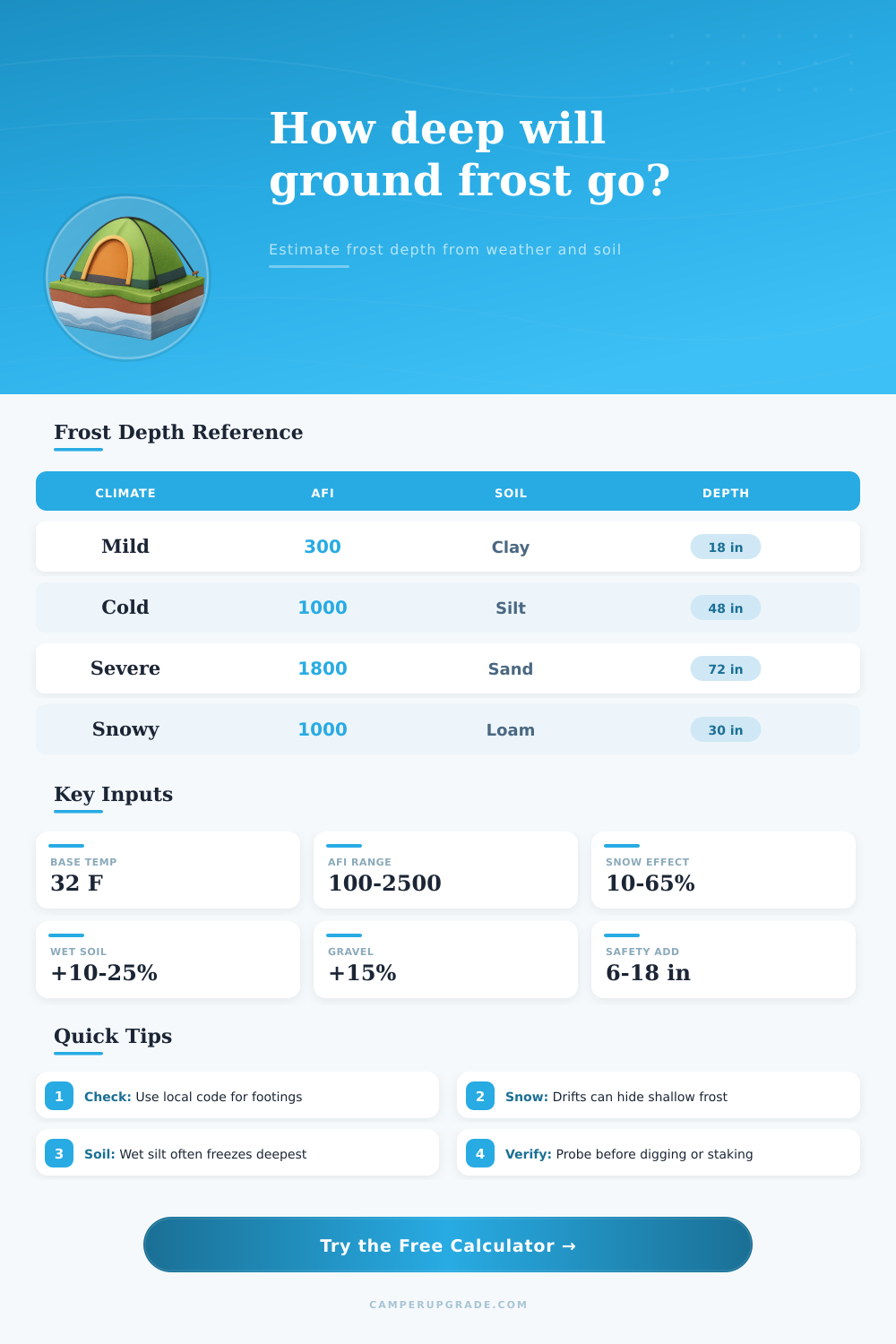
📊Frost Depth Reference Tables
| Air Freezing Index | Typical Climate | Bare Soil Depth | Snowy Ground |
|---|---|---|---|
| 100-300 F-days | Mild winter edge | 8-20 in | 4-12 in |
| 300-700 F-days | Cool inland winter | 20-36 in | 12-24 in |
| 700-1200 F-days | Cold northern winter | 36-54 in | 20-38 in |
| 1200-2000 F-days | Severe continental winter | 54-78 in | 32-56 in |
| 2000+ F-days | Subarctic exposure | 78+ in | 48+ in |
| Soil Type | Relative Frost | Heave Risk | Field Clue |
|---|---|---|---|
| Clean gravel | Deep | Low | Fast draining |
| Coarse sand | Deep | Low-med | Gritty, drains |
| Sandy loam | Moderate | Medium | Some fines |
| Silt loam | Moderate-deep | High | Smooth powdery fines |
| Clay | Moderate | High | Plastic when wet |
| Peat or muck | Shallow | Variable | Dark organic mat |
| Snow / Cover | Ground Index | Depth Change | Use Case |
|---|---|---|---|
| Bare plowed gravel | 100-115% | Deeper | Drive, pad, road |
| Grass, 2 in snow | 75-90% | Slightly less | Open yard |
| 6 in packed snow | 55-70% | Much less | Undisturbed lawn |
| 12 in packed snow | 35-55% | Shallow frost | Drifted site |
| Mulch or duff | 50-75% | Insulated | Wooded area |
| Project Check | Common Target | Typical Allowance | Verify With |
|---|---|---|---|
| Temporary anchors | Below frost | 6-12 in | Probe rod |
| Fence or deck posts | Local frost line | 12+ in | Code office |
| Water line trench | Below frost | 12-24 in | Utility rule |
| Winter campsite pad | Estimate only | 0-6 in | Test dig |
| Slab edge review | Design detail | Engineer | Plans |
💡Field Calculation Tips
You must determine the frost line before you install either a water lines or fence posts. The frost line are the depth to which the ground will freeze during the winter month. If you install a water line too shallow for the depth of the frost line, the ground will freeze around the line, and the expanding water within the line will crack the pipe.
The same phenomenon can occurs with steel pipes. Additionally, if you dig a hole deeper than the frost line depth requirement for your area, you will waste time and energy dig the hole. The frost line for your area may not be uniform in it’s penetration of the earth.
Check the Frost Line Before You Dig
The depth of the frost line will depend on the air interaction with the earth and how the soils retains heat. You can account for the freezing index when calculating the frost line depth. The freezing index is how many degree the air will be below freezing for the winter.
A cold snap that lasts two weeks will affect the earth different than a mild winter chill that lasts for three month. The cover of the surface will influence how cold the earth will feel at the surface. Snow will act as an insulator for the earth, preventing the cold air from the sky from reaching the earth.
A patch of ground cover in snow will be warmer than a patch of bare earth. A plowed driveway will experience deeper freezing than a patch of grass because the driveway will not have snow on it. A layer of mulch or leaves on the ground will also prevent the earth from descending to as low a temperature as a patch of bare soil.
The type of soil in a specific location can influence the depth to which the frost will penetrate the ground. Gravel and sand will allow the cold temperatures of winter to penetrate deep into the ground because these soil will allow for the transfer of the earths thermal energy. Clay soil are denser than gravel and sand and holds more water than gravel or sand.
The clay soil may not experience as deep a frost line as gravel or sand but is more likely to experience frost heave. Frost heave occurs in clay soil because the water that adheres to the clay particles will expand when the water freezes. The expanded water will push against the soil particles and potentially lift a slab of concrete.
The moisture and groundwater in the area will affect the frost line. Saturated soil will transmit the frost line deeper into the ground than dry sand. However, if shallow groundwater is present in the area, that water will act as a thermal buffer for the earth, preventing the earth from freezing as deeply.
Because water has a high heat capacity, it will take alot of energy to cool the water to a low temperature. A high water table will prevent the ground from fully freezing, but it will also increase the chance of frost heaves. A frost depth calculator can tell you the depth of the frost line in your area.
However, if the depth that the calculator returns to you appears to be the incorrect depth for your area, you should check the information that you enter into the calculator. Perhaps you entered the depth of one snowstorm rather than the average depth of snow for the winter months. Maybe the wind in your area is much stronger on your hillside than the calculator’s data present.
A frost depth calculator cannot account for a microclimate in your area. The temperature under a wooden deck in your yard may differ from the temperature of the land at the north side of your house. When calculating the frost line for your area, always add a safety allowance to the depth of the frost line.
The depth of the frost line is the depth at which the ground will freeze in your area during the winter months. However, you want to ensure that you place your water or fence posts deeper into the ground than this depth. Many people add six to eighteen inches to the depth of the frost line before installing their post.
It is better to go deep into the ground making the hole than to have to repair a burst water pipe in the spring. Calculating the frost line allows you to account for the risks of placing water or fence posts in your yard. By calculating the frost line for your area, you can better predict how your earth will behave in the winter months when the temperatures are well below freezing.