Lake Ice Growth Calculator
Estimate clear-ice growth from freezing-degree-days with lake-specific adjustments for snow insulation, wind, current, ice quality, cloud cover, and starting thickness.
🧊Lake Ice Growth Presets
⚙Freezing-Degree-Day And Ice Inputs
This calculator estimates thermal growth only. Ice travel decisions require fresh local measurements, local authority guidance, and conservative judgment.
📊Ice Condition Comparison Grid
📘Lake Ice Growth Reference Tables
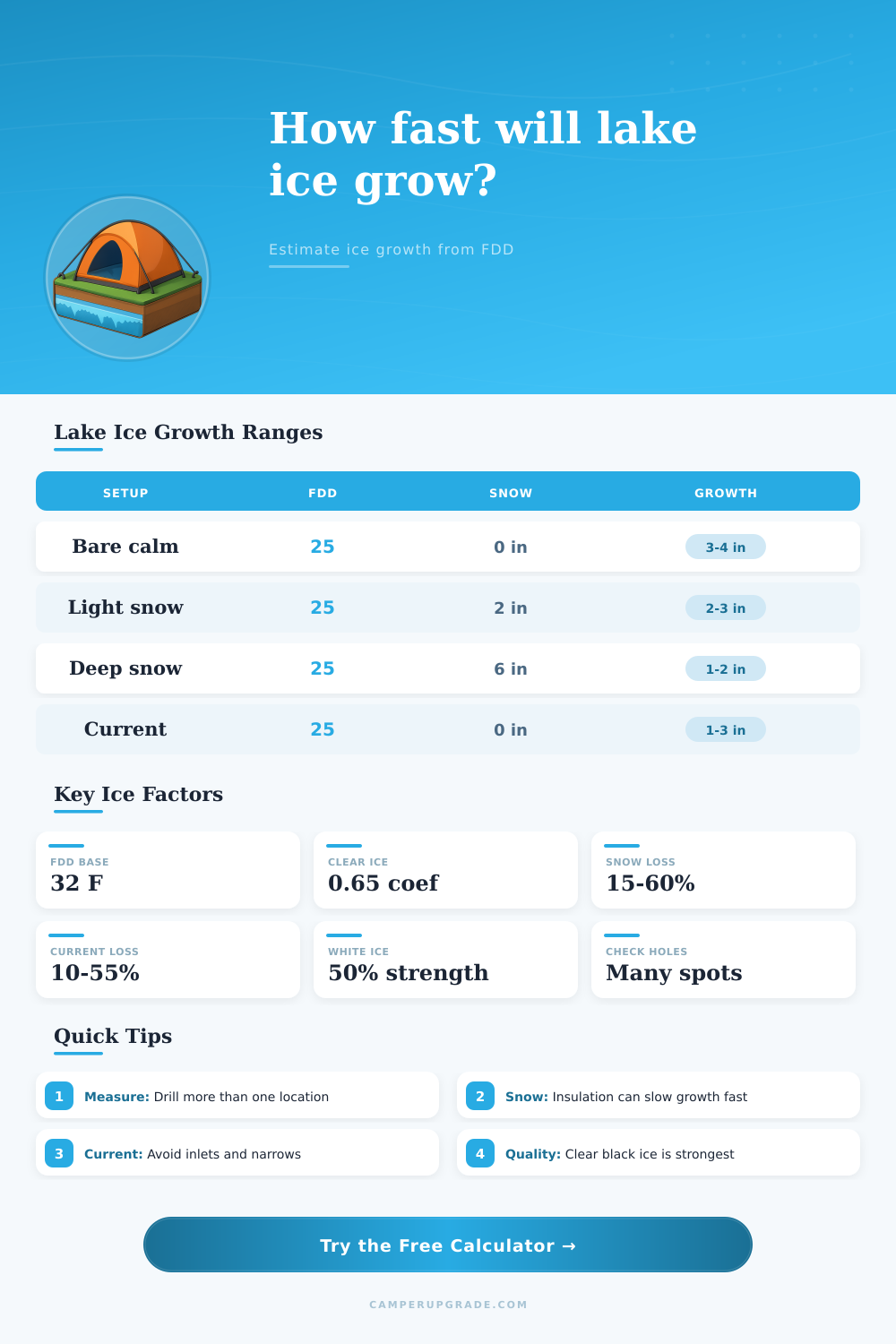
| Accumulated FDD | Bare clear ice | Light snow | Deep snow |
|---|---|---|---|
| 10 °F-days | 2.1 in | 1.6 in | 1.0 in |
| 25 °F-days | 3.3 in | 2.5 in | 1.6 in |
| 50 °F-days | 4.6 in | 3.5 in | 2.3 in |
| 100 °F-days | 6.5 in | 4.9 in | 3.3 in |
| Snow on ice | Insulation effect | Growth factor | Field note |
|---|---|---|---|
| 0 in | Minimal | 1.00x | Best FDD fit |
| 1-2 in | Light | 0.72-0.84x | Watch drifts |
| 3-5 in | Moderate | 0.52-0.68x | Slower growth |
| 6+ in | Heavy | 0.35-0.50x | Flooding risk |
| Lake feature | Expected variation | Growth factor | Check pattern |
|---|---|---|---|
| Shallow pond | Lower | 1.05x | Grid holes |
| Sheltered cove | Moderate | 1.00x | Shore to center |
| Open large lake | High | 0.92x | Many transects |
| Reservoir | High | 0.85x | Avoid drawdown |
| Ice type | Appearance | Strength guide | Calculator factor |
|---|---|---|---|
| Clear black | Dark, solid | Strongest | 1.00x |
| Some white | Layered | Mixed | 0.90x |
| Half white | Cloudy | Weaker | 0.78x |
| Honeycomb | Rotten | Unreliable | 0.55x |
📝Formula Notes And Field References
| Formula item | Value used | Purpose | Limit |
|---|---|---|---|
| FDD | 32 - avg temp | Cold input | Temp avg |
| Clear ice | 0.65 sqrt(FDD) | Base growth | Bare ice |
| Snow factor | 0.35-1.00x | Insulation | Drifts vary |
| Buffer | 0-30% | Planning trim | Not safety |
| Location | Concern | Growth effect | Check |
|---|---|---|---|
| Inlets | Moving water | Lower | Avoid edge |
| Springs | Warm seep | Patchy | Probe often |
| Bridges | Current | Lower | Stay back |
| Pressure ridges | Broken ice | Unstable | Detour |
💡Lake Ice Calculation Tips
Ice thickness are dependent upon several different factors in the environment. In order to determine if ice is safe to walk on, it is first necessary to understands these different factors. One of the factors that is use to determine ice thickness is the concept of freezing degree day.
Freezing degree days help to indicate how much cold air has interacted with the water over a given time period. If the air temperatures remain below freezing, the water within will release heat, which allow the ice to grow in thickness. By using a calculator, you can determine the number of freezing degree days that have passed during a given time period, which help to indicate the thickness of the ice.
What Affects Ice Thickness
Another of the factors that can impact the thickness of ice within a body of water is the presence of snow. Snow typicaly slow the growth of ice. While many individuals may believe that snow allow water to freeze, the snow actualy acts as an insulator for the water.
Because snow traps heat within the water, the cold air cannot interact with the ice to allow it to continue to grow in thickness. For instance, heavy snowfalls will slow the thickening of ice, and can even cause some areas of the water to remain slushy while other areas of that lake are froze. Another of the factors that impact the thickness of the ice is the quality of the ice itself.
One of the strongest forms of ice is clear black ice, which forms slowly and has high level of density. In contrast, white ice is more weak than clear black ice. White ice is formed when the air bubbles within the water are allowed to remain in the ice, or when the snow melt into the ice.
Because snow water is more porous than clear black ice, white ice is more fragile than clear black ice. White ice is only half as strong as clear black ice of the same thickness. Finally, the movement of the water within the frozen body of water will impact the thickness of the ice.
Moving water will allow the ice to remain thinner due to the movement of the water molecules. If there is a river inlet, a bridge, or a natural spring in the lake, warm water will move upward from the bottom of the lake towards the surface of the ice. The water that melts the bottom of the ice makes the ice much thinner than it appear to be on the surface of the ice.
Therefore, people should avoid using the ice areas near these currents, as these currents will neutralize the effect of cold weather on the thickness of the ice on the ice sheet. Wind will affect the thickness of the ice on the lake in two different ways. With one effect, the wind will strip warm air from the ice, allowing the ice to grow more fast.
With the other effect, the wind will create drifts of snow onto parts of the ice sheet, leading to inconsistencies in the thickness of the ice. Because of this effect of the wind, people can expect the thickness of the ice to change significant over short distances. Therefore, people should not rely upon one measurement of the thickness of the ice; instead, a grid of ice hole should be drilled to determine the thickness of the ice over a wide area of the ice sheet.
The shape and size of the body of water will impact how quickly the water freeze. Smaller, shallow ponds will have thinner columns of water, and the thinness of the column will make the water lose heat quickly. Large lakes or reservoirs will contain a great deal of thermal energy within the water, and the wind will mix the water within the large lake.
Because the wind keep the water warm, it will take much longer for a large lake to freeze than it will for a small pond to become covered in ice. While the data regarding the thickness of the ice is a critical factor in determining how cautious an individual needs to be while on the ice, the thickness data should never be used to replace caution. No amount of mathematics can account for all the variables in ice thickness data, such as hidden bubbler within the ice.
However, using this data to project when an individual should begin to check the thickness of the ice will allow an individual to use an auger to measure the thickness of the ice prior to walking on the ice. Furthermore, understanding that the thickness of the ice is actually a reflection of the weather patterns that occurred in the past few days will allow an individual to plan their journey onto the ice. Finally, remembering to account for snow, ice currents, and the quality of the ice will go a long way to ensuring that individual remain safe on the ice sheet.