Camping Cooler Cube Ice Calculator
Estimate bagged cube ice weight, cube volume, cooler fill, bag count, and refill timing from cooler size, food load, temperature, lid openings, and camping conditions.
🏕Cube Ice Camping Presets
⚙Cube Ice and Cooler Inputs
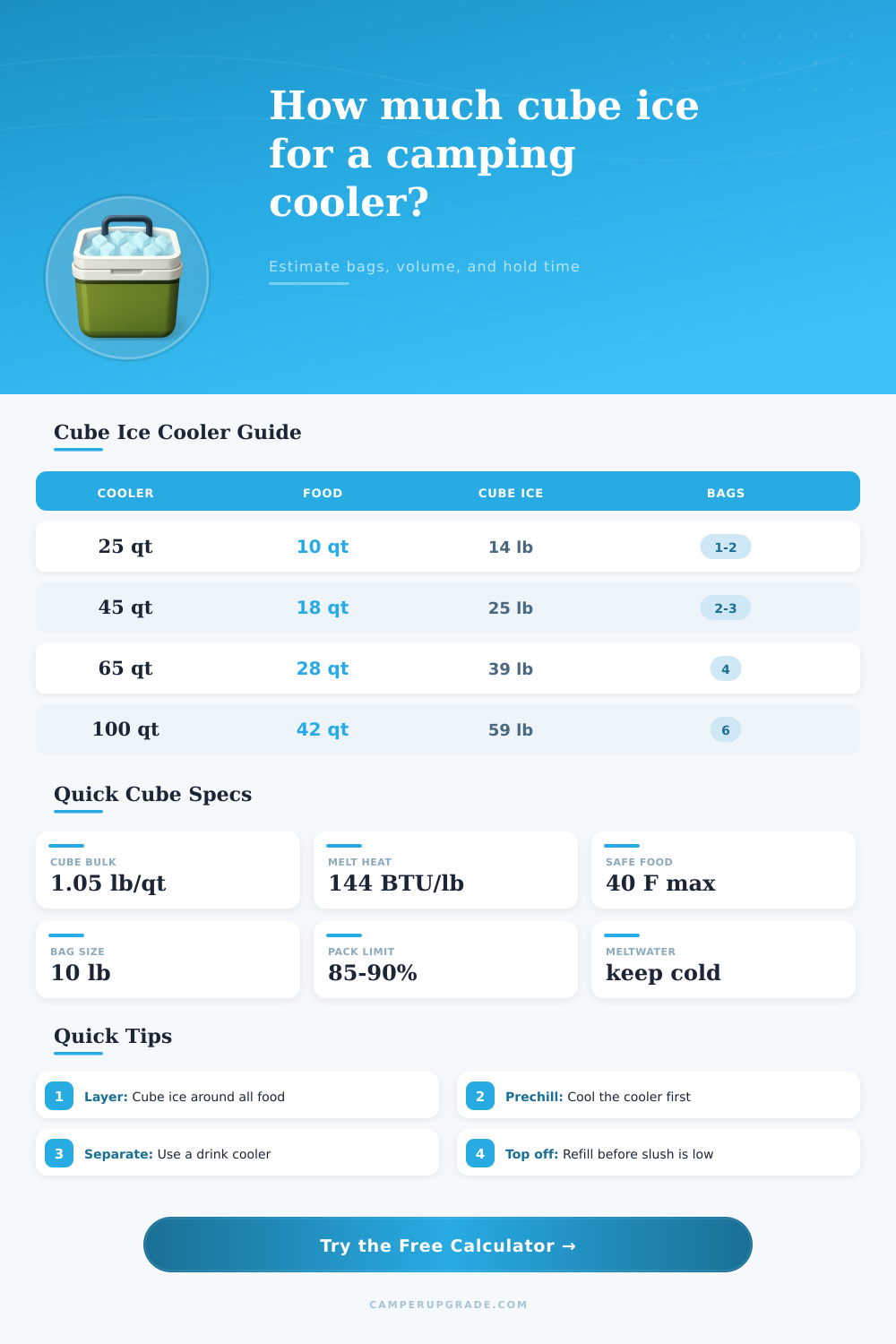
The calculator uses 144 BTU per pound of ice melted, cube-ice bulk density near 1.05 lb per quart, cooler heat gain, lid-opening heat, food cooling load, and a packing-ratio floor for real camping coolers.
🧊Cube Ice Spec Comparison Grid
🛻Ice Type Packing Comparison
Loose cube ice
Good contact around cans and food boxes. Best for drink coolers, top layers, and quick chilling.
Block ice
Melts more slowly and uses less void space, but it does not wrap around irregular food as well.
Crushed ice
Chills fastest because surface area is high, but the same weight usually loses hold time sooner.
Frozen gel packs
Keeps packaging drier and reusable, but contact and latent heat are usually lower than wet ice.
📊Cube Ice Reference Tables
| Bag Size | Cube Volume | Metric Volume | Typical Use |
|---|---|---|---|
| 5 lb cubes | 4.8 qt | 4.5 L | Lunch cooler top-off |
| 7 lb cubes | 6.7 qt | 6.3 L | Small day cooler |
| 10 lb cubes | 9.5 qt | 9.0 L | Weekend food cooler |
| 20 lb cubes | 19.0 qt | 18.0 L | Group or fish cooler |
| Cooler Size | Food Load | 1.5:1 Cubes | 2:1 Cubes |
|---|---|---|---|
| 25 qt | 8 qt | 12 qt / 13 lb | 16 qt / 17 lb |
| 45 qt | 16 qt | 24 qt / 25 lb | 32 qt / 34 lb |
| 65 qt | 24 qt | 36 qt / 38 lb | 48 qt / 50 lb |
| 100 qt | 38 qt | 57 qt / 60 lb | 76 qt / 80 lb |
| 150 qt | 55 qt | 83 qt / 87 lb | 110 qt / 116 lb |
| Camping Condition | Cube Change | Reason | Example |
|---|---|---|---|
| Food starts near 70F | +15% to +30% | Warm load | Grocery stop |
| Ambient above 90F | +20% to +35% | Heat leak | Desert camp |
| Opened 25+ times/day | +10% to +20% | Air exchange | Drink cooler |
| Soft cooler | +25% to +50% | Thin insulation | Picnic bag |
| Food cooler only | -10% to -20% | Fewer opens | Meals only |
| Ice Form | Bulk Density | Contact Cooling | Best Placement |
|---|---|---|---|
| Small cube ice | 1.00 lb/qt | Very high | Between items |
| Standard cubes | 1.05 lb/qt | High | Top and sides |
| Large cubes | 1.12 lb/qt | Moderate | Lower layer |
| Wet slushy cubes | 0.95 lb/qt | Very high | Same-day use |
| Block ice | 1.65 lb/qt | Low | Bottom reserve |
💡Cube Ice Packing Tips
Ice management is a necessary process for any person who wants to keep there food cold during they camping trip. It is possible that the ice within the cooler will melt and the resulting water will become warm, which is due to the fact that the ice cannot overcome the heat within an environment or the heat created by the food itself. The ice dont dissapear, but instead absorbs the heat from the food items within the cooler and from the air outside of the cooler.
For instance, if you place warm food into the cooler, the ice within the cooler will melt at a rapid rate due to the fact that the ice must absorb the heat from the warm food. Thus, each of these variable can be considered prior to the deployment of the ice for camping trips. The type of ice that is used will change how the ice perform within the cooler, as well as how long the ice lasts.
How to Make Ice Last Longer on a Camping Trip
Bagged cube ice is used in cooler because the cube shapes can fit into the spaces between the food items. Additionally, the cube shapes provide a large surface area for the ice to cool the food items. Block ice can last more longer than cube ice, but block ice creates air pockets within the ice that do not efficiently cool the food items.
Yet, you can combine block ice with cube ice to allow the longevity of the ice to be maintained as well as the ability of the ice to cool the food efficient. Another factor that will affect how long the ice within the cooler will last is the insulation of the cooler. Coolers that have higher insulation, such as rotomolded coolers, will allow the ice within the cooler to last longer than soft-sided coolers that have low quality insulation.
Coolers with low quality insulation will have the heat from the environment enter the cooler at a higher rate, causing the ice to melt at a faster rate. Additionally, the cooler will be exposed to the ambient temperature of the environment. Higher ambient temperature will allow for more heat to enter the cooler and melt the ice at a faster rate.
Another factor that will impact how long the ice will last is the behavior of the individual who are using the cooler. Each time that the cooler’s lid is opened, cold air will leave the cooler while warm air enters the cooler. If many individual open the cooler by the food items, the ice within the cooler will melt at a faster rate.
To avoid this issue, individuals may use two separate cooler. For instance, one cooler can be dedicated to the drinks and the other cooler can be used to store food items. This way, the cooler used for drinks will be opened several times while the cooler that stores the food will remain closed.
The way that the food items and ice is packed within the cooler will impact the length of time that the ice will last. For instance, the ice should not be placed on top of the food items because cold air sink. Instead, a layer of ice should be placed at the bottom of the cooler, followed by the food items in the middle of the cooler, and the remaining ice should be placed on top of the food items.
This method will ensure that each food item is surrounded by ice, as well as that each food item remain cold from all sides of the food item. Many individuals will likely make the mistake of draining the melt water from the cooler. Yet, this meltwater should not be drained from the cooler unless the meltwater pose a problem for the food items.
The meltwater will be cold and will help to fill the gaps in air between the food items and the ice. Because water conducts heat better than air, the cold meltwater will help the remaining ice within the cooler to perform more efficiently. Only if the meltwater begins to pose a problem for the food items (such as if the food items begin to float or if the meltwater damage the packaging of the food items) should the melt water be drained from the cooler.
One last factor that must be considered is the need to prechill the cooler prior to the camping trip. If you place ice into warm cooler, the ice will melt immediately from the cooler. Yet, if you prechill the cooler by placing the cooler into a cool place or by placing ice into the cooler during the camping trip the night prior to the trip, then the ice will help to keep the food items cold.
Thus, the ice that is used during the camping trip will be used to keep the food items cold rather than melting the cooler walls. Finally, if any individual choose to use the cooler, it is important to balance the amount of food that will be within the cooler with the amount of ice that will be used.