12V Fridge Solar Calculator
Size camper solar panels and usable battery capacity for compressor fridges, upright RV fridges, and DC cooler setups.
⚡Real Camper Fridge Presets
🔋Fridge, Battery, and Solar Inputs
For best accuracy, use a watt meter or battery monitor and enter measured running watts and duty cycle.
Your 12V Fridge Solar Sizing
📊Panel and Battery Spec Comparison
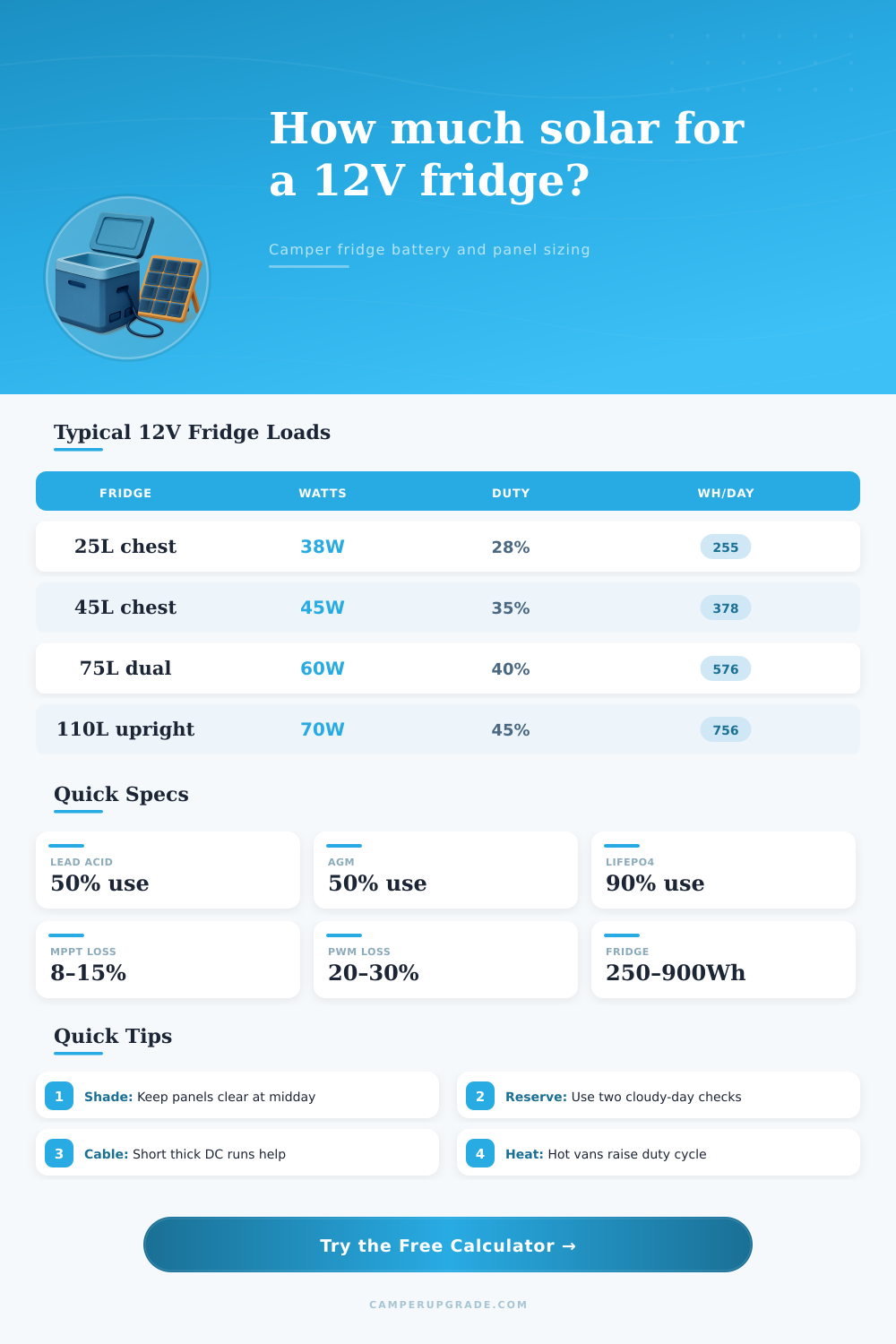
❄Typical 12V Fridge Energy Reference
| Fridge setup | Running watts | Typical duty cycle | Approx daily energy |
|---|---|---|---|
| 25L compressor chest in mild weather | 35–40W | 25–30% | 210–290Wh/day |
| 40–50L compressor chest for touring | 40–50W | 30–40% | 290–480Wh/day |
| 60–75L dual-zone fridge/freezer | 55–65W | 35–50% | 460–780Wh/day |
| 80–90L upright compressor fridge | 60–70W | 35–45% | 500–760Wh/day |
| 100–130L RV compressor upright | 65–85W | 40–55% | 625–1120Wh/day |
| 3-way absorption fridge electronics only | 3–8W | 100% | 72–192Wh/day |
☀Solar Harvest by Peak Sun Hours
| Panel array | 3 peak sun hours | 4.5 peak sun hours | 6 peak sun hours |
|---|---|---|---|
| 100W roof panel at 85% system efficiency | 255Wh/day | 383Wh/day | 510Wh/day |
| 200W roof array at 85% system efficiency | 510Wh/day | 765Wh/day | 1020Wh/day |
| 300W roof array at 85% system efficiency | 765Wh/day | 1148Wh/day | 1530Wh/day |
| 400W roof array at 85% system efficiency | 1020Wh/day | 1530Wh/day | 2040Wh/day |
🔌Battery Usable Energy Reference
| Battery bank | Flooded or AGM at 50% | LiFePO4 at 80% | LiFePO4 at 90% |
|---|---|---|---|
| 12V 50Ah | 300Wh usable | 480Wh usable | 540Wh usable |
| 12V 100Ah | 600Wh usable | 960Wh usable | 1080Wh usable |
| 12V 200Ah | 1200Wh usable | 1920Wh usable | 2160Wh usable |
| 24V 100Ah | 1200Wh usable | 1920Wh usable | 2160Wh usable |
🛖Common Camper Fridge Builds
| Camper use case | Likely daily fridge load | Balanced solar target | Battery reserve target |
|---|---|---|---|
| Weekend SUV cooler, 25L chest | 250–350Wh | 100–150W | 50Ah LiFePO4 |
| Solo van, 45L chest fridge | 350–500Wh | 160–220W | 100Ah LiFePO4 |
| Family campsite, 75L dual-zone | 550–850Wh | 250–350W | 150–200Ah LiFePO4 |
| Hot desert camp with drinks fridge | 700–1100Wh | 350–500W | 200Ah LiFePO4 |
| RV upright compressor fridge | 650–1100Wh | 300–500W | 200Ah LiFePO4 |
⚙Controller and Panel Notes
| Component choice | Typical efficiency | Best use | Calculator impact |
|---|---|---|---|
| Portable panel in partial shade | 50–75% | Flexible camp positioning | Use lower efficiency or higher margin |
| PWM controller | 70–82% | Small matched-voltage arrays | Needs more rated panel watts |
| MPPT controller | 85–95% | Roof arrays and mixed weather | Better harvest from same array |
| Series roof panels | High in clear sun | Long cable runs to MPPT | Shade on one panel hurts more |
| Parallel roof panels | Good shade tolerance | Patchy tree cover | Higher current needs thicker cable |
💡Fridge Solar Sizing Tips
A 12V fridge dont consume power at a constant rate. A 12V fridge consume power in cycle. The compressor within teh 12V fridge must cycle on and off to maintain the temperature within the fridge.
When the interior of the 12V fridge reach the set temperature, the compressor automatically turn off. Many people fail to understand how to keep there food cold within the fridge because they dont understand how a 12V fridge consume energy. In order to prevent a low voltage cutout that will damage the 12V fridge, you must understand how a 12V fridge consumes energy.
How a 12V fridge uses power
The percentage of the time that the compressor within the fridge is on is referred to as the duty cycle. For example, if a 12V fridge has a 30 percent duty cycle, then the compressor will be on for 30 percent of a 24-hour period. Many people make the mistake of multiplying the maximum wattage of the fridge by 24 to determine the power requirement for the fridge.
However, this method will result in more oversized solar array. Several environmental factors will change the way in which a 12V fridge consumes energy. One of the primary factor is the ambient temperature within which the fridge is placed.
For instance, if you place a 12V fridge within an area where there is very little ventilation for the fridge, the heat that build up around the fridge will force the compressor to work hard to cool the interior of the fridge. Additionally, the frequency with which you open the lid of the fridge will force the compressor to work more often to remove the heat that the warm air introduces into the fridge each time you open the lid. The type of battery that you use to power your 12V fridge will determine how much usable energy your battery bank contains.
For instance, if you use a lead-acid battery or an AGM battery to power your 12V fridge, you can only use approximately 50 percent of the battery capacity. If you use more than 50 percent of the capacity of a lead-acid or AGM battery, you will damage the battery. However, if you use a lithium battery, you can use nearly 100 percent of the batterys rated capacity.
Thus, a 100Ah lithium battery will contain more usable energy than a 100Ah AGM battery. Autonomy is the ability of the battery bank to power the 12V fridge without any power from the solar panels. The solar panels wont produce power during heavy storm.
Therefore, the battery bank must be able to provide enough energy to the 12V fridge to last through a storm. The battery bank must have a two-day reserve of energy for the case in which the solar panel does not produce power for two days. The type of solar charge controller that you use will determine how much energy the solar panels will provide to the battery bank.
A PWM controller simply move the power from the solar panels into the battery bank. However, an MPPT controller will convert the high voltage from the solar panels into the specific amperage that the battery bank require, which makes it more efficient than a PWM controller. Additionally, using an MPPT controller is beneficial if the solar panels are in partial shade because it will manage the energy being provided to the battery bank more effective than the PWM controller.
The power path that you choose will impact the efficiency of your system. For example, running the 12V fridge directly from a DC battery is the most efficient process. However, if you use an inverter to convert the DC power from the battery to the 12V fridge to the 120V AC power that the fridge require, and then you use a power brick to convert that 120V AC power back into 12V DC power for the fridge, you will lose some of that energy in the conversion process.
Therefore, to increase the efficiency of your system, avoid using an inverter. A balanced power system will allow the solar panels to produce enough energy to completely replace the energy that the 12V fridge consumes during the day. Thus, the solar panels will produce enough extra energy to recharge the battery bank for use after dark.
If the solar panels dont produce enough energy to recharge the battery bank, you must either increase the capacity of the battery bank or reduce the energy consumption of the 12V fridge by chilling the food prior to placing it in the fridge. You should of checked the tempurature first.