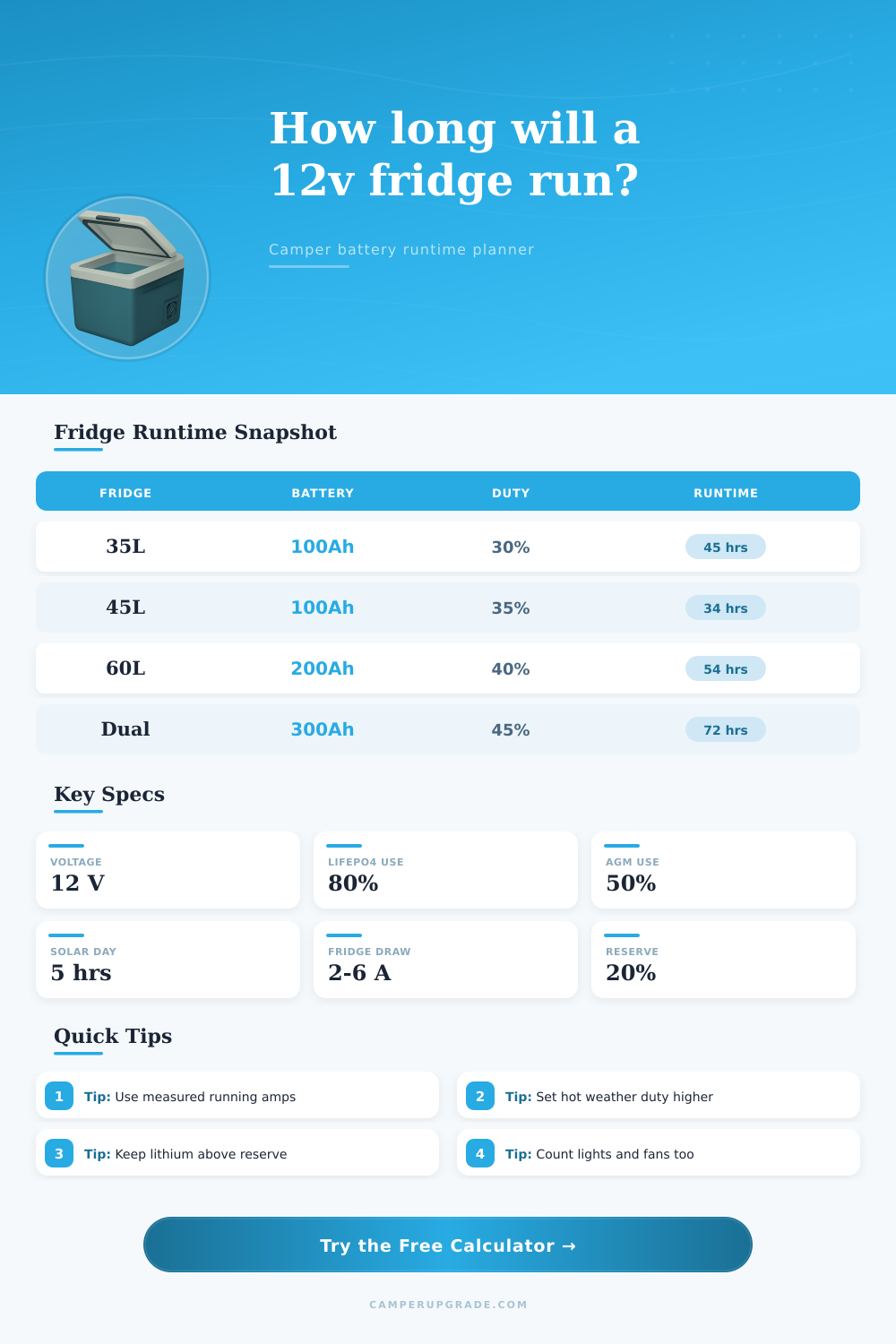
12v Fridge Runtime Calculator
Estimate camper fridge runtime from battery capacity, fridge draw, duty cycle, reserve, inverter loss, and solar charging.
Runtime breakdown
| Battery type | Nominal voltage | Typical usable depth | Best calculator use |
|---|---|---|---|
| LiFePO4 deep-cycle | 12.8 V | 80% usable for routine camping | Long off-grid fridge runtime with stable voltage |
| AGM deep-cycle | 12.0 V | 50% usable for longer battery life | Weekend trips and existing lead-acid systems |
| Flooded lead-acid | 12.0 V | 50% usable with regular recharge | Conservative estimates for older camper banks |
| Gel deep-cycle | 12.0 V | 50% usable with careful charging | Low-current loads and sealed battery compartments |
| 24v lithium bank | 24.0 V | 80% usable when sized correctly | Larger campers with DC-DC and inverter systems |
| Fridge setup | Running draw | Typical duty cycle | Daily energy estimate |
|---|---|---|---|
| 25-35L efficient compressor fridge | 30-45 W | 25-35% | 180-380 Wh/day |
| 40-50L compressor chest fridge | 40-55 W | 30-45% | 290-590 Wh/day |
| 55-75L dual-zone fridge/freezer | 55-75 W | 40-60% | 530-1080 Wh/day |
| Compact freezer at low setpoint | 45-65 W | 50-70% | 540-1090 Wh/day |
| 12v absorption fridge on DC heat | 120-180 W | 80-100% | 2300-4320 Wh/day |
| Solar array | Peak sun hours | 75% charge efficiency | Approx 12v Ah recovered |
|---|---|---|---|
| 100 W portable panel | 4.0 h | 300 Wh/day | 25 Ah/day at 12 V |
| 200 W roof array | 4.5 h | 675 Wh/day | 56 Ah/day at 12 V |
| 300 W roof array | 5.0 h | 1125 Wh/day | 94 Ah/day at 12 V |
| 400 W mixed roof/portable | 5.0 h | 1500 Wh/day | 125 Ah/day at 12 V |
| 600 W large camper array | 5.5 h | 2475 Wh/day | 206 Ah/day at 12 V |
| Scenario | Battery bank | Fridge average load | Battery-only runtime |
|---|---|---|---|
| Small weekend chest fridge | 100Ah LiFePO4, 20% reserve | 45 W at 30% duty | About 61 hours |
| Warm weather 45L fridge | 100Ah LiFePO4, 20% reserve | 55 W at 45% duty | About 31 hours |
| Family 60L fridge | 200Ah LiFePO4, 20% reserve | 60 W at 40% duty | About 68 hours |
| AGM weekend setup | 100Ah AGM, 20% reserve | 45 W at 35% duty | About 24 hours |
| Dual-zone freezer trip | 300Ah LiFePO4, 20% reserve | 70 W at 55% duty | About 64 hours |
When you plan on going on a camping trip or a backcountry trip, you will have to calculate how much energy your 12v fridge will use. A 12 volt fridge require a constant supply of power from the battery. People often make the mistake of assuming that the rated capacity of the battery is the same as the usable capacity from that battery.
The rated capacity of the battery is usualy the theoretical maximum amount of power that the battery can provide and not the amount that can be utilized. If you are using a lead-acid or an AGM battery, you can only use half of the rated capacity of the battery as using the remaining half of the batterys capacity can damage the battery. If, however, you are using a lithium battery, you can use most of the batterys capacity without damaging the battery.
How to Plan Battery Power for a 12V Camping Fridge
Understanding these differences is essential for planning a camping trip. The duty cycle for a camping fridge is another essential factor for determining the energy that the camping fridge will consume. Campfires and tents do not allow for a fridge to remain cool all of the time.
Instead, a fridge cycles on and off as the temperature within the fridge reaches the desired temperature. The duty cycle for a camping fridge will change based off the environment in which the tent or camping lodge will be established. For instance, if the environment is hot, the fridge will have to cycle on more frequent to maintain the desired temperature within the fridge.
Additionally, if you opens the fridge more often, the temperature will drop in the fridge and cause the fridge to cycle on more often to reestablish the temperature within the fridge. Another factor that will affect camping fridge efficiency is the amount of ambient heat that will surround the fridge. If the temperature around the fridge is too hot or if you places the fridge in a corner that does not allow for proper ventilation around the fridge, the heat will build up around the fridge vents.
This additional heat will require the fridge compressor to work harder to cycle the heat out of the fridge. Working harder by the compressor will use up the batterys electricity at a faster rate. Therefore, proper ventilation around the camping fridge will ensure that the fridge does not use up all of the energy and power that is planned for the fridge to use.
Other electrical loads will drain the battery at the same rate that the fridge consumes the batterys energy. Small electrical loads, such as LED lights within the tent or a water pump system, will still use up some of the available energy in the battery. If an inverter is used to power the fridge by converting the batterys DC power to AC power for the fridge, this process isnt 100% efficient and will lead to a loss of some of the energy that the fridge could use.
To avoid this energy loss, using a direct DC connection from the battery to the fridge will be more efficient than using an inverter to supply power to the fridge. The solar panel system will work to recover energy for the battery. The energy that the solar panels generate will not necessarily be the amount of power listed for the solar panel.
For instance, a solar panel with a 200-watt rating will not provide 200 watts of power for the entire day using the solar panel. The power that the solar panel will generate will depend upon the angle of the sun and the amount of cloud cover between the solar panel and the sun. If the solar panel is used to recover energy for the battery, the rate of recovery of that energy will depend upon the number of peak sun hours that the camping area receives daily.
If the energy that the fridge, the electrical load, and the solar panel recovery generate is balanced, the battery will not have to provide the energy for the fridge. Using the battery to provide the energy for the fridge when the energy generated by the fridge, the other electrical loads, and the solar panel recovery is not balanced will eventualy lead the battery to run out of energy. In this situation, having an emergency reserve of at least twenty percent of the batterys energy will allow enough energy to account for the cloudy days when the solar panel will not generate enough energy to provide for the fridges energy needs.
Running a battery down to zero will prevent the battery from taking a charge. By calculating the total energy cost of the fridge per day, comparing that energy cost to the amount of energy that can be utilized from the battery and the energy that can be recovered from the solar panel, you could of planned for how much energy will be available for the fridge during the camping trip.