12V Fridge Power Calculator
Estimate daily watt-hours, battery amp-hours, solar recovery, fuse draw, and wiring voltage drop for a camper fridge.
⚡ Real Camper Fridge Presets
🔌 Fridge Load Inputs
🧰 Component / Spec Comparison Grid
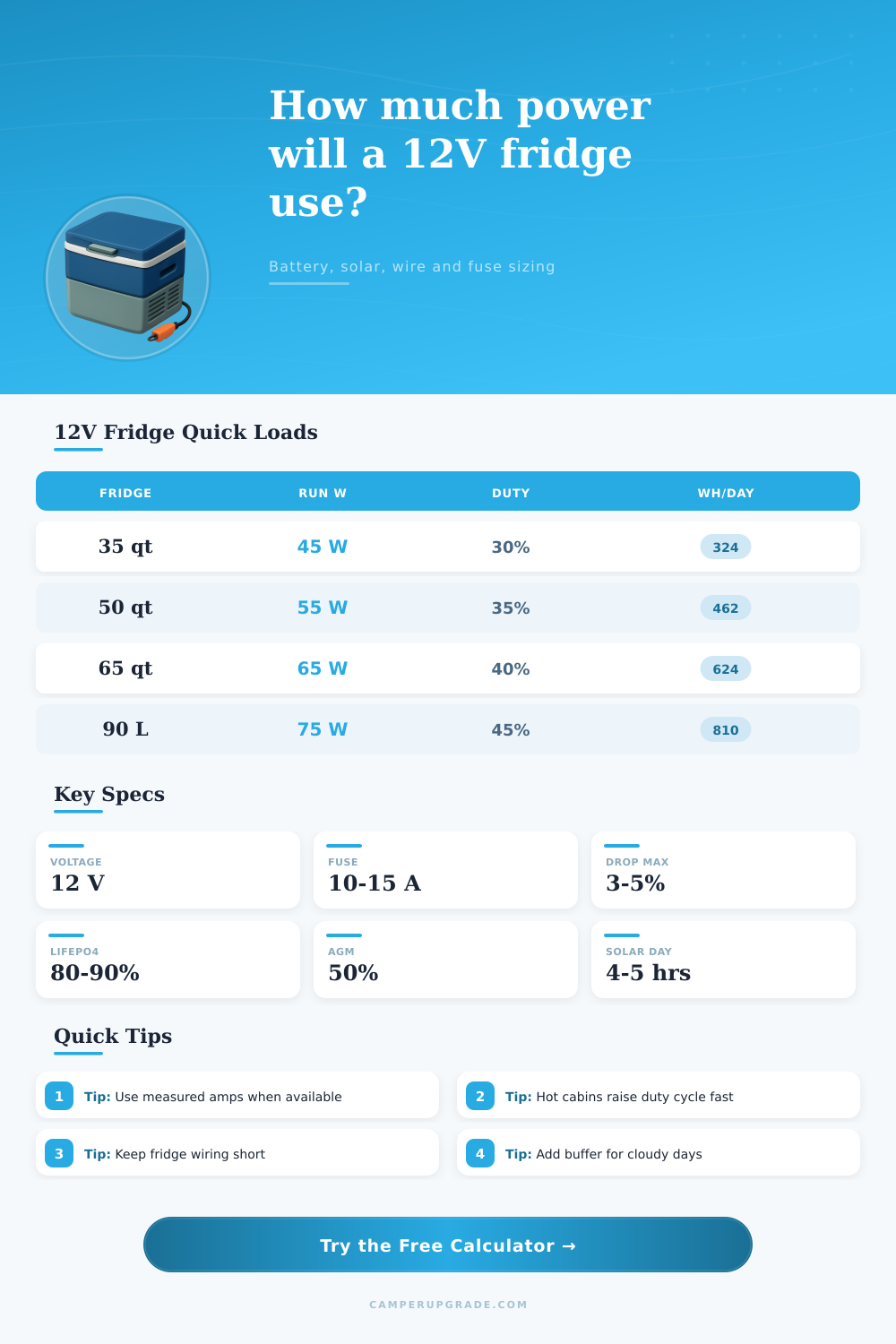
📊 12V Fridge Running Draw Reference
| Fridge type | Typical running draw | Typical duty cycle | Estimated daily energy |
|---|---|---|---|
| Compact chest, 30-40 qt | 35-45 W | 25-35% | 210-380 Wh/day |
| Mid-size chest, 45-55 qt | 45-60 W | 30-40% | 325-575 Wh/day |
| Large chest, 60-70 qt | 55-70 W | 35-45% | 460-760 Wh/day |
| Dual-zone or drawer, 70-80 L | 65-85 W | 40-55% | 625-1120 Wh/day |
| Upright compressor, 85-100 L | 65-90 W | 40-60% | 625-1295 Wh/day |
| Freezer mode chest fridge | 50-80 W | 45-70% | 540-1345 Wh/day |
🌡 Duty Cycle Adjustment Table
| Condition | Planning duty cycle | Why it changes | Calculator input |
|---|---|---|---|
| Cool van interior, 60-70°F | 20-30% | Low heat gain through cabinet walls | 25% |
| Normal camper, 70-80°F | 30-40% | Common mixed driving and camp use | 35% |
| Warm cabin, 80-90°F | 40-50% | Compressor cycles longer to reject heat | 45% |
| Hot compartment, 90-105°F | 50-65% | Ventilation and condenser heat become limiting | 60% |
| Freezer setting near 0°F | 55-75% | Large temperature difference increases runtime | 65% |
🔋 Battery Usable Energy Reference
| Battery bank | Nominal Wh | Usable planning Wh | Example fridge runtime |
|---|---|---|---|
| 100 Ah AGM at 12 V | 1200 Wh | 600 Wh at 50% | About 1.3 days at 450 Wh/day |
| 100 Ah LiFePO4 at 12.8 V | 1280 Wh | 1024 Wh at 80% | About 2.3 days at 450 Wh/day |
| 200 Ah LiFePO4 at 12.8 V | 2560 Wh | 2048 Wh at 80% | About 4.6 days at 450 Wh/day |
| 100 Ah 24 V bank | 2400 Wh | 1920 Wh at 80% | About 4.3 days at 450 Wh/day |
💡 Wire, Fuse, and Solar Reference
| Design item | Rule of thumb | Useful formula | Camper note |
|---|---|---|---|
| Fridge fuse | 125-150% of running amps | Fuse amps = run amps × surge factor | Use the fridge manual if listed |
| Voltage drop target | 3% excellent, 5% acceptable | Drop V = amps × wire ohms | Low voltage can trip compressors |
| Solar replacement | Daily Wh / usable sun | Panel W = Wh / sun / efficiency | Shade often matters more than rating |
| Charging loss | 15-35% | Usable fraction = 1 - loss | Heat, PWM, and wiring reduce harvest |
| Energy buffer | 10-30% | Wh × 1.10 to 1.30 | Door openings and hot food add load |
📌 Practical Sizing Tips
When planning a trip in a vehicle, understanding the power requirements of a 12V fridge is essential. Many peoples makes the mistake of looking at the wattage of the fridge and assuming that is the power that it will use. However, a fridge will not be always on.
A fridge use power based on how often the compressor need to turn on to maintain a specific temperature for the fridges contents. The amount of time the compressor in the fridge will run is called the duty cycle. The duty cycle is the percentage of the time that the compressor is on to keep the fridge at the desired temperature.
How to plan power for a 12V fridge
For instance, if a fridge has a 30 percent duty cycle, the compressor will only be on for approximately seven hours a day. The duty cycle can change based on the temperature in the area in which the fridge is located. If it is hotter outside, the refrigerator will have a higher duty cycle since the compressor will have to work more to remove the heat from inside the refrigerator.
Another factor that you must consider is the usable capacity of the battery that will be used to power the refrigerator. The total capacity of the battery is not the amount of power that can be used. If you use an AGM battery, no more than 50 percent of the total capacity of the battery should be used.
Using the battery at more than 50 percent of it’s total capacity can damage the battery. If you use a lithium battery, or more specificly a LiFePO4 battery, a larger percentage of the total capacity of the battery can be used. In both cases, calculating the percentage of the total capacity of the battery that will be usable will provide information about how much energy the fridge can use before the battery reaches 0 percent.
Another factor to consider is voltage drop. Voltage drop can occur if the fridge is connected to wires that are too thin or too long. Using these types of wires will cause the voltage to drop from the battery to the fridge.
If the voltage drop too low, the fridge could trigger a low voltage shutdown and stop receiving power from the battery. Using thicker wires will prevent voltage drop from the battery to the fridge. Using solar panels to provide power to the battery will provide power for the fridge.
However, solar panels do not always produce the maximum wattage that they are rated for. For instance, a 100 watt solar panel will not produce 100 watts for all of the days that it is in use. Clouds, the angle of the solar panel, and the efficiency of the charge controller will all impact the amount of power that the solar panel produces.
To account for this, you should install more solar capacity than is calculated to be the minimum requirement for the trip. This will ensure that the fridge will have power even when the solar panel is not producing power at full capacity. Finally, human actions can impact the amount of power that the fridge use.
Opening the fridge or placing warm items into the fridge will make the compressor turn on more often. These actions will increase the power requirements of the fridge. To account for these effects, you should include a safety buffer into the total wattage that is calculated for the fridge.
One way to calculate the true power requirements of the fridge is to use a watt meter to measure the actual current that the fridge uses. Using a watt meter will allow a person to calculate the amount of energy the fridge will use over a 24 hour period. Using this measurement instead of the wattage listed on the fridge will provide more accurate information about the energy that the fridge will use.
Using that number will allow a person to better calculate the capacity of the battery and solar panel that will be used to power the fridge. In order to ensure that a person has enough power to supply the fridge, a person must consider and calculate several factors. For example, a person must calculate the daily energy cost of the fridge.
Additionally, the battery must have enough usable capacity for several days to ensure that the fridge will always have power while on the trip. Finally, you must calculate the wiring that is used to power the fridge to ensure that there is no voltage drop from the battery to the fridge. By calculating each of these variables, such as the daily energy cost of the fridge and ensuring that the battery and wiring are able to supply the power that the fridge requires, a person will have a power system that will provide power to the fridge during the trip.
You should of checked the battery capacity more carefully. One way to calculate the true power requirements of the fridge is to use a watt meter to measure the actual current that the fridge uses. Using a watt meter will allow a person to calculate the amount of energy the fridge will use over a 24 hour period.
Using this measurement instead of the wattage listed on the fridge will provide more accurate information about the energy that the fridge will use. Using that number will allow a person to better calculate the capacity of the battery and solar panel that will be used to power the fridge.