Cooler Ice Retention Calculator
Estimate how long your ice should last in a camping cooler based on cooler class, ice load, food temperature, outdoor heat, shade, lid openings, and drain habits.
🧊Camping Cooler Presets
⚙Cooler And Ice Inputs
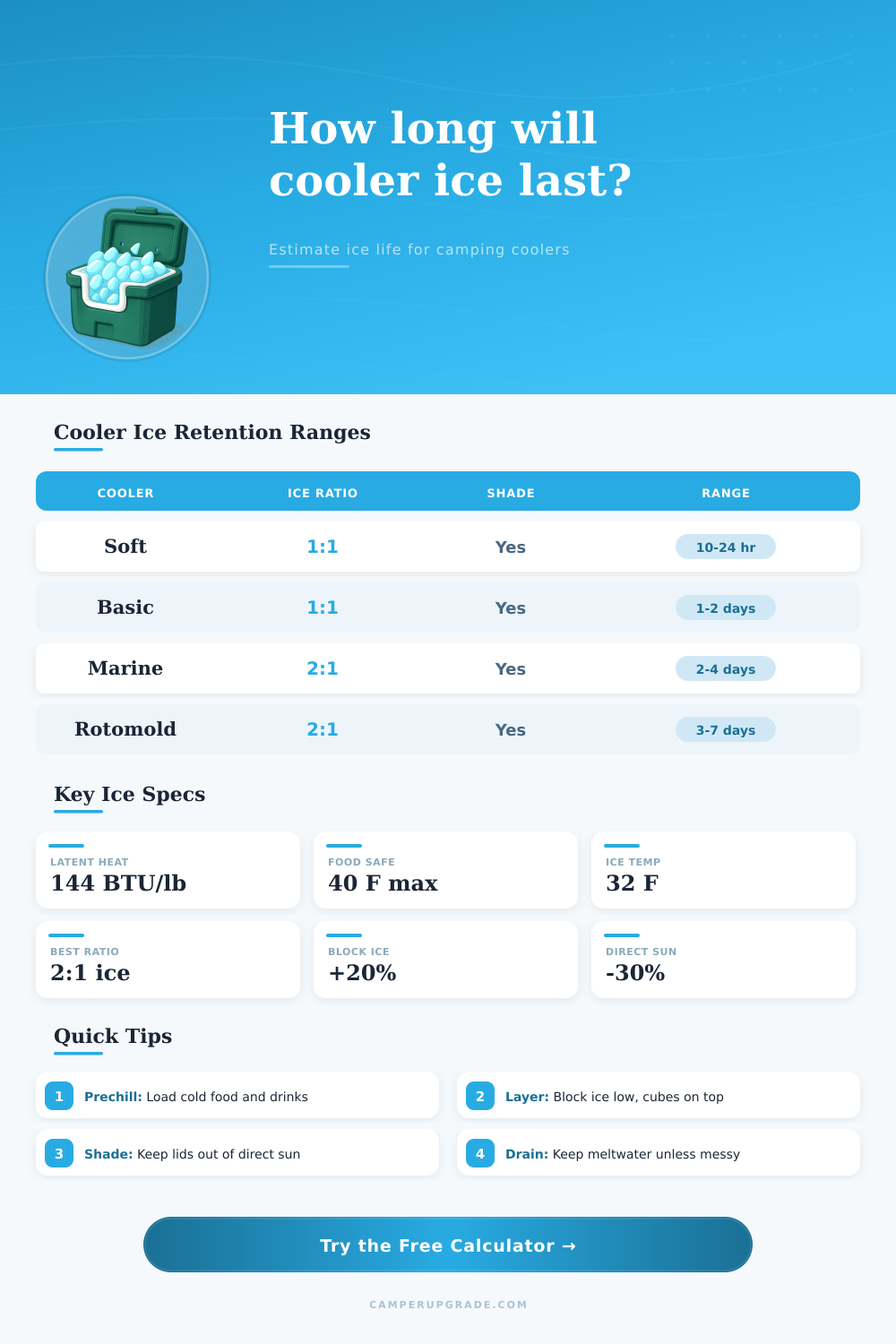
The calculator uses 144 BTU per pound as the latent heat absorbed when ice melts at 32°F, then adjusts for cooler heat leak, warm contents, sun exposure, lid openings, block ice, and meltwater behavior.
📊Cooler Insulation Spec Comparison
🌡Ice Retention And Thermal Reference Tables
| Cooler class | Typical setup | Shade range | Hot sun range |
|---|---|---|---|
| Soft-sided | Lunch or beach bag | 10-24 hr | 6-16 hr |
| Basic hard | Weekend camp chest | 24-48 hr | 16-34 hr |
| Marine | Boat or fishing chest | 48-96 hr | 34-68 hr |
| Rotomolded | Gasketed camp cooler | 72-168 hr | 48-120 hr |
| Expedition | Thick-wall long trip chest | 96-216 hr | 68-150 hr |
| Thermal factor | Model value | Retention effect | Use in calculator |
|---|---|---|---|
| Ice melt energy | 144 BTU/lb | Core cooling reserve | Ice capacity |
| Warm contents | 1 BTU/lb°F | Consumes ice at loading | Load temp |
| Direct sun | +30% to +55% | Raises heat gain | Exposure |
| Lid openings | +1% to +40% | Adds air exchange | Openings/day |
| Kept meltwater | 0% penalty | Buffers cold mass | Drain choice |
| Ice format | Best use | Melt speed | Planning note |
|---|---|---|---|
| Cube ice | Fast chilling drinks | Fast | Fills gaps well |
| Block ice | Long food storage | Slow | Use at bottom |
| Frozen bottles | Dry food cooler | Slow | Drink later |
| Dry ice | Frozen storage only | Very cold | Vent required |
| Ice packs | Short day cooler | Moderate | No meltwater |
| Cooler size | 1:1 ice load | 2:1 ice load | Best trip length |
|---|---|---|---|
| 16 qt | 8-10 lb | 12-16 lb | Day use |
| 30 qt | 15-20 lb | 25-35 lb | 1-2 days |
| 48 qt | 24-32 lb | 40-55 lb | 2-3 days |
| 65 qt | 35-45 lb | 55-75 lb | 3-5 days |
| 94 qt | 50-65 lb | 80-110 lb | 4-7 days |
🧭Practical Cooler Calculation Tips
A cooler does not create cold temperature within the cooler’s compartment. Instead, a cooler slow down the rate at which heat enters the cooler’s compartment. Heat enter a cooler from an outside environment surrounding the cooler.
Additionally, heat enters a cooler due to the item that are placed within the cooler. Many people believe that ice within a cooler is a static resource that will maintain it’s state. However, the ice within a cooler is a fuel source that melt as heat enters the cooler and the cooler’s compartment.
How Coolers Work and How to Keep Ice from Melting
For instance, if an individual place warm items into the cooler, the ice will melt in order to cool the warm items. This process of melting ice to cool warm items will consume a lot of ice within the cooler. To avoid this issue, individuals should pre-chill the item that will be placed into the cooler.
Additionally, individuals should pre-chill the cooler prior to the addition of ice to the cooler. By pre-chilling the cooler and the item to be stored within the cooler, the ice wont have to work to cool the items and the cooler. Another factor that impact how quickly heat enters a cooler is the insulation that surrounds the cooler.
Soft-sided coolers have less insulation than hard-sided cooler. As a result, a soft-sided cooler will allow heat to enter the cooler more quick than a hard-sided cooler. Thick, rotomolded coolers have more insulation than soft-sided coolers.
Therefore, a rotomolded cooler will slow down the entry of heat into the cooler’s compartment more effective than a soft-sided cooler. The type of ice that is used within the cooler also impact the melt rate of the ice within the cooler. If cube ice is placed into the cooler, the large surface area of the cube ice will cause the ice to melt quick.
Conversely, if the user uses block ice in the cooler, the smaller surface area of the block will cause the block ice to melt more slow than the cube ice. These two types of ice can be used within the same cooler. The block ice will melt slowly over an extended period.
The cube ice will melt rapidly and help to fill the gap in which the cool air cannot reach the items to be cooled. The environment in which the cooler is placed will impact the melt rate of the ice within the cooler. Coolers that are placed in the shade will retain their ice longer than coolers that are placed in direct sunlight.
Placing coolers in direct sunlight will allow the cooler to gain the direct heat of the sun, which will enter the cooler and melt the ice. If the cooler is opened, the cold air will leave the cooler’s compartment, and the warm air will enter the cooler. The rise in the cooler’s internal temperature will allow people to place their cooler into two different compartment.
For instance, one cooler can be used to transport warm drink and the other cooler can be used to transport warm food. The cooler that is used for drink can be opened to allow individuals to drink from the drinks. Consequently, the drink cooler will lose its ice quick.
However, the cooler that is used for food will remain closed so that the drinks remains cold. Another consideration in the use of coolers is the draining of the meltwater that forms within coolers. Many people will drain the meltwater from coolers.
However, meltwater is a better conductor of heat than air. If meltwater remain within the cooler, the meltwater will help to buffer the temperature that is maintained within the cooler. However, when people drain the meltwater from coolers, they are removing one of the method by which the cooler will maintain its temperature.
This practice should of not been completed if the food to be transported is stored in watertight container. Finally, people must understand the difference between ice retention and the food-safe window. Coolers will retain their ice for some period of time.
However, the food-safe window for food is a different time frame. The food-safe window for food is the length of time during which the food may be consumed without entering a temperature range that can introduce food-borne illness. The food-safe window for food is between 40 and 140 degrees.
If the food reach 40 degrees, the food is no longer safe to consume. To plan the food delivery to remain within the food-safe window, the ice within the cooler must be planned for the specific food item and the trip that the food will take. Planning the ice that will be within the cooler will allow individuals to determine the amount of ice that will be needed for the food.
Additionally, planning for the ice will ensure that the food remain within the food-safe window for the entire delivery trip.