Cooler Size Calculator
Estimate the cooler capacity, usable food space, drink volume, and ice weight for camping trips, tailgates, RV weekends, paddling days, and basecamp meals.
🏕Trip Presets
⚙Cooler Planning Inputs
This calculator estimates physical capacity. Keep perishable food at 40°F / 4°C or colder, and increase ice if the cooler starts warm or sits in direct sun.
📊Cooler Type Comparison
Soft-sided cooler
Best for day trips, snacks, short beach runs, and tight vehicle storage. Lower ice retention and less rigid interior shape.
Standard hard cooler
Good all-around camping choice for weekends. Handles block ice, mixed meals, and moderate access well.
Marine hard cooler
Often has thicker lids, UV-resistant surfaces, and strong hinges for boating, fishing, and wet campsites.
Rotomolded cooler
Thicker insulation improves hold time but can reduce usable internal room compared with the outside footprint.
🧊Ice And Capacity Reference
📋Cooler Capacity Tables
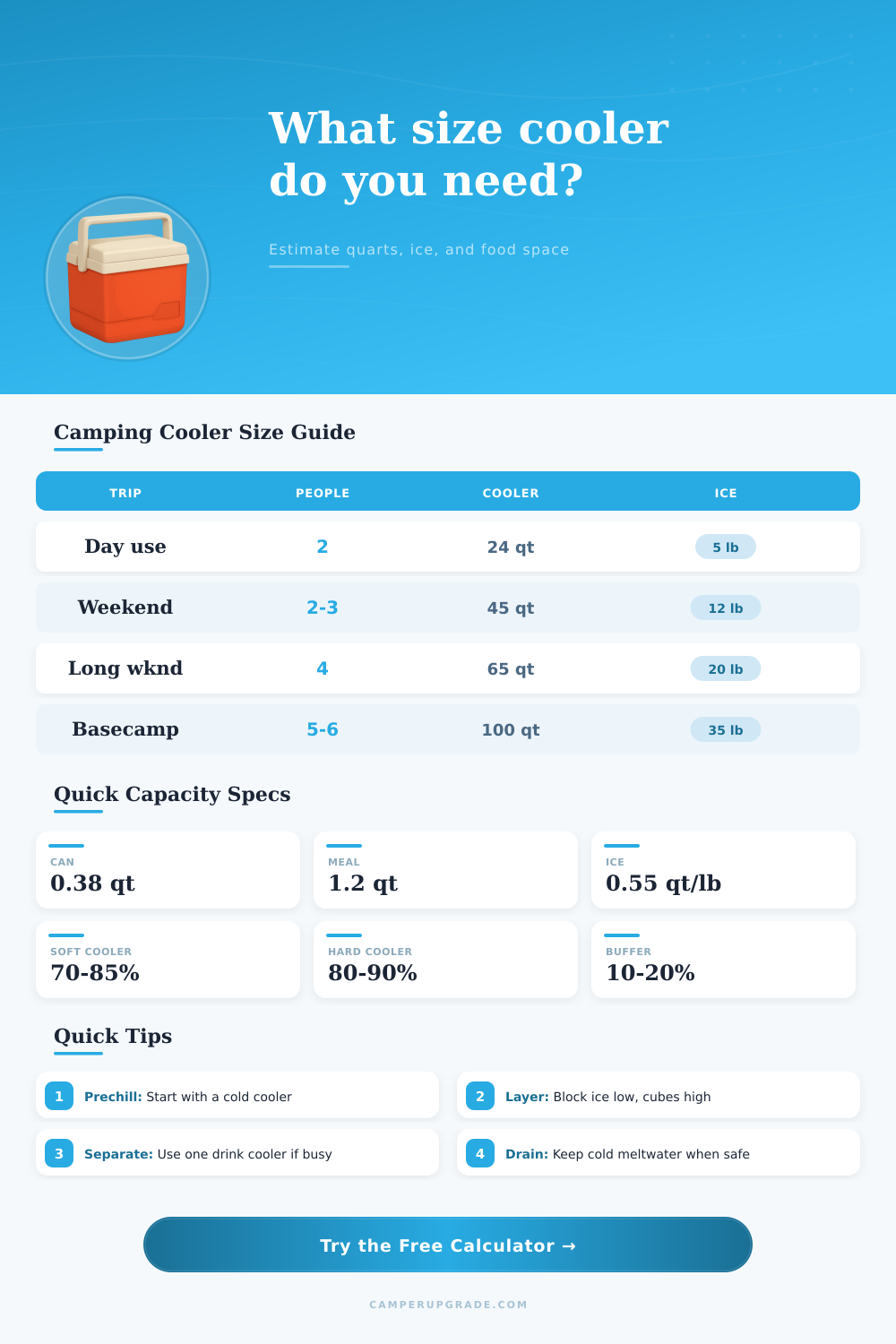
| Common Cooler | Best Use | Food Days | Notes |
|---|---|---|---|
| 12-18 qt | Personal lunch | 1 person day | Soft pack or mini hard cooler |
| 24-30 qt | Day trip | 2 people day | Good for drinks plus sandwiches |
| 40-50 qt | Weekend | 2-3 people | Common car-camping size |
| 55-70 qt | Family camp | 3-4 people | Balances capacity and lift weight |
| 80-110 qt | Basecamp | 5-6 people | Often better split into two coolers |
| Ice Plan | Ice Share | Use Case | Access |
|---|---|---|---|
| Same day | 15-20% | Beach, picnic, tailgate | Frequent |
| Overnight | 20-25% | One-night camp | Moderate |
| Weekend | 25-32% | Two-night camp | Moderate |
| Long hold | 33-40% | 3-4 day trip | Low |
| Maximum | 40-50% | Remote camp | Low |
| Item | Volume | Metric | Packing Note |
|---|---|---|---|
| 12 oz can | 0.38 qt | 0.36 L | Loose cans pack tighter than boxes |
| 16.9 oz bottle | 0.55 qt | 0.52 L | Freeze some for ice backup |
| Camp meal | 1.0-1.5 qt | 0.9-1.4 L | Depends on packaging |
| Ice, 10 lb | 5.5 qt | 5.2 L | Block ice leaves more voids |
| Gallon jug | 4.0 qt | 3.8 L | Large shape needs extra buffer |
| Scenario | People | Days | Starting Size |
|---|---|---|---|
| Lunch stop | 2 | 0.5 | 18-24 qt |
| Couple camp | 2 | 2 | 35-45 qt |
| Family weekend | 4 | 2.5 | 60-75 qt |
| RV long weekend | 4 | 3.5 | 75-100 qt |
| Group basecamp | 6 | 4 | 110+ qt |
🛻Cooler Type Spec Grid
| Type | Best Capacity Range | Usable Interior | Ice Strategy |
|---|---|---|---|
| Soft-sided | 12-36 qt | 70-85% | Use for same-day food or drinks |
| Standard hard | 30-70 qt | 80-88% | Mix block ice and cubes |
| Marine hard | 48-120 qt | 78-86% | Useful for fish, boats, and hot decks |
| Rotomolded | 45-125 qt | 75-85% | Prechill and run a higher ice share |
| 12V electric | 20-60 qt | 85-92% | Needs power but little or no ice |
💡Cooler Sizing Tips
A cooler are a tool that can be used to keep food and drink cold. When people uses coolers to store there food and drinks, however, they often find that the coolers do not hold as much as they expected of the coolers capacity. Many people look at the volume that is listed for the cooler and assume that the cooler will contain that much pounds of food or drinks.
The volume listed for coolers, however, is only the interior volume of the cooler when the cooler are empty. Coolers are never truly empty when individuals are being use them to store food and drinks, however, because coolers requires ice to maintain the cold temperatures of the food and drinks. Each pound of ice that is placed into the cooler take up one pound of space within the cooler that could otherwise be used for food or drinks.
Why Your Cooler Holds Less Than You Think
Thus, individuals who use cooler bag that have a greater volume of space have to add more ice to the cooler to maintain the food and drinks to remain cold. The additional pounds of ice take up additional pounds of space within the cooler, creating a cycle within which the cooler is utilized for food and drinks, but in which space within that cooler is use for the placement of ice rather than the food and drinks. When individuals use coolers, the food and drinks that is placed within the cooler will melt at varying rate.
Each time the lid of the cooler is opened, cold air will escape from the cooler and warm air will enter the cooler. Thus, each time the cooler lid is opened, the ice that is within the cooler will begin to melt at an increased rate due to the introduction of warm air into the cooler. An individual can use two cooler to help manage the food and drinks within the cooler.
For instance, one cooler can be used to store the food and another cooler can be used to store the drinks. By leaving the cooler that contains the food closed and seal, the food will remain cold for longer period of time and the cooler will require less ice to maintain those cold temperatures. The type of cooler that is purchased will impact the ability of the cooler to maintain cold temperatures within the cooler.
Soft sided cooler bags are typically used for individuals who are traveling shorter distances to the food or drinks that are to be stored in the cooler. The soft-sided cooler bags, however, do not provide the same ability to hold cold temperatures as do hard sided coolers. Rotomolded coolers are typically constructed with very thick walls of cooler materials in order to provide insulation to the food or drinks that are placed into the cooler.
These thick walls of rotomolded coolers, however, take up some of the space of the cooler; the exterior of a rotomolded cooler is more larger than the interior space of the cooler. Thus, an individual may purchase a large rotomolded cooler, but the interior space for the food may be smaller than the individual expect due to the thickness of the walls of the cooler. The temperature at which the food and drinks are placed into the cooler will impact the ability of the ice within the cooler to maintain cold temperatures.
If the food or drinks are at room temperature when they are placed into the cooler, the ice within the cooler will need to melt in order to lower the temperature of the food and the drinks. Thus, the ice will melt at an increased rate if the cooler contain room-temperature food and drinks. To avoid melting ice, the cooler can be pre-chilled before placing the food and drinks into it, and the food and drinks can be pre-chilled before being place into the cooler.
Cold drinks will allow the ice within the cooler to act as a preservative for the drinks rather than as an agent to lower the temperatures of the drinks. In addition to the type of cooler that is used, other methods can be employed to manage the space within the cooler. Coolers can be packed in ways that allow food to be placed into the cooler, but which does not allow the cooler to maintain cold temperature for the food that is placed into the cooler.
Air gap within the cooler allow for the coolers temperatures to rise within the cooler. One method for packing food into the cooler is to place block ice at the bottom of the cooler. The remainder of the cooler can be filled with cubed ice to fill those air gaps within the cooler.
Additionally, individuals can place water bottle into the cooler and ensure that those bottles are frozen. These frozen water bottles will act as ice packs within the cooler and also provide drinks to the individual when they melts. Should an individual determine that the cooler is too small to contain all of the food and drinks that are to be transported, they may simplify the food plan that they have or increase the number of ice pack that they use for the cooler.
They should of bought a bigger one.