Winter Backpacking Clothing Calculator
Estimate trail and camp layering from temperature, wind, precipitation, activity level, planned stops, and the garments you already pack.
🏔Winter Trip Presets
⚙Trip Conditions and Garments
Winter Clothing Results
🧥Garment Spec Comparison Grid
📊Winter Layering and Insulation Tables
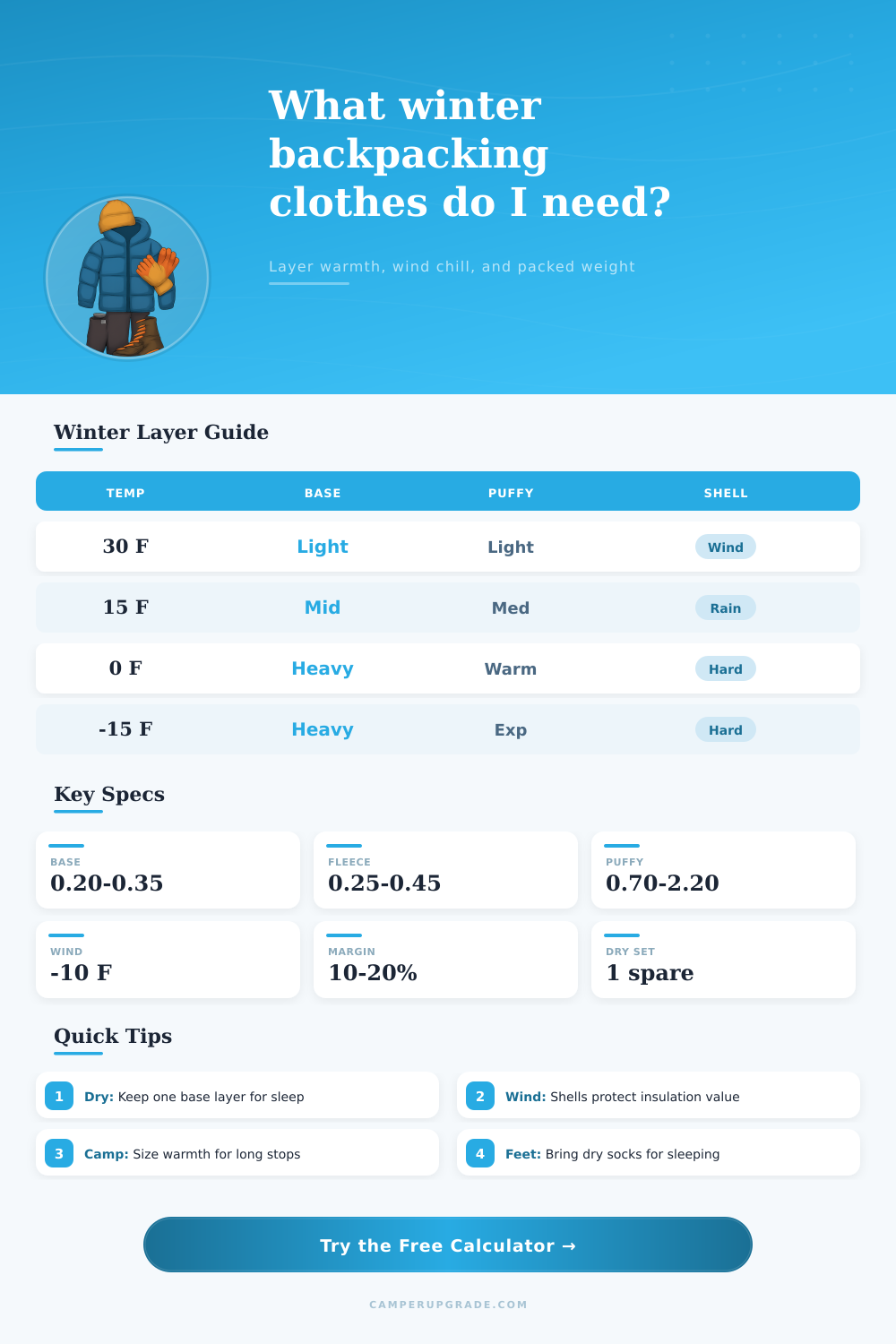
| Wind-chill range | Moving layers | Camp insulation | Typical target |
|---|---|---|---|
| 25 to 35 F | Light base, wind shirt | Light puffy | 1.4 to 1.8 CLO |
| 10 to 25 F | Mid base, fleece, shell | Hooded puffy | 1.8 to 2.5 CLO |
| -5 to 10 F | Heavy base, fleece, shell | Winter parka, warm legs | 2.5 to 3.4 CLO |
| -25 to -5 F | Base, fleece, hardshell | Expedition parka and pants | 3.4 to 4.8 CLO |
| Garment | Typical CLO | Typical weight | Best use |
|---|---|---|---|
| Light synthetic base set | 0.20 to 0.28 | 9 to 13 oz | High-output travel |
| Midweight merino base set | 0.30 to 0.38 | 14 to 20 oz | Cold mixed hiking |
| Grid fleece hoodie | 0.30 to 0.45 | 10 to 16 oz | Breathable active warmth |
| Winter down parka | 1.00 to 1.50 | 18 to 32 oz | Camp and long stops |
| Insulated pants | 0.50 to 0.90 | 12 to 24 oz | Cold camp legs |
| Activity state | Heat output | Layer effect | Calculator factor |
|---|---|---|---|
| Hard climbing or ski touring | Very high | Vent early, carry dry insulation | -30% |
| Steady backpacking | High | Use breathable midlayer | -18% |
| Mixed hiking and stops | Moderate | Balance moving and camp layers | Baseline |
| Slow travel or photos | Low | Add puffy sooner | +18% |
| Camp chores and resting | Very low | Size for static warmth | +35% |
| Moisture exposure | Layer priority | Insulation choice | Risk note |
|---|---|---|---|
| Dry cold | Wind resistance | Down is efficient | Manage sweat |
| Light snow | Brush and spindrift control | Down or synthetic | Pack dry sleep base |
| Wet snow or sleet | Waterproof shell | Synthetic safer | Protect cuffs and mitts |
| Blowing storm | Full hardshell coverage | High-loft parka | Account for delays |
🧭Common Winter Backpacking Setups
| Trip scenario | Expected low | Core clothing | Extra carried pieces |
|---|---|---|---|
| Mild snowshoe overnight | 20 F | Mid base, fleece, rain shell | Light puffy, dry socks |
| Cold forest backpack | 5 F | Heavy base, grid fleece, hardshell | Winter parka, mitts, puffy pants |
| Wet maritime winter | 25 F | Synthetic base, fleece, rain shell | Synthetic parka, spare gloves |
| Above-treeline camp | -5 F | Heavy base, fleece, hardshell | Expedition parka, face mask, overmitts |
| Fast ski approach | 10 F | Light base, breathable fleece, wind shell | Warm parka for transitions |
💡Calculation Tips
Winter backpacking require that you use a clothing system that responds to the amount of wind, moisture, and movement that you experience while on the trail. Your body produce different amount of heat while moving versus when you are sitting still. If you are moving while you are wearing too many layer, you will begin to sweat.
When you are sweating, you will be wearing wet clothing that make you feel cold. If you are sitting still and you are wearing too few layers of clothing for the cold weather, you will feel cold and may begin to shiver. You want to find a balance between these two extremes in order to avoid feeling too cold or too hot from sweat.
What to Wear for Winter Backpacking
One of the best ways to determine how much insulation you will need for the winter backcountry is through the use of a clothing calculator. Clothing calculators uses the factors of wind chill and your activity level to calculate a value known as CLO. The CLO value represent the thickness of the clothing that you will need to wear to retain your body heat.
Based off the CLO value that the clothing calculator calculates, you can determine if you will need a light down sweater or a heavy expedition parka. Clothing calculators help to remove the guesswork of insulation need by using the math behind the calculations to determine your insulation requirements. Wind speed is one of the factors that will significantly affects how warm you will feel while on the trail.
The wind will strip away the warmth that is created by your body and make it feel more colder than the actual air temperature. As such, a shell layer will be needed. The shell does not provide much warmth, but it will protect your warm insulation from the cold air.
Without a windproof layer, the wind will not let your body heat be retained due to the effect of the wind in your insulation. Moisture is another of the factors that will affect how warm you will feel while on the trail. Moisture like snow or sleet can enter your outer layer.
If moisture enter your down parka, the down insulation will lose it’s ability to provide warmth for your body. People often have to decide between synthetic insulation or down insulation based on the moisture in the air. Down insulation is considered to be light and can compress to small volumes, however it does not work well when it is wet.
Synthetic insulation will work as an alternative to down insulation for those in moisture environment. Your bodys metabolism will also play a major role in how warm you will feel in the cold winter temperatures. Those with high metabolisms will feel warm while they are performing activities, while others with low metabolism will feel cold.
A safety margin may have to be included in your clothing system to retain warmth for those with low metabolisms. By using a safety margin, such as ten or twenty percent, individuals will remain warm while on the trail even if they is not creating alot of body heat. The activity that you are performing while on the trail will alter the amount of insulation that you need.
High output activities, like ski touring, will create a lot of body heat so you will need less insulation to retain warmth. However, low output activities, such as doing camp chore will not create as much heat with your body. You should of put on your heaviest layers prior to feeling cold so that you do not lose the warmth that your body heat can provide.
The weight of your insulation is the final consideration for insulation needs. Any amount of insulation will add to the total weight of your pack. Too much weight will prevent you from moving as fast and efficient as you would like on the trail and you may begin to sweat.
You must find a balance in terms of insulation that will keep you warm while you are sitting still, but not too much that it will add to the weight of your pack. It is best to have a clothing system that allow you to add or remove insulation quickly so that you can maintain your body temperature.