Ski Skin Length Calculator
Size climbing skins by ski length, tip hardware, tail clip range, edge clearance, skin width, and plush material.
Full sizing breakdown
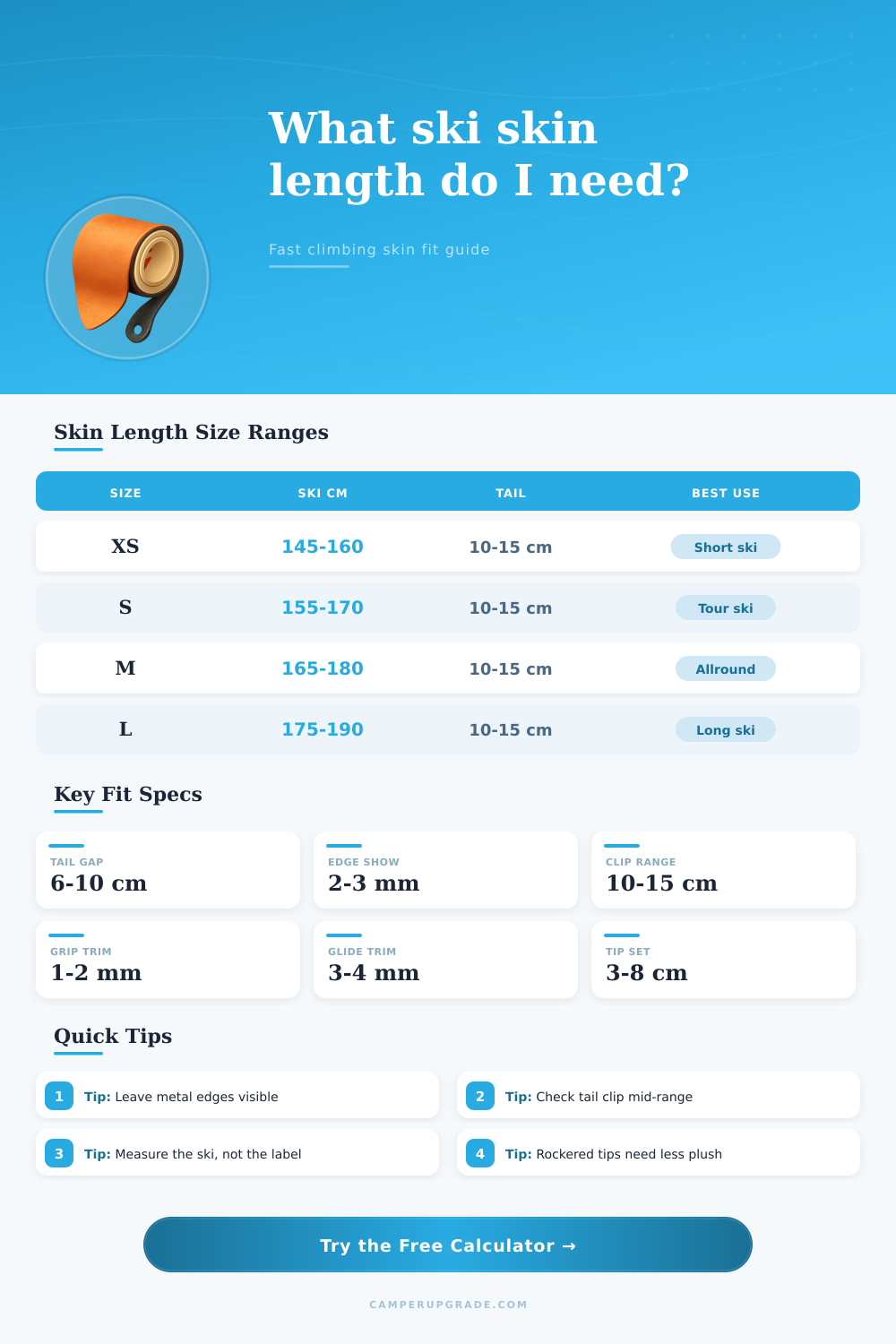
| Generic size | Typical ski length | Mid-range sweet spot | Tail adjustment notes |
|---|---|---|---|
| XS | 145-160 cm | 151-154 cm | Best for junior, short touring, and compact skis. |
| S | 155-170 cm | 161-164 cm | Good when the tail clip has 10-15 cm of travel. |
| M | 165-180 cm | 171-174 cm | Most common adult touring ski size band. |
| L | 175-190 cm | 181-184 cm | Fits longer freeride and powder touring skis. |
| XL | 185-200 cm | 191-194 cm | For very long skis; check strap travel before cutting. |
| Trim style | Edge exposure per side | Width formula | Best fit goal |
|---|---|---|---|
| Maximum grip | 1-1.5 mm | Skin width - 2 to 3 mm | Full plush near edge for steep climbing. |
| Balanced touring | 2 mm | Skin width - 4 mm | Reliable grip while leaving usable metal edge. |
| Traverse friendly | 2.5-3 mm | Skin width - 5 to 6 mm | More edge showing on icy sidehills. |
| Glide biased | 3-4 mm | Skin width - 6 to 8 mm | Less plush drag on long lower-angle tours. |
| Hardware area | Typical allowance | Calculator field | Sizing effect |
|---|---|---|---|
| Wire tip loop | 3-6 cm setback | Tip loop to plush start | Subtracts from plush cut length. |
| Rubber tip / universal tip | 5-8 cm setback | Tip loop to plush start | More hardware length before actual plush. |
| Adjustable tail clip | 10-15 cm travel | Tail clip adjustment travel | Creates stock-size overlap between ski lengths. |
| Bare tail gap | 6-10 cm | Target bare tail gap | Prevents the clip from sitting on plush or end cap. |
| Race fixed tail | 0-5 cm gap | Target bare tail gap | Shorter, lighter setups may skip adjustable clips. |
| Setup | Ski length | Suggested size | Typical cut length |
|---|---|---|---|
| Short touring ski | 156 cm | XS or S | 143 cm with 5 cm tip and 8 cm tail gap. |
| All-mountain tour ski | 172 cm | M | 159 cm with 5 cm tip and 8 cm tail gap. |
| Powder touring ski | 184 cm | L | 170 cm with 6 cm tip and 8 cm tail gap. |
| Wide freeride ski | 189 cm | L or XL | 175 cm with 6 cm tip and 8 cm tail gap. |
| Skimo race ski | 161 cm | S | 154 cm with 3 cm tip and 4 cm tail gap. |
Sizing climbing skin require precise measurement. To put on climbing skins correctly, the individual must understand that improper sizing will cause the climbing skins to peel or slip on the ski while skiing. The length of the ski that are marked on the ski isnt the length that is used for sizing the climbing skins.
For skiing skins that feature rocker in their construction, the length of the ski that will be used for sizing is the length of the skis base that will be in contact with a snow. This portion of the ski is referred to as the skis running base length. The length of the climbing skin that is used for sizing is based off the length of the skis running base length to avoid the climbing skin from hanging off of the ski.
How to Measure and Fit Climbing Skins
In addition to the length of the ski, the distance between the tip of the ski and the beginning of the climbing skin material is referred to as the skis tip setback. The tip setback may vary between skiing skins that has wire bails to those that have rubber tips. The distance for the tip setback must be measured for the hardware that is used on the ski.
Placing the climbing skin too far toward the tip of the ski will cause the climbing skin to interfere with the tip hardware. Conversely, placing the climbing skin too far from the tip will result in a loss of grip on ski slopes that is steeper then those traversed by the skier. In addition to the tip setback, the distance between the end of the climbing skin and the end of the ski is referred to as the skis tail gap.
The climbing skin should not be cut to the end of the ski because the tail clip for the climbing skin requires space for gripping the ski base. If the climbing skin is too long, the tail clip will catch on the climbing skin. The material for the climbing skin impact the sizing and trimming requirements of the climbing skin.
Skis that utilize mohair for the climbing skin will exhibit more better gliding movement on the snow than skiing skins that use other material for the climbing skin. However, mohair has a challenging grip on icy and steep ski slopes. Skis that use nylon for their climbing skins will have a better grip on ski slopes than those with mohair, but there will be more drag for skiing skins that are relatively level with the snow surface.
Many skiing skins feature a hybrid material of both nylon and mohair. For skiing skins that use high-traction nylon for their climbing skins, the climber may trim the climbing skin to be wider to allow for better grip on steep ski slopes. Another factor to consider with skiing skins is the trim width of the climbing skin.
Climbing skins should not be trimmed to completely cover the metal edge of the ski. If the metal edges of the ski are covered entirely with the climbing skin, those metal edges wont be able to grip the snow while skiing on the ski. A few millimeters of the metal edges should be exposed on each side of the ski.
Another consideration is the size of the climbing skins that are purchased. Ski skins should not be purchased in sizes that are to the limit of the adjustment range of the tail clip. The tail clip may become detached from the ski if there is a snag in the snow or a layer of ice that extend beyond the tail clips current adjustment.
The tail clip should be purchased to be in the middle of the adjustment range so that there is provision for adjustments in the future when the climbing skin begins to wear down from skiing. By mapping out the lengths of the climbing skin that will be cut and the metal edges of the ski that the climbing skin will cover, the skier will avoid cutting the climbing skin. Correctly sized climbing skins will allow an individual to gain the necessary grip to ski uphill while leaving the metal edges exposed to allow for gripping of the snow while traversing on ski slopes.