Ice Skate Sharpening Interval Calculator
Estimate how many edge hours your skates should hold, when to sharpen next, and how much bite remains for hockey, figure, recreational, goalie, and outdoor skating.
⛸Skating Presets
⚙Edge Wear Inputs
This calculator estimates interval from edge wear patterns. Sharpen sooner if the blade has visible nicks, a rolled edge, rust, or uneven inside/outside bite.
🔬Blade Steel Comparison Grid
📊Skate Sharpening Reference Tables
| Skater use | Typical interval | Best cue |
|---|---|---|
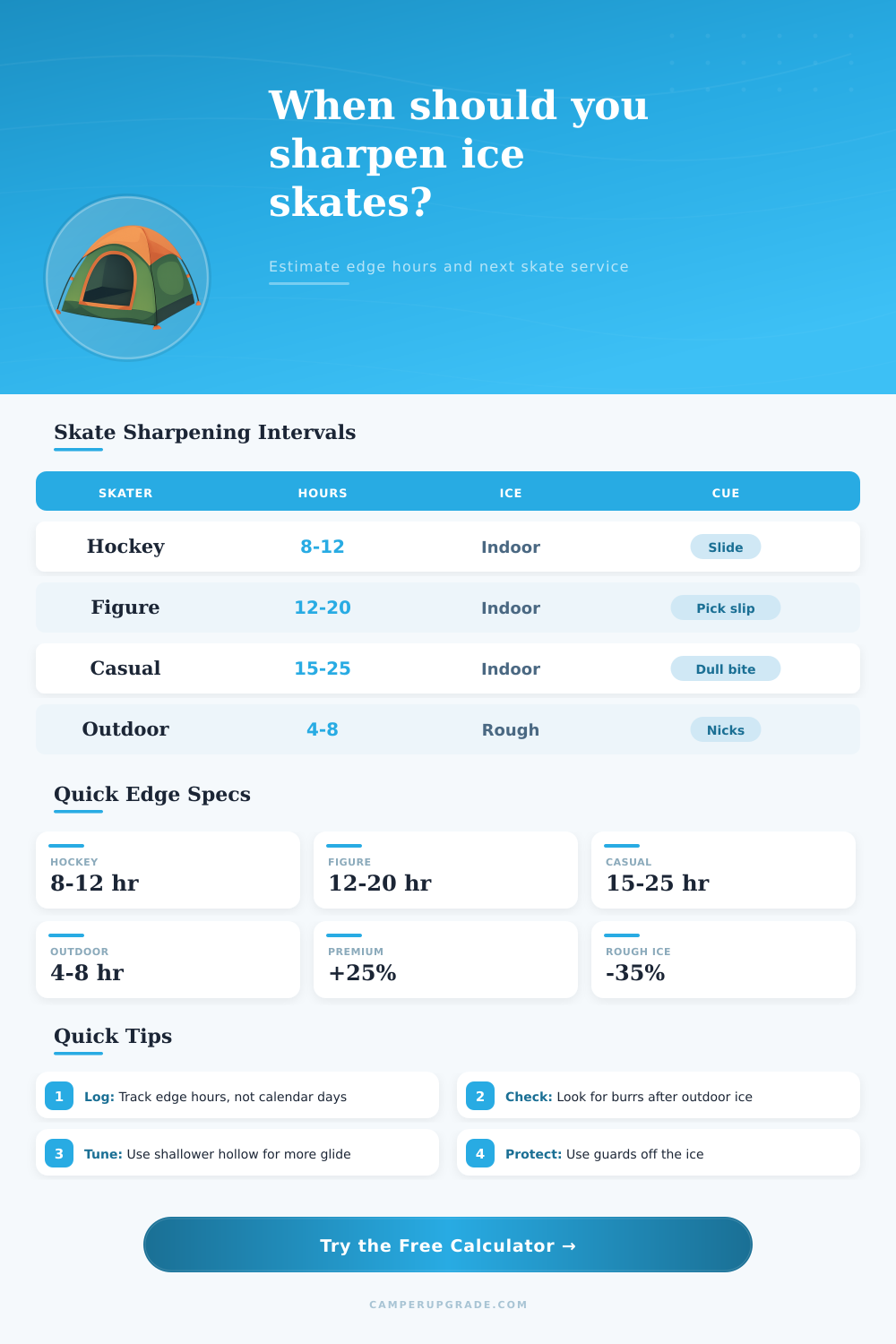
| Recreational indoor | 15 to 25 edge hours | Stops begin to slide |
| Hockey skater | 8 to 12 edge hours | Weak acceleration bite |
| Figure freestyle | 12 to 20 edge hours | Jumps or picks feel uncertain |
| Ice dance or moves | 15 to 25 edge hours | Edges lose clean hold |
| Goalie | 10 to 20 edge hours | Pushes lose bite |
| Outdoor pond ice | 4 to 8 edge hours | Nicks or gray edge line |
| Synthetic ice | 3 to 6 edge hours | Fast bite drop-off |
| Hollow | Feel | Interval effect |
|---|---|---|
| 3/8 in | Very strong bite | Sharpen about 10% sooner |
| 1/2 in | Common all-around bite | Baseline interval |
| 5/8 in | More glide, less grab | About 5% longer |
| 3/4 in | Shallow, efficient glide | About 10% longer |
| Flat bottom V | Glide with defined bite | About 5% longer |
| Ice surface | Multiplier | Why it matters |
|---|---|---|
| Fresh clean indoor | 1.10x | Fewer chips and contaminants |
| Average rink ice | 1.00x | Normal resurfaced use |
| Chippy late-session | 0.85x | Snow, ruts, and chatter |
| Outdoor rough ice | 0.60x | Sand, grit, cracks, debris |
| Synthetic tiles | 0.50x | High friction surface wear |
| Edge symptom | Likely cause | Action |
|---|---|---|
| One foot slides out | Rolled or uneven edge | Sharpen now |
| Both skates feel flat | Normal dulling | Schedule soon |
| Clicking on turns | Nick or burr | Inspect steel |
| Too much digging | Hollow too deep | Try shallower ROH |
| Great glide, no bite | Hollow too shallow or dull | Sharpen or adjust |
💡Sharpening Interval Tips
Skate blade maintenance require tracking the amount of time that a person spends on the ice. Many people use a calendar to track the time that they skate. However, using a calendar to track skate blade maintenance is inaccuracy because a calendar does not account for the friction between the skate blade and the ice on the ice skating surface.
Instead, people should use a skate blade edge hour calculator to track the amounts of time that they use their skate blade. Using an edge hour calculator will allow people to accurately track how often they must maintain there skate blade. The quality of the ice that is used also impacts the rate of dulling of the skate blade.
How to Track and Care for Your Skate Blades
For example, if an individual is skating on freshly resurfaced indoor ice, the ice will preserve the skate blade. However, if the person is skating on rough ice or public session ice, the skate blade will dull at a more faster rate. Additionally, outdoor pond ice features abrasive outdoor pond ice grit that will dull the metal of the skate blade much more fast than indoor ice.
Edge hour calculators account for these different types of ice by using a multiplier to adjust the total amount of hours that the skate blade has been use. Another factor that affects the rate of dulling of a skate blade is the material of which the skate blade is made. The most common material for skate blades is stainless steel.
However, high carbon steel and premium coated runners is harder materials that hold their edge longer. In contrast, rental skate blades are made with a softer steel that dulls very quick. Thus, the type of metal that is used in the skate blade is another determining factor of how many skating hours a person can accumulate before needing to have their skate blade sharpened.
The depth of the hollow of the skate blade will also affect the blades performance. Individuals who use a deep hollow will notice the dulling of their skate blade more quickly than individuals who use a shallow hollow. This is due to the fact that a deep hollow is more aggressive in its grip on the ice.
A shallow hollow allow for the skate blade to glide over the ice more efficient and for a longer period of time before the blade begins to feel dull. Thus, an individual must decide the depth of the hollow that is used to their skate blade based off their skating need. The skating skills and the intensity with which an individual skates will impact the rate at which their skate blade dulls.
For example, individuals who skate hockey will wear down their skate blades much faster than individuals who skate on the ice during a casual public skate. Additionally, figure skaters will wear down their skate blades much more faster than other individuals who perform different types of skating maneuvers on the ice. Thus, an individual can adjust an edge hour calculator for the various type of skating intensity that an individual performs.
An individual should also pay attention to the way that their skate blade functions. For example, if the individual experiences one foot slipping on the ice while the other foot grips the ice, this indicate an uneven or rolled edge on the skate blade. Additionally, if the individual hears a clicking sound while performing a turn on the ice, this may indicate that the skate blade have a nick in its steel composition.
This is a serious issue with a skate blade because it can affect the balance and safety of the individual on their skate blade. The reference tables that are provided in an edge hour calculator can assist an individual in correlating these physical issue to the appropriate maintenance solution to their skate blade. Finally, to properly maintain ones skate blades, it is important for an individual to create a log of the hours that they skate on the ice.
Additionally, using the edge hour calculator will allow an individual to determine when they need to have their skate blades sharpened. By using these calculations and data to track the maintenance of their equipment, an individual will eliminate the frustrations of skating with dull skate blades. Thus, by tracking the hours that an individual skate blades and calculates the wear on the skate blade, and by sharpening the skate blade in turn, an individual will ensure that their skate blade continue to provide them with the necessary grip and control while skating.