Ski Wax Base Preparation Calculator
Estimate prep wax grams, saturation coats, hot-scrape cycles, iron time, and brush passes from ski dimensions, base condition, wax type, and snow temperature.
🎿Real Ski Prep Presets
⚙Base Prep Inputs
🧪Material / Spec Comparison Grid
📊Reference Tables
| Prep wax class | Typical iron setting | Estimated use rate | Best base-prep role |
|---|---|---|---|
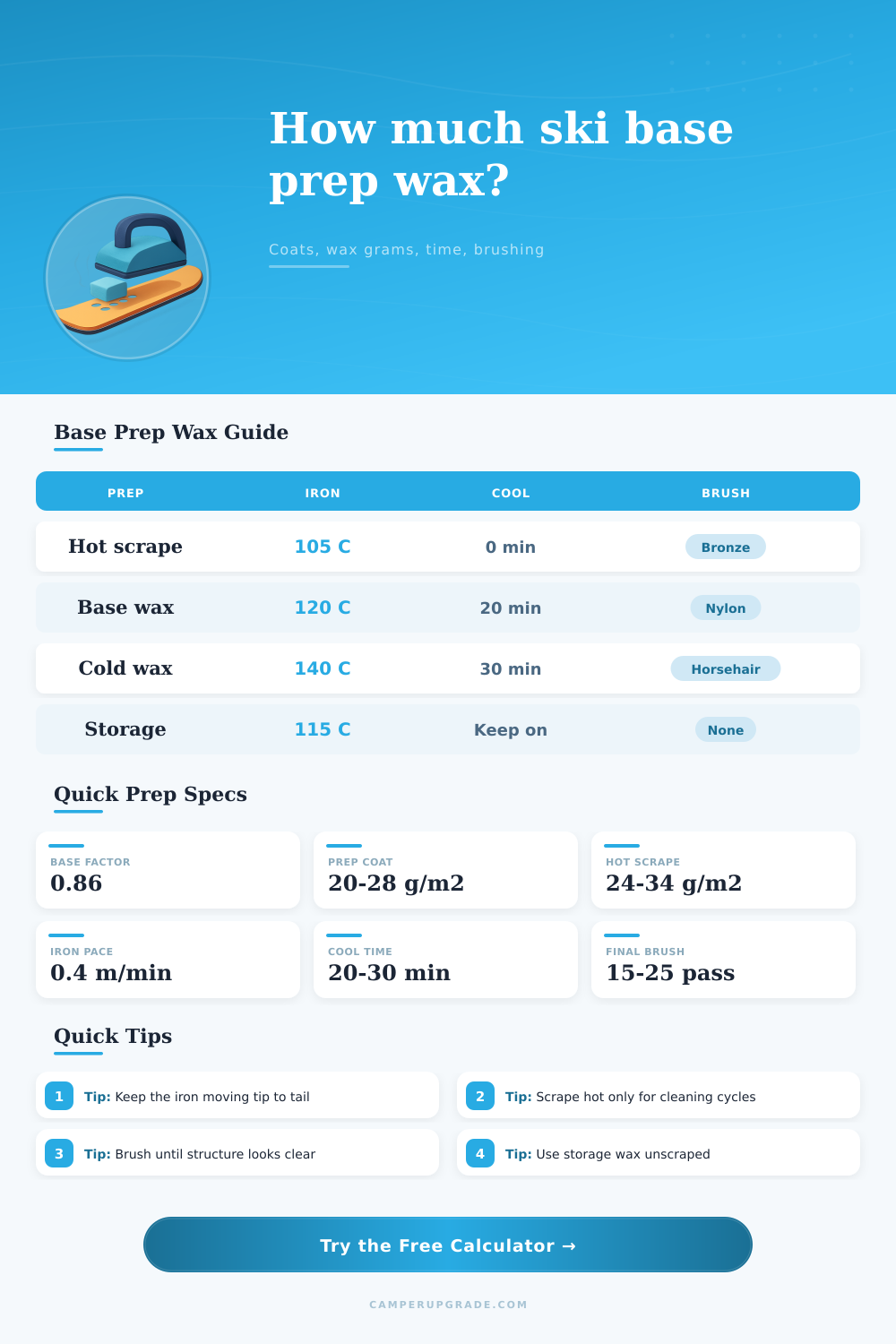
| Soft base-prep wax | 105-120°C / 221-248°F | 20-28 g per m² per coat | Initial saturation, normal prep, glide-zone conditioning |
| Universal hydrocarbon wax | 120-130°C / 248-266°F | 18-26 g per m² per coat | Everyday prep layer when snow is mixed or unknown |
| Hard cold wax | 135-150°C / 275-302°F | 16-24 g per m² per coat | Cold abrasive snow, final hardening layer after base prep |
| Graphite or moly wax | 125-140°C / 257-284°F | 18-26 g per m² per coat | Dirty, wet, man-made, or transformed spring snow |
| Fluoro-free liquid glide | No iron; dry by label | 8-12 ml per m² | Top refresh after a hot-wax base layer is scraped and brushed |
| Storage wax | 105-120°C / 221-248°F | 28-40 g per m² | Thick protective coat left on base and edges |
| Base condition | Absorption multiplier | Hot-scrape cycles | Recommended coat count |
|---|---|---|---|
| Normal maintained base | 1.00 | 0-1 | 1 prep coat plus final glide coat |
| Fresh factory or stone-ground base | 1.18 | 1 | 3-5 saturation coats before performance wax |
| Dry gray base at edges | 1.35 | 1-2 | 3-4 warm prep coats, then snow-temperature wax |
| Oxidized or chalky neglected base | 1.55 | 2-3 | 4-6 conditioning coats with bronze brushing between |
| Dirty spring base | 1.42 | 2-3 | Hot scrape until wax pulls clean, then graphite or universal |
| Brush or scraper step | Typical passes per ski | Used before wax | Used after wax |
|---|---|---|---|
| Sharp plastic scraper | 3-6 long tip-to-tail pulls | No | Yes, after cool-down or hot-scrape while soft |
| Bronze or brass brush | 6-12 strokes | Yes, opens and cleans structure | Lightly for durable wax in coarse structure |
| Stiff nylon brush | 10-18 strokes | Optional dust removal | Primary wax removal after scraping |
| Horsehair or fine nylon | 15-25 strokes | No | Final polish, especially cold wax or race finish |
| Fiber pad or fiberlene wipe | 1-2 full wipes | Yes, after cleaner dries | Final dust lift after brushing |
| Ski setup | Typical glide area | One prep coat wax | Standard bench time |
|---|---|---|---|
| 172 cm alpine pair, 88 mm average width | 0.26 m² | 6-8 g | 35-50 min with cooling |
| 186 cm freeride pair, 108 mm average width | 0.35 m² | 8-10 g | 40-55 min with cooling |
| 192 cm skate ski pair, 44 mm average width | 0.15 m² | 3-5 g | 30-45 min with cooling |
| 158 cm snowboard, 255 mm average width | 0.35 m² | 8-11 g | 40-60 min with cooling |
| Storage coat on alpine pair | 0.26 m² | 8-12 g | 20-30 min, leave unscraped |
💡Base Prep Notes
Ski bases is made of a material called polyethylene. Polyethylene are a porous material. If the polyethylene base is dry, the wax wont penetrate the polyethylene base.
The wax will only sit on the surface of the polyethylene base, but it will eventualy peel off the base. Base preparation allow the polyethylene base to absorb enough moisture to hold the waxes that you will apply to the base. Base preparation fills the microscopic void within the polyethylene base.
How to Prepare Ski Bases
When the voids are filled, the snow will not be able to remove the wax that is applied to the base through friction between the snow and the ski base. Depending on the condition of the polyethylene base, you will need a different amount of wax to properly prepare the base. A pair of brand new skis or a pair of skis that have been professionally stone ground will have a wider and more open polyethylene base structure.
Such a structure will require many layer of soft wax to penetrate the open polyethylene base. On the other hand, a polyethylene base that is well maintained will require lesser wax than a polyethylene base that has been neglected or has become chalky through exposure to snow. A hot scrape is a process that many peoples misunderstand during the base preparation process.
If the polyethylene base contain dirt or oxidized polyethylene base material, a hot scrape will remove that material while the wax is still hot. The hot wax act as a solvent to the dirt or oxidized material that is within the microscopic voids of the polyethylene base. This removes the material so that the saturation coat will be able to penetrate the polyethylene base.
The temperature of the iron that you will use to apply the wax to the ski base have importance to the base preparation process. Each type of wax that is used have a specific melting point. If the iron does not hit the melting point of the wax, the wax will not penetrate the polyethylene base.
If the iron is too cold, the wax will not penetrate the base. However, if the iron is too hot, the wax will burn or the hot iron will damage the camber of the ski. The iron should be moved from the tip of the ski to the tail of the ski in a fluid motion.
The process should be stopped if the wax begins to smoke. If the wax begins to smoke, it means the wax is chemically breaking down during the process and will not be as effective during the ski base preparation process. After the wax is applied to the base, it is important for the skis to cool completely.
If you scrape the skis while they are still warm, the wax will begin to peel from the polyethylene base. When the skis have returned to room temperature, the wax will have contracted to the polyethylene base and will not be easily scraped off. The final stage of base preparation is called brushing.
Brushing is used to reopen the polyethylene base structure so that the polyethylene base can manage the thin film of water that will allow the skis to glide on top of the snow. If there is too much wax within the polyethylene base, it will create a suction effect that will slow the skis down. Therefore, you should use a stiff brush to clean the deepest groove of the polyethylene base.
The polyethylene base should be finished with a soft brush to polish the surface of the base. Planning your ski waxing process will save you time and money. Base preparation take a significant amount of time.
You must take time to properly apply each saturation coat, scrape the skis after each wax application, and allow the skis to reach room temperature before continuing. You can use a tool to calculate the amount of gram of wax you will need for your skis and the amount of time that you will spend at your ski waxing bench. If you plan properly, you will not run out of wax during the ski waxing process.
If you perform the base preparation process correctly, the polyethylene base will appear deep and rich. A deep and rich polyethylene base means the base has been properly saturated with wax and is ready to recieve the glide wax that will allow your skis to glide easy on the snow.