Snowboard Wax Temp Calculator
Match snow temperature, humidity, base type, and wax family before you heat the iron.
| Condition | Snow feel | Wax family | Iron start |
|---|---|---|---|
| Powder | Dry, cold | Cold race | 124C |
| Groomed | Firm, even | Cold / all-temp | 130C |
| Hard ice | Fast, sharp | Cold | 126C |
| Spring slush | Wet, sticky | Spring | 140C |
| Coastal snow | Heavy, damp | Warm | 138C |
| Base type | Safe cap | Typical range | Best note |
|---|---|---|---|
| Extruded | 125C | 115-123C | Use gentle heat |
| Sintered | 135C | 124-133C | Most common choice |
| High-density | 140C | 128-138C | Handles more heat |
| Race base | 145C | 130-142C | Use a steady pass |
| Snow temp | Air temp | Suggested family | Glide bias |
|---|---|---|---|
| -15 to -10C | -18 to -12C | Cold race | Fast and dry |
| -9 to -4C | -12 to -5C | Cold | Balanced winter |
| -3 to +2C | -6 to +1C | All-temp | Most versatile |
| +1 to +5C | -1 to +6C | Warm / spring | Soft and wet |
| Step | Target | Result | Finish |
|---|---|---|---|
| Prep | Clean base | Dry surface | No dust |
| Heat | Steady pass | Even melt | No smoke |
| Cool | Fully set | Hard film | Wait patiently |
| Brush | Light strokes | Open structure | Fast glide |
Snowboard waxing require you to decide on an correct temperature for the wax that you will use and the correct temperature for the iron that you will use to melt the wax. If the temperature of the iron are too low, the wax will not melt into the base of the snowboard. If the temperature of the iron is too high, the wax will smoke and it will damage the base of the snowboard.
You want to ensure that the wax melt into the base of the snowboard so that the snowboard can glide over the snow. The most important factor to consider when choosing the type of wax to use is the temperature of the snow. The temperature of the snow will determine the friction that the snowboard will experience.
Choose the Right Iron and Wax Temperature for Your Snowboard
If the snow is cold and dry, you must use an ultra-hard wax and the iron temperature should not rise beyond 130 Celsius. Using an iron temperature more higher than 130 Celsius on cold snow will cause the snow to smoke before the wax can enter the pore of the base of the snowboard. If the snow is warm and slushy, you should use an soft wax.
In this case, the temperature of the iron should not go beyond 145 Celsius. Using an iron temperature higher than 145 Celsius on snow temperature between 0 and -10 degrees Celsius will damage the polyethylene material in the base of the snowboard. Air temperature is the second most important factor when choosing wax.
Air temperature can differ from the temperature of the snow and will change as the sun rise. High humidity will make the snow feel more soft. In this case, you should use a wax that repel water.
Other consideration is riding style. Snowboarders who ride in snow park may prefer all-temperature waxes while those who ride in the backcountry may prefer a wax that are specifically made for cold temperatures. The type of base on your snowboard will determine the maximum safe temperature for the iron.
If you have an extruded base, which is most common on beginner snowboards, the iron should not reach a temperature higher than 125 Celsius. If you have a sintered base, which is most common on snowboards that is made for all-mountain use, the base can withstand an iron temperature of up to 135 Celsius. Race snowboards have a very dens base that can withstand an iron temperature of up to 145 Celsius.
Using an iron temperature that is too high for your base will damage the base of your snowboard. Another factor to consider is how many day you have used the snowboard. After many days of riding on the snowboard, the wax base will clog the pore of the base of the snowboard.
In this case, you can use a higher temperature for the iron to help melt the wax that has collected in the pores. You can determine if the iron temperature is correct by watching how the wax melt under the iron. Using a temperature that is too low for the wax will cause clumps of wax to form under the iron.
Using a temperature that is too high will cause the wax to smoke. Smoke indicate that the hydrocarbons in the wax is breaking down under high heat. The goal is to melt the wax into the base of the snowboard so that a thin sheen appear on the base.
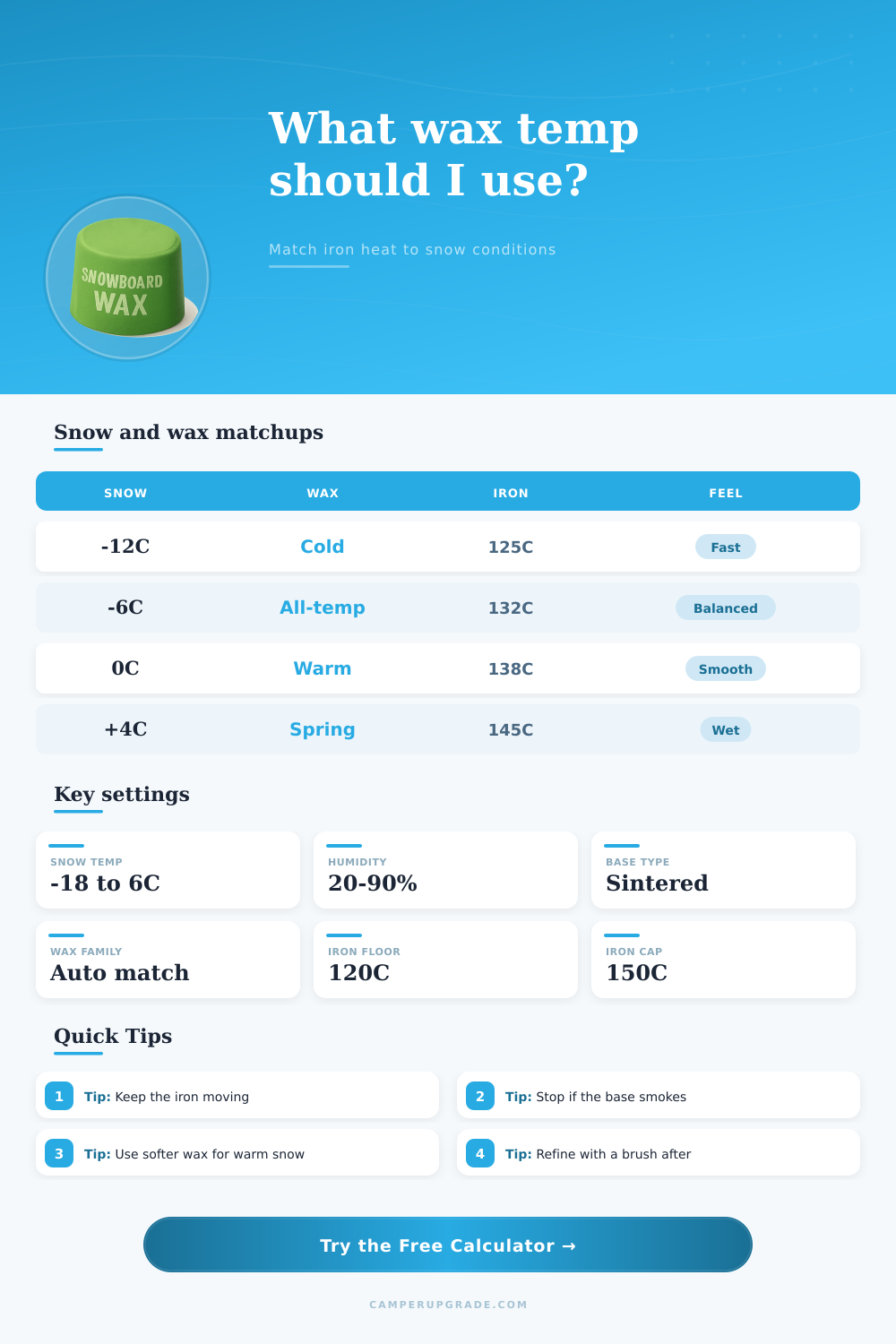
For snow temperature around minus six degrees, you can use all-temperature wax at 132 Celsius with the iron. For very cold snow, you can use a cold race wax at 125 Celsius with the iron. For warm snow, use a spring family wax at 145 Celsius with the iron.
Do not try to guess the best iron temperature by feel alone. Always start with a low temperature and increase the temperature of the iron only if the wax does not easily spread on the base of the snowboard. Always brush the base of the snowboard after waxing it.
The wax will remain opaque until you use a nylon or horsehair brush to scrape the wax on the base of the snowboard. This help to expose the fast layer of the wax. Humidity will also affect how you wax your snowboard.
If the humidity is low, use a speed wax. If the humidity is high, use a softer wax so that the snowboard will not experience drag as it move on the snow. Always use constant motion with the iron and apply light pressure to the iron.
You should never hold the iron in one place on the base of the snowboard. If the wax begins to smoke, stop waxing the base of your snowboard. This indicate that the iron is too hot for the base of the snowboard.
Finally, ensure that the snowboard cools to room temperature before you scrape the wax off the base of the snowboard.