🏂 Snowboard Stance Angle Calculator
Dial in stance width, front and rear binding angles, setback, and board fit using your body data, board width, and riding style.
Used for the base stance width estimate.
Longer inseams usually support a broader stance.
A wider upper body often likes more platform.
Heavier riders often like calmer angles and width.
Larger boots can benefit from steeper angles.
Narrow waists usually need more angle clearance.
Useful for directional and splitboard balance.
📏Snowboard Spec Grid
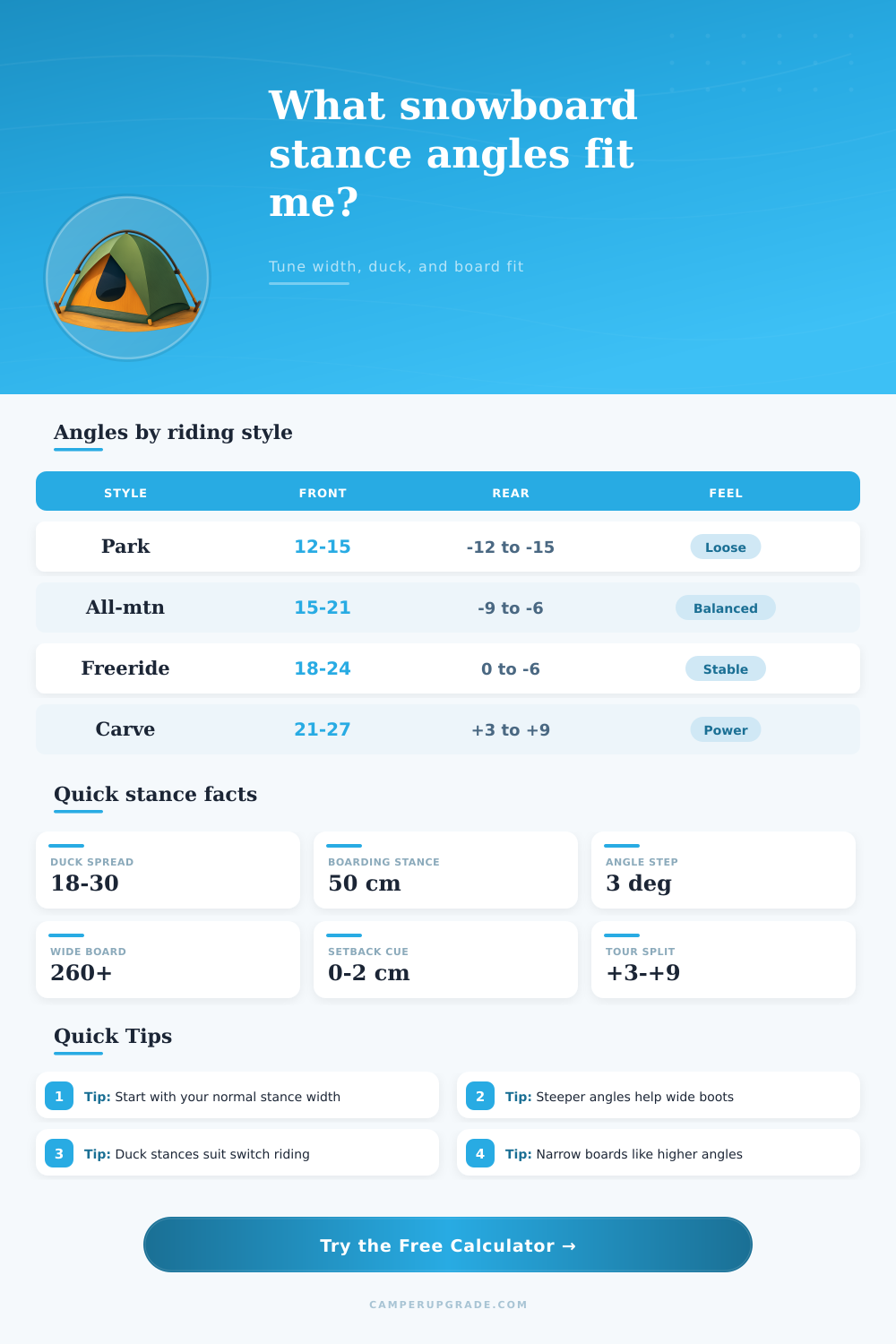
📈Angles by Riding Style
| Style | Front angle | Rear angle | Feel note |
|---|---|---|---|
| Park / freestyle | 12-15 | -12 to -15 | Loose and switch ready |
| All-mountain | 15-21 | -9 to -6 | Balanced daily stance |
| Freeride | 18-24 | 0 to -6 | Directional control |
| Powder | 15-21 | -6 to 0 | Surfier front-foot drive |
| Carving | 21-27 | +3 to +9 | Strong edge pressure |
| Splitboard | 18-24 | 0 to +6 | Longer traverse comfort |
📚Body and Boot Reference
| Rider cue | Typical low | Common range | Broad cue |
|---|---|---|---|
| Height | 160 cm | 175-180 cm | 190 cm |
| Inseam | 74 cm | 80-86 cm | 94 cm |
| Shoulders | 40 cm | 45-48 cm | 54 cm |
| Boot sole | 285 mm | 300-310 mm | 325 mm |
| Weight | 60 kg | 70-85 kg | 95 kg |
| Stance width | 44 cm | 48-52 cm | 56 cm |
📐Board Width and Clearance Guide
| Waist width | Boot length | Angle band | Clearance note |
|---|---|---|---|
| 240-244 mm | 305-320 mm | 18-27 deg | Needs steeper angles |
| 245-249 mm | 300-315 mm | 15-24 deg | Most resort boards fit here |
| 250-254 mm | 295-310 mm | 12-21 deg | Balanced all-mountain zone |
| 255-259 mm | 290-305 mm | 9-18 deg | Room for duck or directional |
| 260-264 mm | 285-300 mm | 6-15 deg | Great for larger feet |
| 265+ mm | 280-295 mm | 3-12 deg | Wide board, mellow angles |
Stance angle is a way for a person to set the position of the bindings on there snowboard. The stance angle for a snowboard determines how it will respond to the movements of the person on the snowboard. A person must adjust their stance widths and stance angle for optimal control of there snowboard.
The stance width for a snowboard is the distance between the bindings on the snowboard. This stance width will determine the stance angles for the snowboard. To determine stance width, a person can use their inseam and shoulder widths.
How to Set Your Snowboard Stance Angle and Width
Taller individuals with long legs require a stance width as they need more leverage. Individuals with more compact builds may require a stance width that is wider than there shoulder. However, those with heavy builds may require a stance width that is wider to maintain stabilities.
Using a stance width that is too narrow will lead to instability when riding on choppy snow as the snowboarder will be riding on the toes of their boots. Using a stance width that is too wide will lead to the knees locking up when turning the snowboard. Additionally, the size of a snowboarder’s boots may impact there stance width as stance width will impact toe drag or heel drag when turning the snowboard.
The stance angle for a snowboard can be divided into two measurements: the front foot angle and the rear feet angle. The front foot angle controls how a snowboarder initiates edges on the snowboard. A positive front foot angle will allow a snowboarder to drive the nose of the snowboard.
Snowboarders who ride on groomed snow or powder generaly use a front foot angle of between 15 and 24 degrees. The rear foot angle is used to provide balance to the snowboarder when standing on a snowboard. Using a negative rear foot angle will create a duck stances.
A duck stance is when the front foot angle is positive and the rear foot angle is negative. Snowboarders who wish to ride in a switch position generaly use a duck stance. Additionally, a snowboarder can use a positive rear foot angle to provide directional power to the snowboard.
The stance spread is the difference between the front and rear feet angles. Stance spread can indicate whether a snowboarder will have a stance that is loose for park snowboards or tight for high speeds on snowboards. The specifications of a snowboard may impact the stance angle that a snowboarder uses when standing on their snowboard.
Snowboards with a narrow waist have dimensions less than 250mm in width. Stance angles for these snowboards is steeper to avoid toe drag. Toe drag can cause snowboarders to crash on the snow.
Snowboards with wide waists have dimensions of 260mm or more in width. These snowboards allow for more mellow stance angles because the heels of the boots will not scrape against the snow when turning. The length of a snowboard and a setback will also impact the stance angle.
Snowboard setback is the position of the bindings relative to the middle of the snowboard. A larger setback will allow snowboarders to better float on powder. The type of snowboarding that an individual performs will impact the stance angle that they use.
Park snowboarders use a duck stance; 15 degrees for the front feet and -15 degrees for the rear foot for instance, to be symmetrical when they are standing on their switches. All mountain snowboarders may use 18 degrees for the front foot and -6 degrees for the rear foot to provide them with a stance that is suitable for multiple types of terrain. Freeriders tend to use a more directional stance angle such as 21 degrees for the front foot and 0 degrees for the rear foot to allow for stability at high speeds.
Powder surfer may use a stance angle that has a lower front foot angle and a slight positive rear foot angle to facilitate the snowboards nose to float on top of the snow. Carvers use high angles for both the front and rear feet to provide them with maximum edge bite on hard snow. Many snowboarders make mistakes when setting there stance angles.
For instance, they may copy the stance angles of professional snowboarders without considering their boot size or waste width for their snowboards. Using wide boots on a snowboard with a narrow waist will cause toe drag. Many snowboarders also dont consider their own body type when establishing their stance angles.
For instance, snowboarders with tight hips may prefer stance angles that are more open than those with flexible knees. A snowboarder should make adjustments to one aspect at a time to find their correct stance angle. For instance, they may add 3 degrees to the front foot angle to see how the snowboard feels ridden.
The type of terrain that a snowboarder intends to ride on may impact there stance angles. For instance, those who ride in parks or on groomed snow may use a wide stance angle spread but use a stance angle spread that is narrower for those who ride on steep or choppy snow terrain to keep the weight in the center of the snowboard. Finally, the snowboarder will likely require some iterations to stance width and stance angle to find the correct stance for themself.