Snowboard Size Calculator
Dial in board length, width, stance, setback, and flex from your body data, boot size, terrain, and riding style.
🏂Quick Fit Presets
📏Fit Inputs
📊Snowboard Size Spec Grid
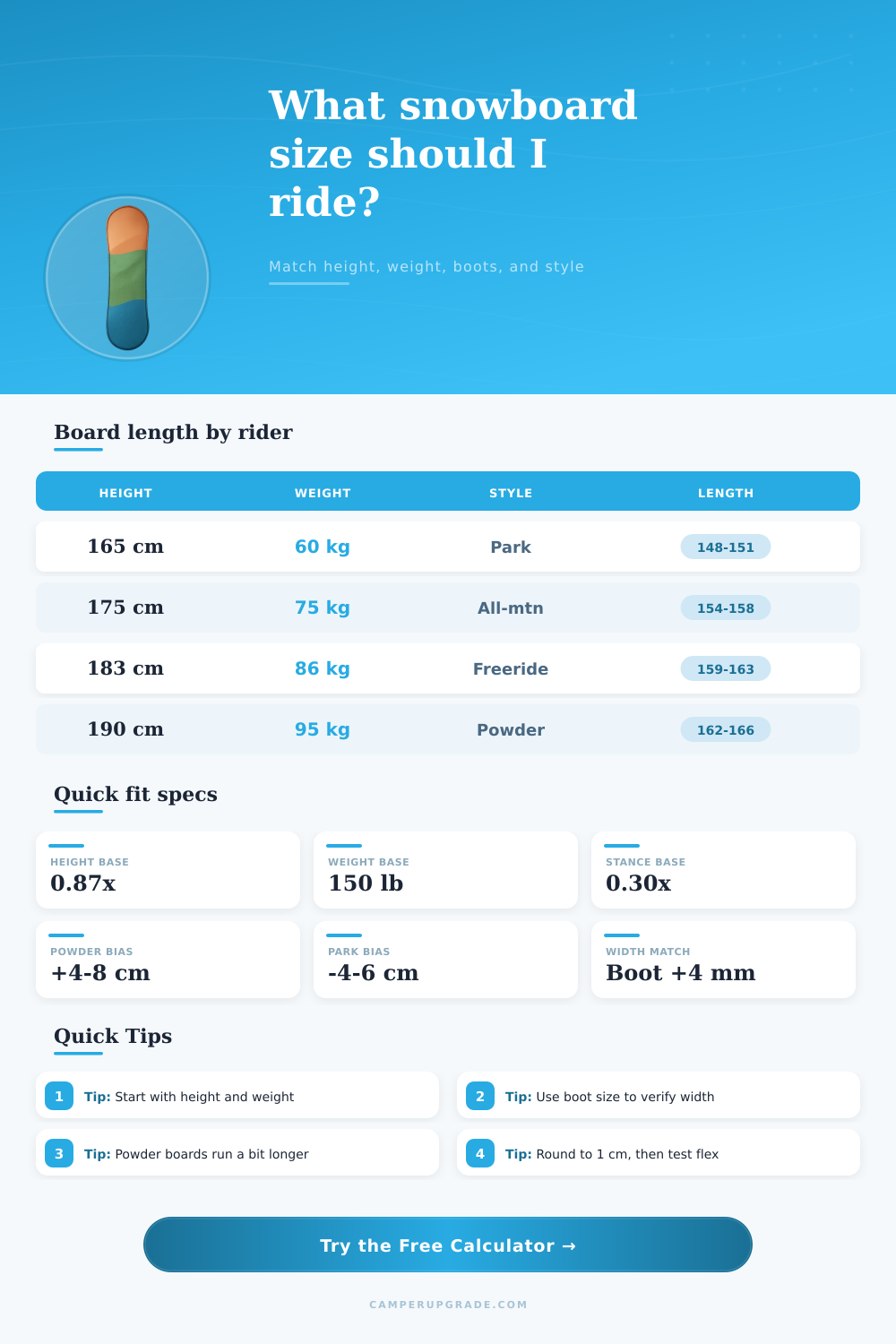
📖Board Length Reference
| Height | Weight | Style | Length |
|---|---|---|---|
| 160-168 cm | 45-60 kg | Park | 143-149 cm |
| 168-176 cm | 60-75 kg | All-mtn | 149-156 cm |
| 176-184 cm | 72-88 kg | Freeride | 155-162 cm |
| 184-192 cm | 85-100 kg | Powder | 160-168 cm |
| 170-188 cm | 65-85 kg | Carving | 154-161 cm |
| 165-180 cm | 55-78 kg | Touring | 151-158 cm |
👓Boot Size to Width Guide
| Boot | Waist | Overhang | Note |
|---|---|---|---|
| 22.0-24.0 | 244-250 mm | 12-15 mm | Narrow fit |
| 24.5-25.5 | 248-254 mm | 14-16 mm | Standard fit |
| 26.0-27.0 | 252-258 mm | 15-18 mm | All-mtn fit |
| 27.5-28.5 | 256-264 mm | 16-19 mm | Mid-wide fit |
| 29.0-30.0 | 260-270 mm | 17-20 mm | Wide fit |
| 30.5+ | 266-276 mm | 18-22 mm | Extra wide |
📏Stance Width Reference
| Height | Stance | Style | Feel |
|---|---|---|---|
| 160-168 cm | 49-53 cm | Park | Quick |
| 168-176 cm | 52-56 cm | All-mtn | Balanced |
| 176-184 cm | 55-59 cm | Freeride | Stable |
| 184-192 cm | 58-62 cm | Powder | Surf-like |
| 170-190 cm | 53-58 cm | Carving | Edge hold |
| 165-185 cm | 51-56 cm | Touring | Efficient |
🔬Flex and Terrain Matrix
| Target | Terrain | Flex | Feel |
|---|---|---|---|
| 4-5 | Park | Soft | Jibby |
| 5-6 | Groomed | Balanced | Easy |
| 6-7 | All-mtn | Medium | Versatile |
| 7-8 | Freeride | Stiff | Stable |
| 6-8 | Powder | Medium+ | Float |
| 5-7 | Touring | Medium | Efficient |
🚧Shape and Setback Guide
| Shape | Setback | Width Bias | Use |
|---|---|---|---|
| True twin | -1 to 0 cm | -1 mm | Park |
| Directional twin | 0 to 1 cm | 0 mm | Daily |
| Directional | 1 to 2.5 cm | +2 mm | Freeride |
| Volume shifted | 1.5 to 3 cm | +4 mm | Powder |
| Splitboard | 1 to 2 cm | +2 mm | Touring |
| Hybrid camber | 0.5 to 1.5 cm | +1 mm | All-mtn |
To choose a snowboard, you must consider several different physical factors regarding the way that the snowboard will function on the snow. The way that you need to balance your physical measurements with the terrain that you will encounter on the mountains is one of the first considerations that you should make in your purchase of a snowboard. Your physical measurement will ultimataly inform you of the type of snowboard that you should purchase.
Your height and weight is the most important measurements regarding the choice of snowboard that you will have to make. Your height will inform you of the length of snowboard that you should have, as those who are taller may require a snowboard that can travel at more greater speeds over uneven snow. However, your weight will impact the choice of snowboard in relation to the way that you will float on the snow, and how much control that you have over your snowboard.
How to Choose a Snowboard
Thus, an individual that is tall and lightweight may require a different type of snowboard than an individual that is short and heavy; the heavier individual will require more area on the snowboard so the snowboard dont sink into the snow. Additionally, another measurement that will impact the choice of snowboard is your boot size; boot size will determine the waist width of your snowboard. If your waist is too narrow for your snowboard, you may experience toe drag, wherein your boot will scrape against the snow while you are turning.
The terrain on which you will be riding will impact the type of snowboard that you should purchase. If you plan to ride in a terrain park, you may desire a snowboard that is shorter and softer to allow for easier spinning on the snowboard and to ride on rails. If you plan to ride in deep powder, a longer and wider snowboard may be better for you, as these snowboards will allow you to have more “float” on the deep snow.
If you plan to ride on the mountain in general, you may want a versatile snowboard that can handle both groomed snow trails as well as trees. Additionally, your skill level on the snowboard will impact the type of snowboard that you should use. Beginners may prefer buying a snowboard that is shorter, as these snowboards is easier to turn.
Experts may prefer buying a snowboard that is longer and allows for more precision in their snowboarding on the mountain at high speeds. Finally, the temperature of the snow may impact the type of snowboard that you should purchase; in cold snow, a stiffer snowboard will allow for better grip of your snowboard on the ice, while on warm snow, flexibility in the snowboard are desired. Another factor in the purchase of a snowboard is the flex that the snowboard will have; this flex should match the way in which you ride your snowboard.
Soft snowboards are easier to press and maneuver on the snow; however, they may not be as stable on harder snow. In contrast, stiffer snowboards are more stable when turning at fast rates; however, they may be more difficult to control if you are a timid snowboarder. The stance in which you stand on your snowboard will impact the way in which it feels when you are riding it; those who desire greater stability will have a wider stance, while those who wish to perform tricks in a terrain park will have a narrower stance.
Finally, the shape of your snowboard will impact the types of terrain on which you will want to ride; twin snowboards that have a true twin shape allow for those who ride them to ride in either direction on the snow. Directional snowboards are good for riding on powder. Many snowboarders tend to make mistake when purchasing a snowboard; they tend to focus on only one measurement of the snowboard at a time.
For instance, many individuals may use outdated height charts to measure the length of snowboards that they should have; snowboards have evolved in the last few decades to include volume-shifted designs that allow for shorter snowboards to have the same amount of float as a snowboard that is longer. Additionally, another snowboard mistake is to purchase a snowboard that is of the same size as one of your friend snowboards; your boots and your weight may not be similar to that of your friend. Thus, begin with your height and weight to determine the size of snowboard that you should have; adjust for terrain and boots.
Finally, you should test the snowboards that you are considering prior to making your purchase. Most snowboard shops will allow you to demo snowboards that are in the size range that you have determined based off your height, weight, and boot size. You will want to ensure that you have between 10 and 20 millimeter of overhang on each side of your boots within the snowboard bindings; this will ensure that you dont have toe drag when you are turning.
Additionally, you can test the flex of the snowboard by turning the nose and tail of the snowboard to determine if that type of flex is suitable to your riding style. Finally, if possible, you should of tested the snowboards on actual snow to determine whether they initiate turns smoothly or whether they are unstable on the snow.