🎿 Ski Stance Calculator
Dial in stance width, pressure split, knee flex, and balance cues from body data, ski geometry, and the way you actually ski.
What it does not replace: a physical fit check, boot alignment work, or on-snow coaching feedback.
Sets the core stance-width anchor.
Longer legs usually allow a calmer base.
Heavier skiers often prefer a touch more width.
Boot length affects leverage and cuff feel.
Wider waists usually prefer a broader stance.
Longer skis can feel better with a steadier base.
This helps the calculator lean wider for stability or tighter for quicker edge changes.
| Height band | Beginner | Intermediate | Expert |
|---|---|---|---|
| 155-165 cm | 38-42 cm | 40-44 cm | 42-46 cm |
| 166-175 cm | 40-44 cm | 42-46 cm | 44-48 cm |
| 176-185 cm | 42-46 cm | 44-48 cm | 46-52 cm |
| 186-195 cm | 44-48 cm | 46-52 cm | 48-54 cm |
| 196+ cm | 46-50 cm | 48-54 cm | 50-56 cm |
| Terrain | Tempo | Width bias | Balance cue |
|---|---|---|---|
| Groomed | Steady | Neutral | Clean edge |
| Moguls | Quick | -1 to -2 cm | Compact and agile |
| Powder | Slow | +1 to +3 cm | Float and calm |
| Race | Fast | -1 cm | Direct drive |
| Touring | Medium | -1 cm | Efficient travel |
| Boot sole | Ski waist | Width cue | Notes |
|---|---|---|---|
| <280 mm | 70-85 mm | 38-44 cm | Quick and narrow |
| 280-300 mm | 84-95 mm | 42-48 cm | Classic resort fit |
| 301-320 mm | 95-105 mm | 46-52 cm | Wider stability band |
| 321-340 mm | 105-115 mm | 48-54 cm | Freeride leverage |
| 340+ mm | 115+ mm | 50-56 cm | Check boot clearance |
| Scenario | Width | Pressure | Feel |
|---|---|---|---|
| Beginner cruiser | 39-43 cm | 54 / 46 | Calm |
| All-mountain daily | 44-48 cm | 52 / 48 | Neutral |
| Frontside carver | 42-46 cm | 53 / 47 | Direct |
| Powder freeride | 46-52 cm | 50 / 50 | Stable |
| Mogul compact | 40-44 cm | 55 / 45 | Quick |
| Setup | Width | Knee flex | Best use |
|---|---|---|---|
| Compact | 38-42 cm | 30-34° | Bumps and turns |
| Neutral | 42-46 cm | 32-36° | Daily resort |
| Athletic | 46-50 cm | 34-38° | Fast carving |
| Wide | 50-54 cm | 36-40° | Powder and chop |
| Race | 40-44 cm | 33-37° | Hard snow |
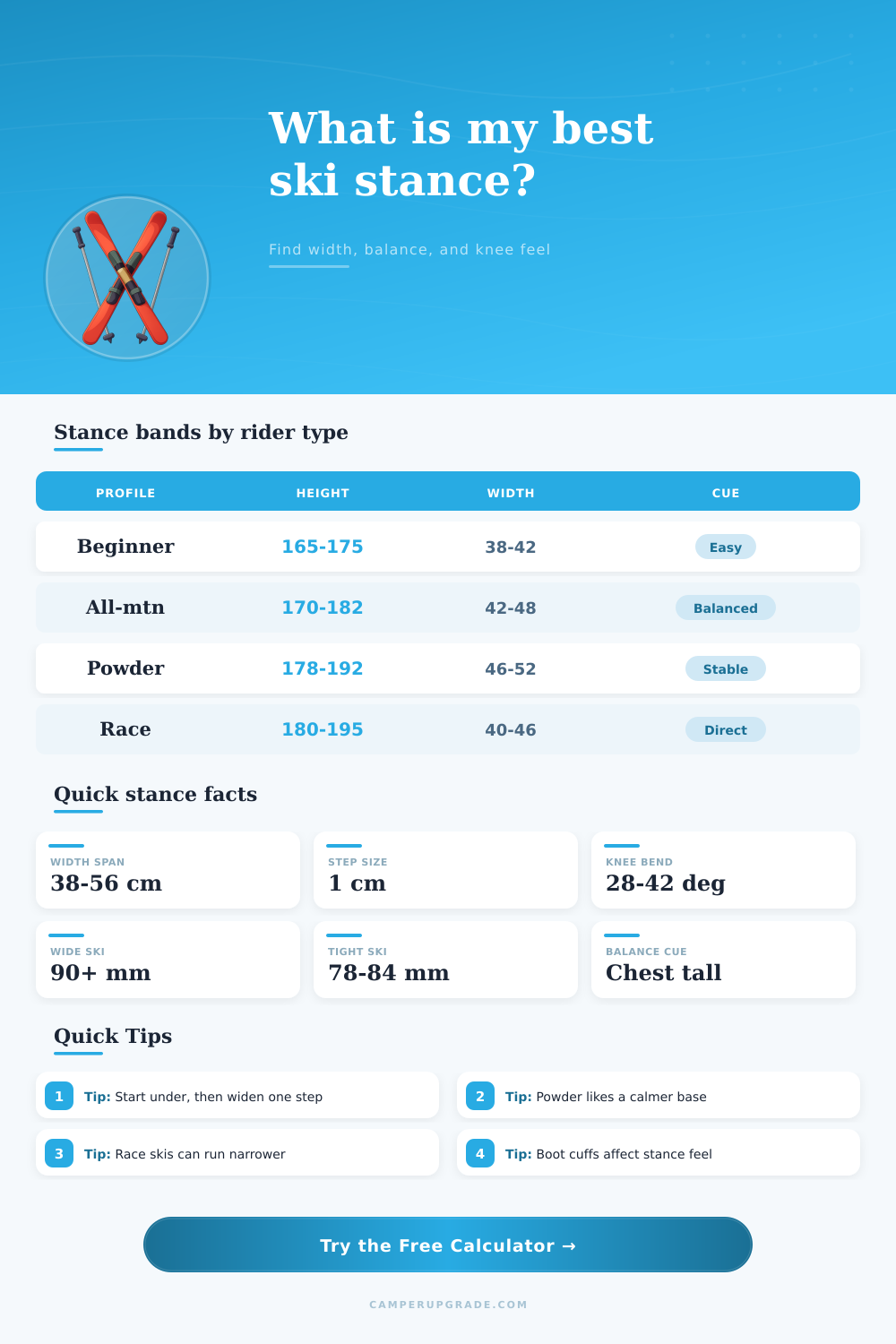
Ski stance are the distance between a persons feet while skiing, as well as the way that a person weighs the feet, bends the ankles and knee. Ski stance is an important factor in skiing in that ski stance is one of the factors that determines the amount of control that a person has over there skis. If a person use an incorrect ski stance, they may struggle to effectively control there skis, as well as experience discomfort in their knees.
A person can improve their skiing performance by adjusting their stance according to their height, the length of their leg, and the type of skis that they are using. Many factor influence the stance that a person should use when skiing, including their body proportions. For instance, taller individuals with longer legs may require a stance that is wider than shorter individuals with shorter legs.
How to Find the Right Ski Stance
Additionally, the weight of the individual may play a role in determining the stance that is required of that individual; heavier individuals may require a stance that is wider than individuals with less body mass to allow for the even spread of their body weight and to reduce the vibration that they feel when skiing on firm snow. Finally, the width of the individuals skis may also impact the stance that they should use; individuals who use skis with a narrow waist, such as skis with a waist width under 84 millimeters, may use a stance that is narrower than individuals with skis that have a wide waist, such as skis that are over 105 millimeters in width. A person can use a calculation tool to determine their stance.
Such tools can calculate the starting width of the individuals stance in centimeters or inches based off their body and equipment specifications. Tool suggestions for the individual may include the tuning range, the adjustment of the skis within the calculation tool, and the pressure split, or the way that the individual should distribute their weight between their front and back ski binding. The calculation tool may take into account the skiing discipline that the individual intends to perform; moguls, for instance, may require a different stance than powder skiing.
Additionally, different skiing stances has different functions. For instance, an individual with a narrow ski stance may be able to easily redirect their skis, but may experience instability when skiing at high speeds. In contrast, an individual with a wide ski stance may have more stability when skiing on snow of variable conditions, but may struggle to redirect their skis.
Furthermore, the pressure split impacts the way in which an individual skis; a split that indicates a greater weight on the front ski will help that individual to drive their skis forward, while a split that indicates even weight on the front and back ski will keep that individual in a neutral stance. Additionally, the individual should maintain a flex of between 32 and 38 degrees of the knees when skiing; too little of a flex will result in discomfort from the impacts between the skis and the snow, while too much of a flex may prevent the individual from maintaining control over their skis. There are various factors that can lead to an incorrect stance of an individual while skiing.
For instance, a person may focus on their total height when skiing instead of their inseam length, which is the most important measurement of the two. Additionally, an individuals boot fit can also impact their stance; high boot cuffs may create the illusion of a stance that is wider than that which is actualy created by the individual. Finally, the terrain that an individual is skiing on can change the stance that is required of that individual; firm snow may require an individual to have a different stance than an individual skiing in deep powder.
An individual can test their ski stance by making adjustments to their stance based upon the type of skiing that they are performing. For instance, an individual may start their stance at the width that the calculation tool calculates for that individual. After skiing several runs, though, the individual can adjust their stance; if the individual feels that their skis are too twitchy when skiing around turns, they should widen their stance by one centimeter.
In contrast, if an individuals skis are slow to pivot or if their skis begin to cross each other while skiing, they should adjust their stance to be narrower. An individuals mobility of their hip may also affect their stance; individuals with more mobile hips can use a stance that is more looser than an individual with less mobility in that joint. Finally, an individual should remember that the stance that they use when skiing is a tool that can be used to improve their skiing.
By inputting different data about themselves and their skiing equipment, an individual can calculate the stance that will work best for themselves. By following the suggestions of the calculation tool regarding their stance, tuning range, and pressure split, an individual can adjust their ski bindings to their bindings. Furthermore, by adjusting their stance according to their body measurements, and by testing their stance while on the ski slope, an individual can improve their control of their skis, as well as experience more stability while skiing.