🎿 Ski Turning Radius Calculator
Estimate sidecut radius, loaded arc, and turn class from ski geometry, edge angle, snow, and how you pressure the ski.
What it does not replace: on-snow demoing, ski tuning, or a coach watching your turn shape from the hill.
Longer skis usually widen the projected arc if the sidecut stays the same.
More load can bend the ski a little more and tighten the live turn.
Height helps the calculator temper the arc for leverage and stance.
Higher edge angles usually carve a tighter and cleaner arc.
Use the actual ski tip width, not the boot sole width.
The waist drives most of the sidecut depth and radius math.
A wider tail can support a stronger finish at the end of the arc.
Stance width changes how easy it feels to tip the ski on edge.
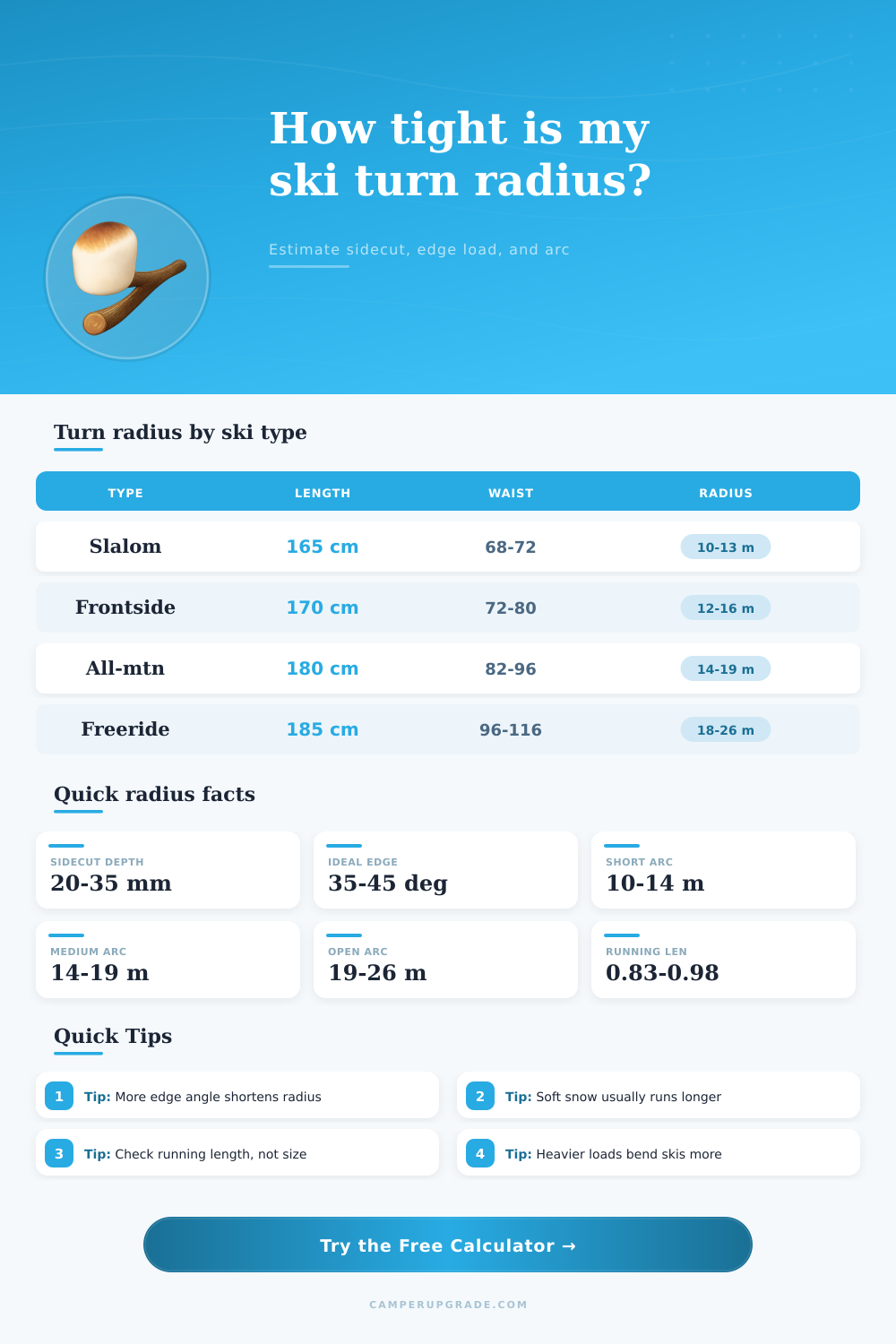
| Ski style | Length | Waist | Typical radius |
|---|---|---|---|
| Slalom | 160-170 | 65-72 | 9-13 m |
| Frontside | 168-178 | 72-82 | 12-16 m |
| All-mountain | 174-186 | 82-98 | 14-20 m |
| Freeride | 180-194 | 98-118 | 18-26 m |
| Race GS | 180-195 | 70-86 | 21-30 m |
| Edge angle | Radius bias | Arc feel | Best for |
|---|---|---|---|
| 25-30 deg | Longer | Easy drift | Learning |
| 31-38 deg | Near base | Balanced | Daily resort |
| 39-46 deg | Shorter | Clean carve | Strong turns |
| 47-54 deg | Much shorter | Snappy | Ice and gates |
| 55+ deg | Shortest | Locked in | Race use |
| Snow | Speed | Pressure | Effect |
|---|---|---|---|
| Firm | Fast | Strong | Tighter arc |
| Mixed | Steady | Balanced | Base radius |
| Soft | Easy | Light | Longer arc |
| Deep | Easy | Light | Longest arc |
| Chopped | Fast | Strong | Stable arc |
| Rocker profile | Engaged length | Feel | Common shape |
|---|---|---|---|
| Full camber | 95-98% | Very direct | Slalom |
| Frontside | 91-95% | Quick | Carver |
| All-mountain | 87-91% | Versatile | Daily ski |
| Freeride | 83-87% | Surfier | Powder ski |
| Powder | 78-83% | Loose | Big mountain |
Turning radius are a measurement that describes the shape of the arc that a ski will make when a person turns. Ski makers uses the design of the ski known as the sidecut to create the skiing equipments turning radius. The sidecut is a design of the ski where the middle of the ski are narrower than the ski’s tips and tails.
When a person place weight onto the ski, the sidecut allow the ski to bend into an arc. The turning radius of a ski is a static measurement of the ski’s sidecut, but there is many factors that can alter the actual turning radius that a person experiences while skiing. One of the factors that alters the actual turning radius is the amount of pressure that a person place onto the ski.
What changes a ski’s turning radius
If a person places more pressure onto the ski, the ski will flex more further into the sidecut, leading to a shorter turning radius. The second of the factors that impact the turning radius is the edge angle of the ski. The edge angle is the angle at which a person tilt the ski in relation to the snow.
If a person increase the angle of the ski’s edge, the turning radius will decrease. The third of the factors that impact the actual turning radius of a ski are the snow conditions. On firm snow, the edges of the skis will have more grip on the snow.
However, in softer snow, the ski will slide or skid. Because of this, the turning radius will be larger in softer snow. The physical design of the ski will also impact it’s actual turning radius.
Ski makers may incorporate a feature into the ski known as rocker. Rocker is a feature where the ski’s tips and tails is raised above the snow. Because rocker reduces the length of the ski’s edge that is in contact with the snow, it will increase the turning radius of that ski.
Another physical feature of the ski that affect its turning radius is the mounting position of the ski’s bindings. If a person mount the bindings further in the front of the ski, a ski will turn more quick. Because of this, skiing in moguls is easier with such a mounting position, and the turning radius will be shorter.
However, mounting the bindings toward the back of the ski will provide more stability at the cost of altering the turning radius of the ski. Many people make the mistake of focusing on the static turning radius of the ski label only. The loaded turning radius is more important to a skier.
The static turning radius of a ski measure the sidecut of the ski when it isnt in use. The loaded turning radius of a ski is the arc that the ski make when the skier is placing their weight and edge angle onto the ski. For instance, a slalom race might use skis that has a 10-meter turning radius.
However, because they use alot of pressure and edge angle when competing in slalom races, their loaded turning radius may be 8 meter on firm ice. In contrast, a person who is skiing in soft slush will have a larger turning radius because their ski isnt providing as much pressure onto the skis. People of different weights and skiing skill will experience different turning radii with the same ski.
For instance, a heavier person will flex the skis more than a lighter person. A deeper flex result in a shorter turning radius. People with higher skiing skills will be able to maintain a higher edge angle without the ski skidding on the snow.
A higher edge angle will result in a more even turning radius when skiing. A skier of any level should of consider their weight, their skill level, and the edge angle that they will use when determining their loaded turning radius with the skis that they ski with.