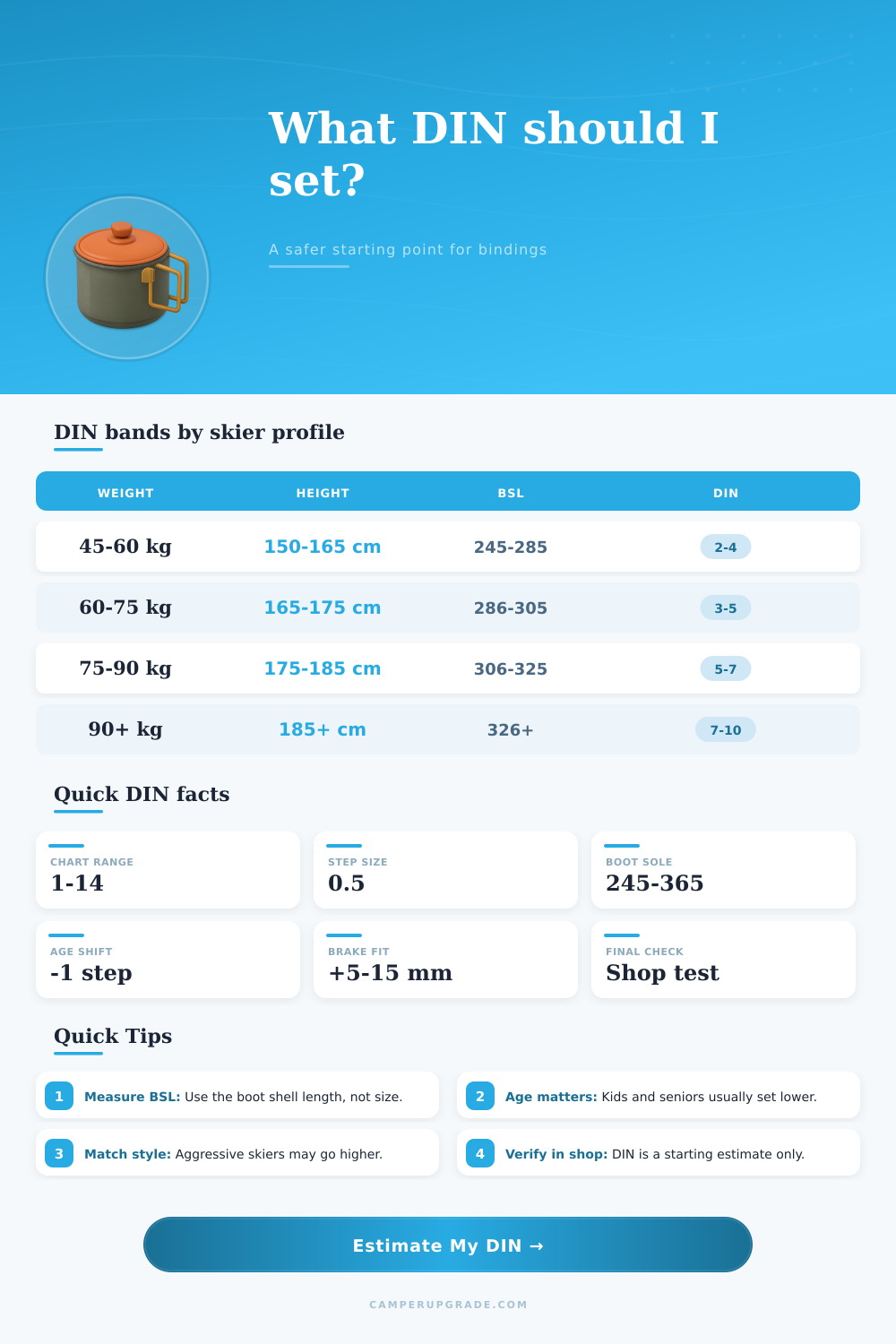
Ski Binding DIN Calculator
Estimate a starting DIN, check binding limits, and review boot and brake fit from skier data.
Use this as a calibration guide. The calculator blends the DIN chart with skier type, age, boot sole length, and setup style so you can see how each input changes the result before a shop verifies the final release test.
Weight is the first anchor in the DIN chart.
Height helps resolve the chart band when weight is close to a boundary.
Use the printed shell length, not the boot size label.
Young children and older skiers usually land lower.
Waist width changes brake fit and adds a small stability bias.
Longer skis can justify a firmer feel when all else is equal.
This does not directly change DIN, but it affects compatibility checks and AFD expectations.
| Skier profile | Weight band | Height band | Starting note |
|---|---|---|---|
| Light beginner | 45-60 kg | 150-165 cm | Low DIN bias |
| Average resort skier | 60-80 kg | 165-178 cm | Middle range |
| Athletic all-mountain | 80-95 kg | 175-188 cm | Middle-high |
| Heavy expert | 95+ kg | 180+ cm | Higher start |
| Park or speed bias | Any fit | Any fit | Increase one step |
| Cautious or older | Any fit | Any fit | Decrease one step |
| Boot sole length | Chart impact | Fit issue | Check |
|---|---|---|---|
| 240-260 mm | Lower band | Short boot shell | AFD contact |
| 261-300 mm | Mid-low band | Common resort boot | Heel tension |
| 301-330 mm | Middle band | Large shell | Toe height |
| 331-360 mm | Higher band | Long touring shell | Brake sweep |
| 360+ mm | Special case | Check model chart | Shop verify |
| Terrain style | Speed | Airtime | Typical move |
|---|---|---|---|
| Groomers | Steady | Low | Near chart start |
| Mixed resort | Fast | Low-med | Small raise |
| Powder | Variable | Medium | Raise one notch |
| Park | Fast | High | Higher hold |
| Touring | Steady | Low-med | Verify boot/bind |
| Race | High | Low | Chart high side |
| Ski waist | Brake width | Mount feel | Note |
|---|---|---|---|
| 70-84 mm | 75-95 mm | Snug | Frontside |
| 85-94 mm | 95-105 mm | Standard | All-mountain |
| 95-104 mm | 105-115 mm | Wide | Freeride |
| 105-114 mm | 115-125 mm | Very wide | Powder |
| 115+ mm | 125-135 mm | Extra wide | Check sweep |
Ski bindings is used to connect the boot to the ski. The bindings are designed to allow the boot to release from the ski in the case of a fall. The DIN setting for a ski binding determine the amount of force necessary to release the boot from the ski binding.
If the DIN setting is set to a too-low force, the ski binding will release the boot too early. If the DIN setting is set to a too-high force, the boot wont release from the ski when it is needed to do so. Therefore, setting the ski binding to the correct DIN setting is necessary for both the skier and the ski bindings.
How to Choose the Right DIN Setting
The DIN setting stands for Deutsche Industrie Norme. This scale measure the amount of torque that is necessary to release the ski bindings. The DIN scale ranges from 0.5 to 18 units of torque.
However, the specific range can vary depending upon the model of the ski binding. The factors that influence the DIN setting for the ski boot includes the skier’s weight, their height, and the length of the sole of there boot. A person that weighs more will have a higher DIN setting required for the ski bindings compared to a person that weighs less.
A person that is taller may have a different DIN setting than a shorter individual due to the different leverage that will be applied to the ski bindings. Additionally, individual boot sole length will impact the DIN setting for the ski boot. As the length of the ski boot sole changes, so does the angle of the ski bindings.
A person’s skiing style and physical characteristic will play a role in the DIN setting for there ski boot. For instance, a skier that is more cautious about skiing may have a lower DIN setting than an aggressive skier. An aggressive skier will require a higher DIN setting to prevent the ski binding from releasing during more challenging skiing conditions.
The age of the skier may also play a roll in the DIN setting. Individuals that are older may have more fragile bone than younger skiers. Therefore, they may require a lower DIN setting.
One’s skiing ability may also impact the DIN setting. A beginner may have a different DIN setting compared with an expert skier. Experts may require a higher DIN setting because they apply more force when skiing compared with beginners.
The terrain that an individual skis upon may play a roll in the DIN setting. For instance, if an individual skis on ice, they may require a higher DIN setting to ensure the ski binding does not release on those harder skis. However, for powder skis, an individual may have a different DIN setting.
Additionally, the width of the skis will play a roll in the DIN setting. For instance, if an individual uses wide skis for freeride skiing, the DIN setting for the ski bindings may be higher for the boot. Lastly, if an individual has alpine ski bindings for resort skiing, they will have a different DIN setting than someone with touring ski bindings for uphill skiing.
As both ski boots and ski bindings change over time, a professional must verify the DIN setting for an individual. Ski boots wear down with skiing; the sole of the boot can compress over time. The changes in the ski boot can impact the ski bindings.
Therefore, since the ski equipment has changed, the DIN setting for the ski bindings may have changed for that individual as well. Individuals should visit a professional shop to have a professional technician inspect their ski equipment. Professionals have the tools to correctly measure the release values for the ski bindings.
A professional technician can check the twist release for the ski bindings, the forward lean release, as well as the sideways release for the ski bindings to ensure that the ski binding is working correct. Another thing to ensure is that the brakes for the ski bindings are compatible with the skis. The ski brakes are the parts of the ski binding that prevent the ski from sliding away from the skier after the boot is released from the ski bindings.
The width of the waist of the ski will dictate the width of the ski brakes. If the ski brakes are too narrow, they may not be able to catch the ski. If they are too wide, they may rub against the ski.
Additionally, the boot norm, such as GripWalk or alpine norm, must be compatible with the anti-friction device on the ski bindings. If these two element are not compatible, the ski bindings will not release properly from the boot. In order to determine the proper DIN setting for a ski boot, there are many different variables to consider.
The weight of the skier, their height, the length of their boot sole, their age, their physical skiing abilities, and their skiing style all play a role in the proper setting of their ski bindings. Additionally, other factors relating to the skiing conditions and equipment may also impact their DIN setting. When determining this setting for their ski boot, individuals should always consider their safety first.
Finally, an professional technician that services ski equipment should always verify the proper setting for each individuals ski boot.