Ski Boot Flex Calculator
Dial in your boot flex from body data, terrain, temperature, and fit preference, then compare the result with a practical support range.
🎿Quick Fit Presets
📏Fit Inputs
📊Ski Boot Spec Grid
📖Flex Support Grid
| Mondo | US Men | US Women | EU | Typical BSL (mm) |
|---|---|---|---|---|
| 23.5 | 5.5 | 6.5 | 37 | 276–282 |
| 24.5 | 6.5 | 7.5 | 38.5 | 286–292 |
| 25.5 | 7.5 | 8.5 | 40 | 296–302 |
| 26.5 | 8.5 | 9.5 | 41 | 304–310 |
| 27.5 | 9.5 | 10.5 | 42.5 | 314–320 |
| 28.5 | 10.5 | 11.5 | 44 | 324–330 |
| 29.5 | 11.5 | 12.5 | 45.5 | 334–340 |
📏Weight and Ability Reference
| Fit Goal | Gap (mm) | Heel Hold | Use Case | Notes |
|---|---|---|---|---|
| Race | 8–12 | Maximum | Gates, hardpack | Needs shell work often |
| Performance | 10–15 | High | Aggressive all-mountain | Best control balance |
| Recreational | 15–20 | Moderate | Mixed resort skiing | Easier all-day comfort |
| Comfort | 20–25 | Relaxed | Low intensity cruising | Warmer but less precision |
🎯Terrain and Discipline Guide
| Flex Bias | Flex Feel | Support Class | Mobility Match | Fit Direction |
|---|---|---|---|---|
| ≤ 96 mm | 97–98 mm | Low Volume | Low to medium | Precision shell |
| 97–101 mm | 99–101 mm | Medium Volume | Medium | Balanced shell |
| 102–106 mm | 102 mm | High Volume | Medium to high | Roomier forefoot |
| ≥ 107 mm | 103–104+ mm | High Volume+ | High | Punch likely needed |
💪Temperature and Mobility
| Weight (lb) | Beginner | Intermediate | Advanced | Expert/Race |
|---|---|---|---|---|
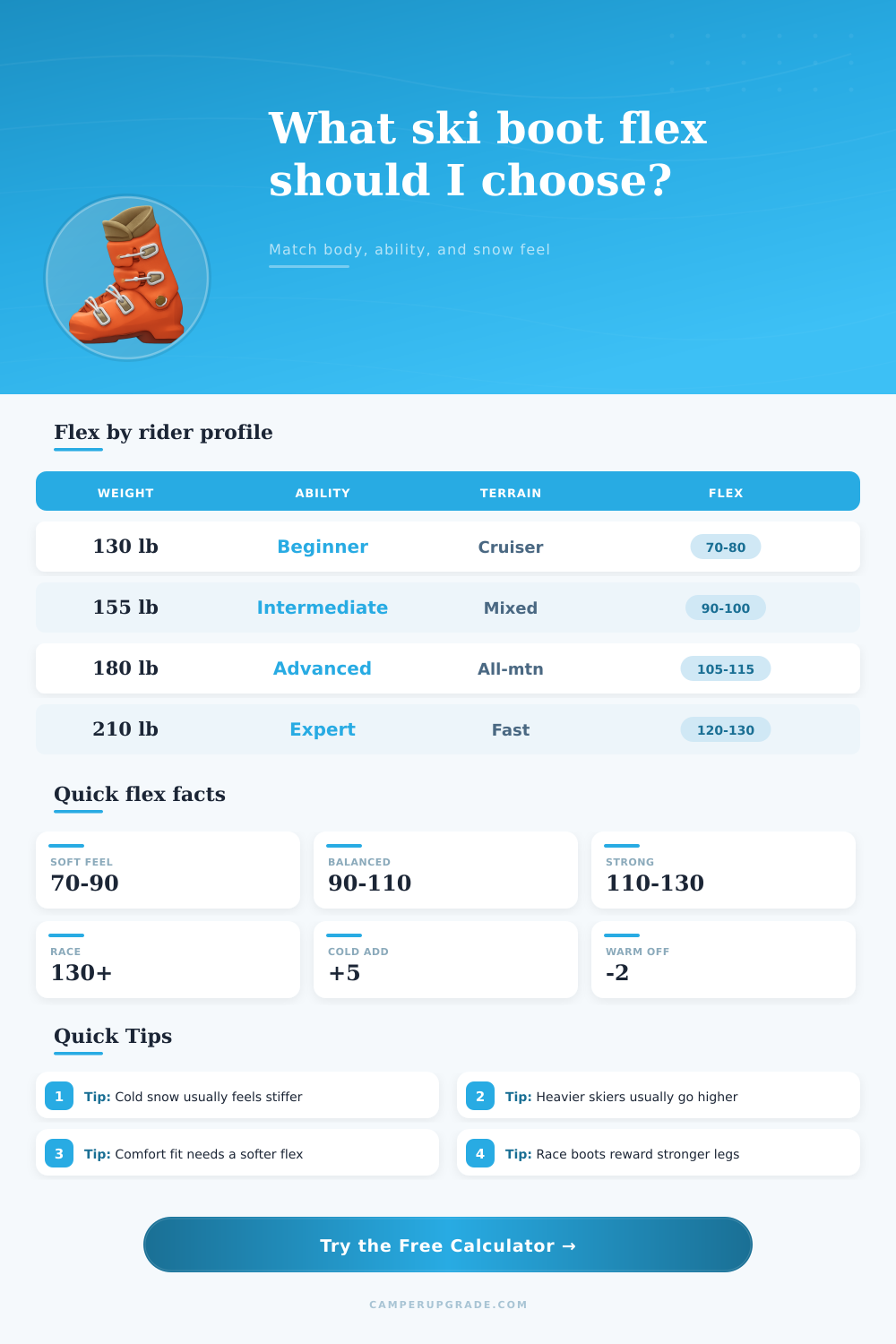
| 110–140 | 70–80 | 80–90 | 90–100 | 100–110 |
| 141–170 | 80–90 | 90–100 | 100–110 | 110–120 |
| 171–200 | 90–100 | 100–110 | 110–120 | 120–130 |
| 201–240 | 100–110 | 110–120 | 120–130 | 130+ |
Ski boot flex are a measurement of the force a person must applied to the cuff of there ski boot to bend the ski boot forward. Ski boot flex is an essential factor in skiing because it determines how a ski boot transmits the power generated by a persons legs to the skis. If the ski boot flex is too soft, the ski boot will not be able to resist the force necessary for perform aggressive skiing movements, and those movements will feel vaguely and lacking in control.
If the ski boot flex is too stiff, the stiffness of the ski boot will lead to leg fatigue. Fatigue results from the muscles in a person’s legs having to work harder in order to bend the stiff ski boot flex. The flex of ski boots is measured on a numerical scale.
What Is Ski Boot Flex
The lower the number, the softer the ski boot flex. For example, a flex of 50 is a softer ski boot flex than a flex of 140. The higher the number on the ski boot flex scale, the stiffer the ski boot flex.
A ski boot flex that is higher in number will transmit more power from a skiers legs to there skis than a ski boot with a lower number. Beginners to skiing may prefer a ski boot with a softer flex to allow for more forgiveness in they’re skiing technique. Skiers who ski at high speeds may prefer a ski boot with a stiffer ski boot flex to allow for more better control of their skis at higher speeds.
A persons body weight can impact the ski boot flex a person should use. A person who weigh less will generate less force with their legs than a person who weighs more. Thus, a person with a lighter body weight should use a ski boot flex in the 70 to 90 range.
A person with a heavier body weight will generate more force with their legs, so their ski boot flex should be higher, such as 110 or higher to prevent overwhelming the ski boot flex. Ski boot flex is also affected by the temperature of the ski boot. When it is cold outside the plastic of ski boots becomes more brittle.
Thus, ski boot flex will appear stiffer in the cold weather. When the weather is warmer the plastic of ski boots will be softer. Thus, ski boot flex will feel less stiff in warmer temperatures.
Because temperature can change the stiffness of ski boot flex a ski boot flex that feels correct in cold weather may feel too soft in warm weather. The thickness of a persons socks can also impact how a person feels the flex of their ski boots. If a person wears thick socks the ski boot flex will feel softer because the thick socks will absorb the energy created by a persons leg muscles.
If the legs are not allowed to move as much within a ski boot due to a snug fit the ski boot flex will feel stiffer. A roomy fit in ski boots will make ski boot flex feel softer. The type of skiing terrain a person prefers to ski will dictate the ski boot flex that a person should use.
A person who skis on groomed runs will need a ski boot with a stiffer ski boot flex than a person who skis on terrain park jumps. A person who skis on all-mountain terrain of varying difficulty may want to select a ski boot with a ski boot flex that is in the mid-range for versatility in skiing. A person should not select a ski boot flex that is too stiff for there physical conditioning.
Using a ski boot flex that is too stiff for a persons body may lead to leg fatigue very quick. A person can also consider the volume of their feet when purchasing ski boots. A person with wide feet will require a ski boot with more room for there feet than a person with narrow feet.
A person can use a ski boot flex calculator to determine what ski boot flex is best for them. Ski boot flex calculators take a persons weight, skiing ability, and skiing terrain as inputs in order to calculate what ski boot flex will work best for them. A person can also visit a professional bootfitter in order to ensure that their ski boots has the correct fit for there feet.
A bootfitter may perform adjustments to the ski boots like canting or punching to ensure the ski boot flex and the fit of the ski boot are set up for the persons skiing abilities.