🎿 Ski Pole Length Calculator
Estimate a practical pole length from height, elbow check, stance, terrain, ski width, and skiing style.
How the fit is built: this calculator blends the classic height rule with an elbow-height check, then trims or lengthens the result for discipline, terrain, stance, ski width, basket choice, and grip style. The goal is a usable pole length, not just a rough chart number.
This is the main starting point for alpine pole sizing.
Stand tall and bend the arm to about 90 degrees for the check.
Longer skis often pair better with a slightly calmer pole choice.
Wide skis in soft snow usually favor a slightly shorter pole.
Strap style changes the feel more than the math, but it still helps you dial the final pick.
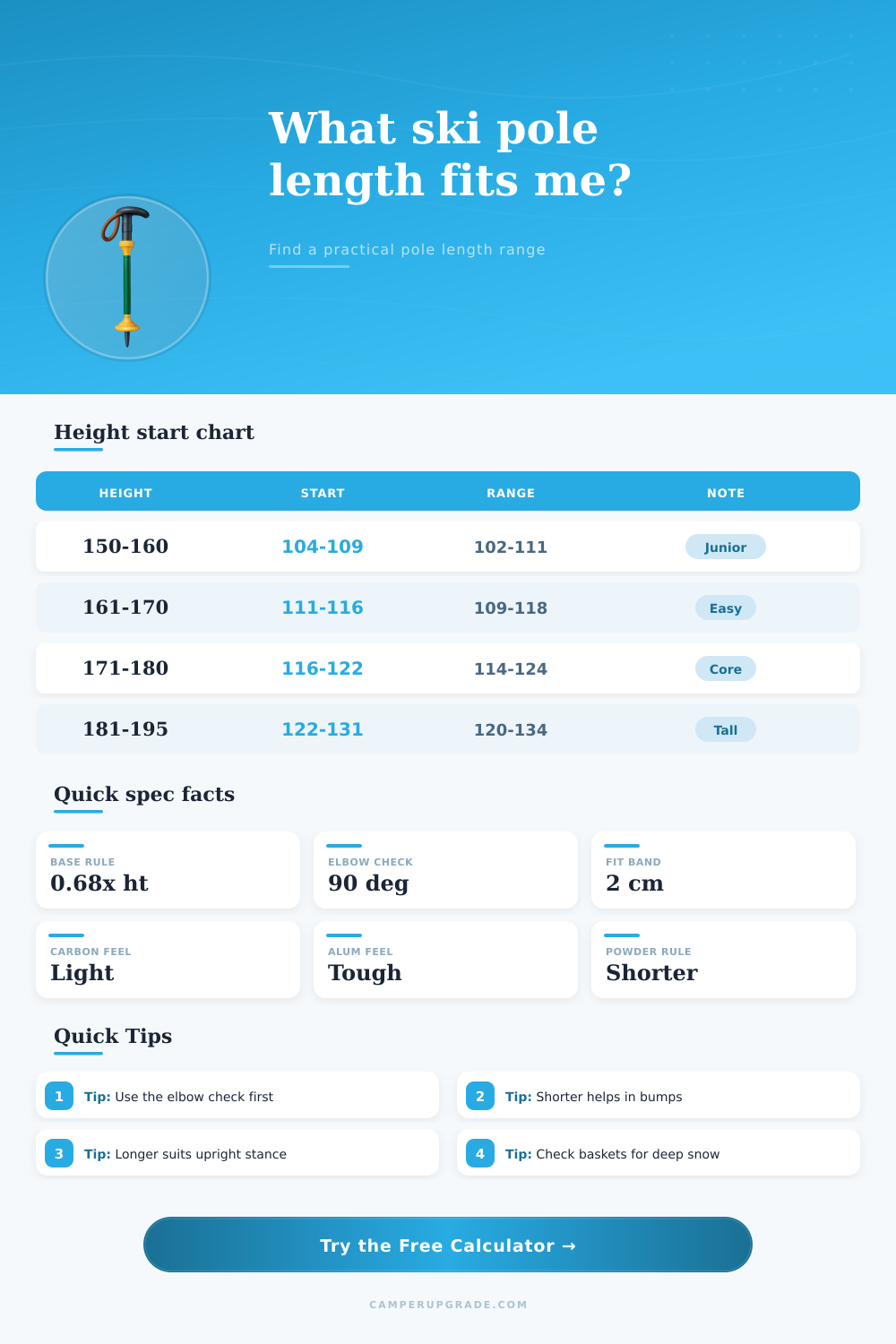
| Height | Start | Range | Note |
|---|---|---|---|
| 150-160 cm | 104-109 cm | 102-111 cm | Junior |
| 161-170 cm | 111-116 cm | 109-118 cm | Easy |
| 171-180 cm | 116-122 cm | 114-124 cm | Core |
| 181-195 cm | 122-131 cm | 120-134 cm | Tall |
| Discipline | Shift | Plant feel | Why |
|---|---|---|---|
| All-mountain | 0 cm | Neutral | Most common |
| Race carve | +1 cm | Fast | Quick plant |
| Moguls | -4 cm | Compact | Rapid turns |
| Telemark | +4 cm | Upright | Deeper stance |
| Terrain | Bias | Action | Note |
|---|---|---|---|
| Groomers | Neutral | Use chart | Baseline fit |
| Powder | Shorter | -4 cm | Less drag |
| Bumps | Shorter | -4 cm | Quick hands |
| Steeps | Shorter | -2 cm | Stable poles |
| Material | Weight | Durability | Best use |
|---|---|---|---|
| Carbon | Light | Stiff | Fast plant |
| Aluminum | Medium | Strong | All-around |
| Hybrid | Balanced | Mixed | Versatile |
| Composite | Damped | Comfort | Smooth feel |
Ski poles are an essential tool for skiing as the ski pole provide a point of contact for skiing to balance they weight and to set their skiing rhythm. Using ski poles of an incorrect length can cause individual to feel as if your skiing rhythm is incorrect and that their skiing turn are awkward. As such, individuals has to select the correct ski pole length for their individual skiing needs.
One of the most common ways of determining the length of the ski poles that an individual should use is through their height. The most common rule of thumb for ski pole length is 68% of an individual’s height, which place the majority of adults in the 115 to 125 cm range. To find this measurement for themselves, individuals can stand in a marked position in which they extend their arm to a 90-degree angle with the floor, with their palm face forward.
How to Choose the Right Ski Pole Length
If the ski pole handle align with the crease of an individual’s elbow when their arm is at a 90-degree angle to the floor, then the ski pole is of an appropriate length for their height. The measurement should be taken from the floor to the crease of the elbow, as this crease is the point of reference for balancing an individual at a 90-degree angle to the floor. Aside from an individual’s height, there is a few other factors that can play a role in the length of the ski poles that an individual should use.
For instance, individuals that ski in powder may prefer ski poles of shorter length so that their hand remain higher above the snow and to minimize the drag that powder may create for their skiing movement. For those who ski in bumps or moguls, shorter ski poles allow for an individual to more quick plant their ski poles into the snow without having to extend their body too far into tight area. Additionally, individuals who use a telemark skiing stance may require ski poles of longer lengths, as the telemark stance require an extra reach to ski deep into a lunge position.
Carver skiers who ski on groomed ski areas may prefer to add a centimeter to their ski pole length for their increased ability to ski quick with their ski poles. Additionally, individuals whose skis is of a wider width may prefer ski poles of longer lengths, as their wider skis will create more balance in their position in soft snow, and the longer ski poles will not feel clumsily when skiing. In addition to these factor related to an individual’s skiing ability, there are also other feature of ski poles that may help to determine the length that an individual should select for their ski poles.
For instance, aluminum ski poles can take more impact, making them suitable for individuals who ski on rocky terrain or younger individual. Carbon ski poles are stiffer, but can snap if they land on an object like a tree. Additionally, hybrid ski poles contain element of both aluminum and carbon ski poles.
Additionally, the weight of the ski poles is another determining factor. For instance, carbon ski poles are lighter than aluminum ski poles. Additionally, the reduction of the swing weight of an individual’s ski poles will allow for those pole to be planted more quick, and a reduction of swing weight will reduce the fatigue that each individual feel throughout their skiing season.
Some of the mistake that some individuals can make with determining the length of their ski poles is to ignore their personal skiing stance. For instance, athlete that have a leaning skiing stance may prefer shorter ski poles, while those who have an upright skiing stance may prefer ski poles of longer length. Additionally, individuals can determine their stance by skiing in place while planting their ski pole; if their elbow bend past 94 degrees when skiing, they should use shorter ski poles.
If the angle of their ski pole is too straight when skiing in place, they should use longer ski poles. Finally, the length of ski poles can impact the skiing rhythm and tempo of an individual. For instance, short ski poles will increase the tempo of an individual’s skiing, which may be prefer for skiing in trees or skiing parks.
Additionally, long ski poles will allow for smooth turn and more space during those turns. As such, ensuring that ski poles are of the correct length will ensure an individual maintain their skiing rhythm throughout the skiing season. By ensuring that ski poles are of the correct length, individuals will find that they spend less time adjusting their equipment, and more time skiing at there desired tempo.